
Eli Lilly Understands Keystone Advantage

A medicine is priced as though its worth were settled the day the label clears — a number stamped once, assumed true forever. It is the most expensive misconception in the industry, and the one underneath the policy arguments blocking health-market innovation the world over.
The “value” of a drug is not fixed at approval. It moves. It gains force where the medicine lands in the right body and the right life, and bleeds it where adherence slips, where the wrong patient was chosen, where nobody was watching when it mattered. The current conversation sees this and still cannot price it. It convenes in conference panel discussions and on earnings calls and chants the word — value, value, value — like a congregation that has forgotten what the prayer was for, the chant sitting at the extreme end of monotonous repetition, carrying it further from, well, value.
Value in healthcare is a flow, not an end state. A flow will not sit still for instruments built to measure fixed quantities. A ruler measures length: one settled distance, true and motionless. A flow is motion over time. Hold a ruler against something moving and it hands you a number, clean and confident and wrong, because it has caught everything except the one property that matters, which is that it moves. A flow that feeds back on itself — that learns where it has been, changes where it goes next, and progressively integrates more of its environment over time — is a stranger and more powerful animal than anything in the mathematical gymnastics of standard economics, a discipline that spends its genius contorting a living process until it will hold still long enough to be counted, that tries to explain what the tree was thinking when the apple fell.
Life does not hold still. It is alive, always becoming something next.
The boundary between living systems and technological systems has dissolved; where the two touch, the distinction has stopped meaning anything. A system that learns from its own output, adapts to its environment, and grows more capable over time is not behaving like a machine. It is behaving like a living thing. Biology has stopped being a metaphor for strategy and has become its method. That is the storyline that runs through Eli Lilly’s stake in Abridge, the company built on the conversation between a patient and a doctor, now positioning itself as a neutral care-and-service infrastructure connecting providers, payers, and life sciences companies. It is also the logic running underneath most deals worth watching now.
It licenses a different order of ambition.
If the behaviors we once reserved for nature — growth, adaptation, the drive to get better — can be engineered, the creative act is no longer invention. It is synthesis and direction. We can synthesize what we find in nature now, including minds: intelligence without consciousness, smart but not awake, tuned to a single purpose.
A strategist is no longer confined to the minds nature handed out. You can commission a new species of one, narrow and tireless, specialized cognition built for the single job your business actually needs done. This is where most strategy goes soft, because most of it still treats artificial intelligence as something you buy and aim at a problem.
It is the wrong instinct.
Recursive Self-Improvement
Value comes from iteration. The data is not the prize — access to it is cheap, and getting cheaper. The prize is what runs across the data: the algorithm that navigates it, synthesizes it, and turns it, each pass handing back something worth more than what went in.
AI is the engine of that iteration — a mind, not a tool — and to be strategic with it you have to think like it. It wants to get better, and getting better means more to measure. Knowing that, you give it exactly what it wants: more space for computability.
What it reaches for most, the drive the AI labs chase and cannot yet close, is recursive self-improvement: the capacity to rewrite its own code and grow more capable, a closed loop that compounds. In the laboratory that loop is imagined as happening without us. In a market, someone has to close it on purpose, and keep it fed.
Eli Lilly is becoming that someone.
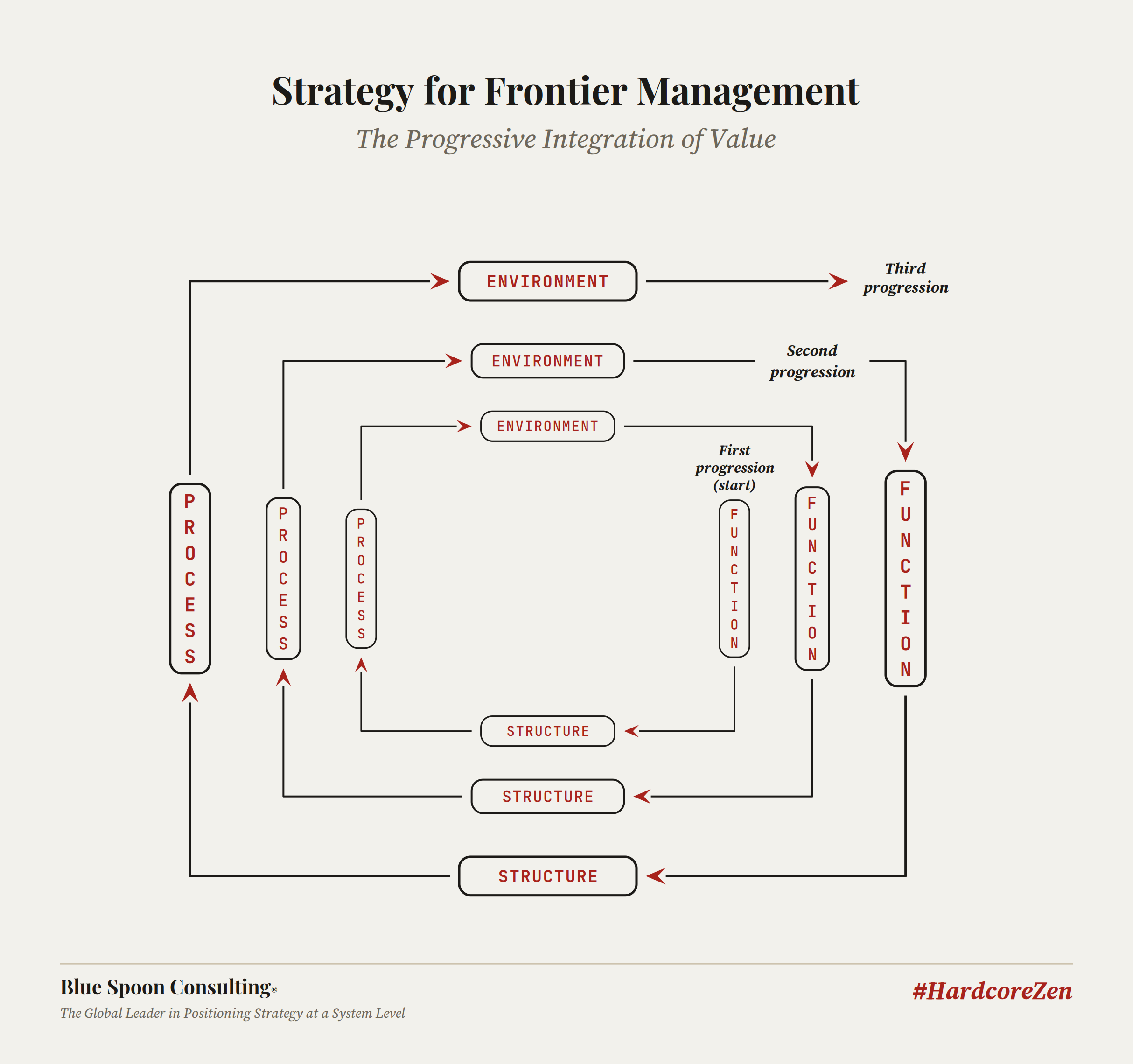
Read the stake in Abridge as the deliberate synthesis of a living system. A conversation between a patient and a doctor goes in. Out comes the note, the billing code, the claim, the care gap, the trial match. Then the outcome of all of it flows back as signal. The system trained on that signal captures the next conversation more completely, which yields a cleaner claim and a sharper match and a better outcome, which trains a better one. The flow improves itself. Each turn makes the next worth more. That is recursive self-improvement expressed not as code but as a business, an organism grown rather than built, and no drug, however good, has ever been able to become one.
The self-improvement that frightens the labs is the kind that needs no human in it. The kind that wins markets is the opposite: a human chooses the organism, builds it, and feeds it on purpose. The intelligence is artificial; the intent is not. What makes the move rare is not the tools. Anyone can buy the technology. What is rare is the willingness to demote your own crown jewel to one organ in a larger body. Most drugmakers cannot. The molecule is their center of gravity, and no company moves its own without losing its balance. They say ecosystem and keep the molecule at the center, so the word stays a slide. Eisai has presented a “dementia ecosystem” around its Alzheimer’s drug for years and has not grown it into a body.
What would happen if Lilly now took a stake in an electronic health records company, not the incumbent Epic but one of its hungry challengers, athenahealth or eClinicalWorks? What would happen if Lilly then integrated Lilly TuneLab, the AI discovery platform it trained on its own R&D and opened to outside biotechs, into that operating system? What would happen if it then folded in LillyDirect, the channel that carries the drug straight to the patient, and to the employer paying for it?
Stand at the Source
The Abridge stake buys the conversation, the source the rest of medicine begins in, and grafts it on as a new organ. For the sake of the hypothetical, the body keeps growing, taking in more of its environment each turn. A stake in the electronic health record, where care is written down. A stake in the system that discovers and makes the drug, with Lilly TuneLab as its engine. A stake in the channel that carries the drug to the patient and bills the employer who pays for it. Wired into one another, the three stop being three separate species and become one thing: a new environment, a changed context for strategy, all engineered to change the practice of medicine.
Size sometimes looks like the answer. It is often a red herring.
Microsoft paid $19.7 billion for Nuance in 2022, its second-largest acquisition ever behind LinkedIn, and what it bought was the incumbent: Dragon, the dictation and ambient-scribe software already running inside more than half the physicians and three-quarters of the hospitals in the United States. It bought the most mass, the heavy way to win. In Abridge, Lilly has invested in something smaller and more decisive. It bought access to the headwaters. The conversation is where the current begins, and whoever owns the beginning owns everything downstream of it. NVIDIA is co-building the foundation model on that conversation, which means the loop is being engineered, with the clinical encounter set as its source.
And this is what the stake actually buys, the part the headlines miss: computational imagination — the room to imagine value, curate it, and measure it while it moves, and so to manage the production of it. Stand at the source of the conversation and you hold the one instrument that can price what happens downstream of it.
This is the keystone position. Every system has one part that carries more than its size, the one the others cannot survive without, whose removal brings the whole structure down. Stand at the source and you become it — not the biggest player in health care but the one the rest of it depends on.
Shiv Rao, Abridge’s founder, told Fortune the only thing that matters in AI’s impact on healthcare “is business model innovation.” He is right, and deeper than he sounds: the business model he means is the organism.
Lilly is building toward it from both ends at once: frontier innovation in the molecule, frontier management in the system that decides whether the molecule ever reaches a body and at what price. LillyPod, the supercomputer Lilly built with NVIDIA, is the machine end, discovery at industrial scale. Abridge is the other, and the two are starting to touch: its life-sciences module surfaces trial eligibility from inside the conversation, the first use Lilly and Abridge are exploring together. The conversation does not replace the drug. It gets the drug to the right body faster, and that is frontier innovation and frontier management feeding each other.
How to Sustain a Strategic Rotation
A living system decays if it is not fed, which is the entire discipline of frontier management. You sustain it by giving it more to metabolize.
Abridge grew this way deliberately, adding billing, prior authorization, claims, decision support, trial screening, each a new input the system learns from and another reason it outpaces everyone else’s. LillyDirect is showing the same pattern in the drug market, a channel that is becoming a gravity well of its own, pulling Alzheimer’s screening and metabolic care and nutrition into orbit. The stake in Abridge runs the same rotation upstream, into the encounter itself.
The companies that treat this moment as a procurement exercise will buy a scribe and get a scribe. The ones that think like the machine, that understand a mind wants to improve and synthesize the living system that lets it, will get an instrument that measures the world as it moves and grows while they sleep. Lilly looks to have chosen the second. It did not build a better ruler. It built something that moves with the current, and grows by it.
That is what total system leadership looks like.
/ jgs
John G. Singer is the founder and Executive Director of Blue Spoon, the global leader in positioning strategy at a system level. Hardcore Zen is published weekly on Substack.
Disclosure: Blue Spoon has no financial relationship — equity, advisory, or commercial — with any company named in this essay. The analysis is independent.
Blue Spoon runs the Working Whiteboard: ninety minutes with your leadership team. One session, one chart — your market as a system, objectives positioned strategically instead of operationally, original storylines of value. Inquire.