

On War, Walgreens and WPP: A Meditation on Brand Collapse

Ray Dalio was asked recently by Ross Douthat of The New York Times whether America was still number one. Dalio, who founded Bridgewater out of his apartment in 1975, who predicted the 2008 financial crash, who has spent fifty years building the largest hedge fund in the world by reading the rise and fall of empires, did not answer the question directly. He answered with a smaller one.
"There are only three things any country has to do in order to be healthy," he said. "And this is throughout history. First, educate your children well in terms of their capabilities, the quality of their ability to be productive, and their civility. Two, have them come out to a country in which there is order and that people work together to be productive, so that there is broad-based productivity and prosperity. And three, don't get into a war. Don't get into a civil war, or don't get into an international war. That's all you have to do."
That is the entire test. Three rules — about capability, cohesion, and the discipline not to enter wars the country cannot finish. He says them the way a doctor says them. Educate the young. Maintain a society where people can produce together. Do not start wars.
By the test of his own three rules, Dalio is saying without saying, the United States — and many of the biggest, oldest, most trusted brands in business and industry and academia — is failing all three. The gaps in education are widening. The civility, the broad-based productivity, the working together — gone, or going. And the war in Iran, which the Trump administration started on its own initiative and now cannot end on its own terms, is the third rule snapped clean in half.
This is brand collapse. Not the kind that hits a logo. The kind that hits an institution when the story it tells about itself stops holding.
The thing arrives slowly and then all at once. A century-old American pharmacy chain admits its business model is "non-sustainable," sells itself to a private equity firm whose expertise is dismantling, and is broken into five pieces. The world's largest advertising company sheds ten thousand jobs in a year and announces that the architecture which justified the entire enterprise is being abandoned. The country that wrote the postwar international order arrives in Beijing predicting a "fantastic future together" with the rising power and confirms, in public, that it is "perhaps a declining nation."
The pattern is the same in all three cases. Walgreens cannot say what Walgreens is for. WPP cannot say what WPP is for. America cannot say what America is for. The brand, in each case, was the answer to a question. The answer is gone. The question has not been retired. The question is still being asked, by markets and by adversaries and by allies and by employees and by the public, and the silence in response is the sound of an organism that has stopped being able to maintain itself as a coherent thing.
The Corner Store
In October 2024, while still publicly traded, Walgreens told its own shareholders on an earnings call that its business model was "non-sustainable." The CEO at the time, Tim Wentworth, was the one who said it. He announced the closure of twelve hundred U.S. stores over three years. Pharmacy deserts began to expand across the rural and low-income neighborhoods that the chain had served for more than a century.
The company's healthcare bet, VillageMD, was a brick-and-mortar primary care play that did not work. The clinics were being closed faster than they had been opened. Compare Omada Health — fifteen years in, digital, cardiometabolic, employer-distributed — which reported earlier this month the strongest quarter in its history: forty-two percent revenue growth, a million members for the first time, positive EBITDA, expanding margins. Omada's president, Wei-Li Shao, described the company as "connective tissue between how employers buy, how members engage and how outcomes are delivered." That is a brand. It is what Omada can credibly say about itself. Walgreens, at any scale, no longer can.
In August 2025, the private equity firm Sycamore Partners took the company private for ten billion dollars. Within weeks, Walgreens was no longer a company. It was five companies. Pharmacy, retail, wholesale, digital, international, each broken out as a standalone entity. The Stefano Pessina family, which had built Walgreens Boots Alliance through forty years of dealmaking, reinvested its full stake. Mike Motz, formerly the chief executive of Staples U.S. Retail, also a Sycamore portfolio company, was named the new CEO.
The five companies are not a strategy. They are what is left when the organizing story of a 124-year-old institution dies and the lawyers walk in to sort the furniture.
What Walgreens lost was the answer to a question it had once been able to answer with conviction: what is this place for? The corner pharmacy in the American town, the trusted face behind the counter, the institution that knew your medications and your family, the brand built across the better part of a century by Charles R. Walgreen and his descendants — that brand was a thing.
Then it became a portfolio of things. Then the portfolio was disassembled. Then the things were sold separately. The brand had collapsed long before the deal closed; the deal merely catalogued the collapse.
How to Commit Brandicide
WPP next, and the same logic in a different register.
Once the world's largest advertising company. Forty years of acquisitions under Martin Sorrell. Five consecutive quarters of revenue decline. Headcount down nearly ten thousand in a single year — from a hundred and eight thousand at the end of 2024 to ninety-nine thousand at the end of 2025. Severance costs more than doubled to one hundred and forty-one million pounds. Share price down nearly sixty percent over the course of 2025. Market capitalization collapsed from twenty-four billion pounds at the 2017 peak to roughly three billion pounds now.
The new CEO, Cindy Rose, was brought in last September from Microsoft. In February she told the company's own employees and shareholders that "what has made us successful in the past will not make us successful in the future." Which is true and also tells you nothing about what will make the company successful in the future. The Elevate28 turnaround plan, the document she presented to investors, promised integration, simplification, AI infusion, and five hundred million pounds in annualized cost reductions by 2028 through "operating model changes, deduplication of support functions and real-estate/long-tail efficiencies." It is the language of someone counting what is left, not the language of someone building something.
On Friday, May 8, twenty-five percent of WPP's shareholders voted against Rose's eleven-million-pound pay package. The board pushed it through anyway. Earlier this month, Rose did not host her own Q1 earnings call. The chief financial officer hosted it instead. A holding company that cannot get its own CEO to host its own earnings call is not stabilizing. It is performing the rituals of stabilization while the underlying coherence continues to evaporate.
Sorrell's original thesis, which had built the company across four decades, was that scale beats craft. The thesis is dead. No new thesis has been named. Rose's most-quoted line — "we don't want to be a holding company anymore" — is the public abandonment of the only identity the company has ever had. The company has named what it is not. It has not named what it is. That is the harder sentence to write, and it is the only one that matters.
There is a third case, unfolding now, that completes the picture. The American business school.
Purdue's Mitch Daniels School is knocking forty percent off MBA tuition. UC Irvine's Merage School is cutting up to thirty-eight percent on its Flex and Executive programs. Johns Hopkins Carey is offering fifty percent scholarships to Maryland college graduates entering its specialized master's programs. Washington University's Olin is offering ten thousand dollars to any professional whose career has been "affected by AI." A decade ago, forty-eight percent of management graduate students received financial assistance. Last year it was sixty-two percent.
This is a garage sale.
The hand-lettered signs are out on the lawn of the American business school, and the merchandise that was supposed to be the most prestigious credential in professional life is being marked down forty, thirty-eight, fifty percent, take it home today, no reasonable offer refused. The price of an MBA is going down because the storyline of value is missing. The institution that has spent a century teaching strategy to other institutions cannot answer the strategy question about itself. Discounting is not an answer. Discounting is a tactic. The schools have reached for the operational lever — price — because the conceptual lever — purpose — requires work they have not done. No dean wants to be the Tim Wentworth of American higher education, the one who admits the obvious before the obvious admits itself.
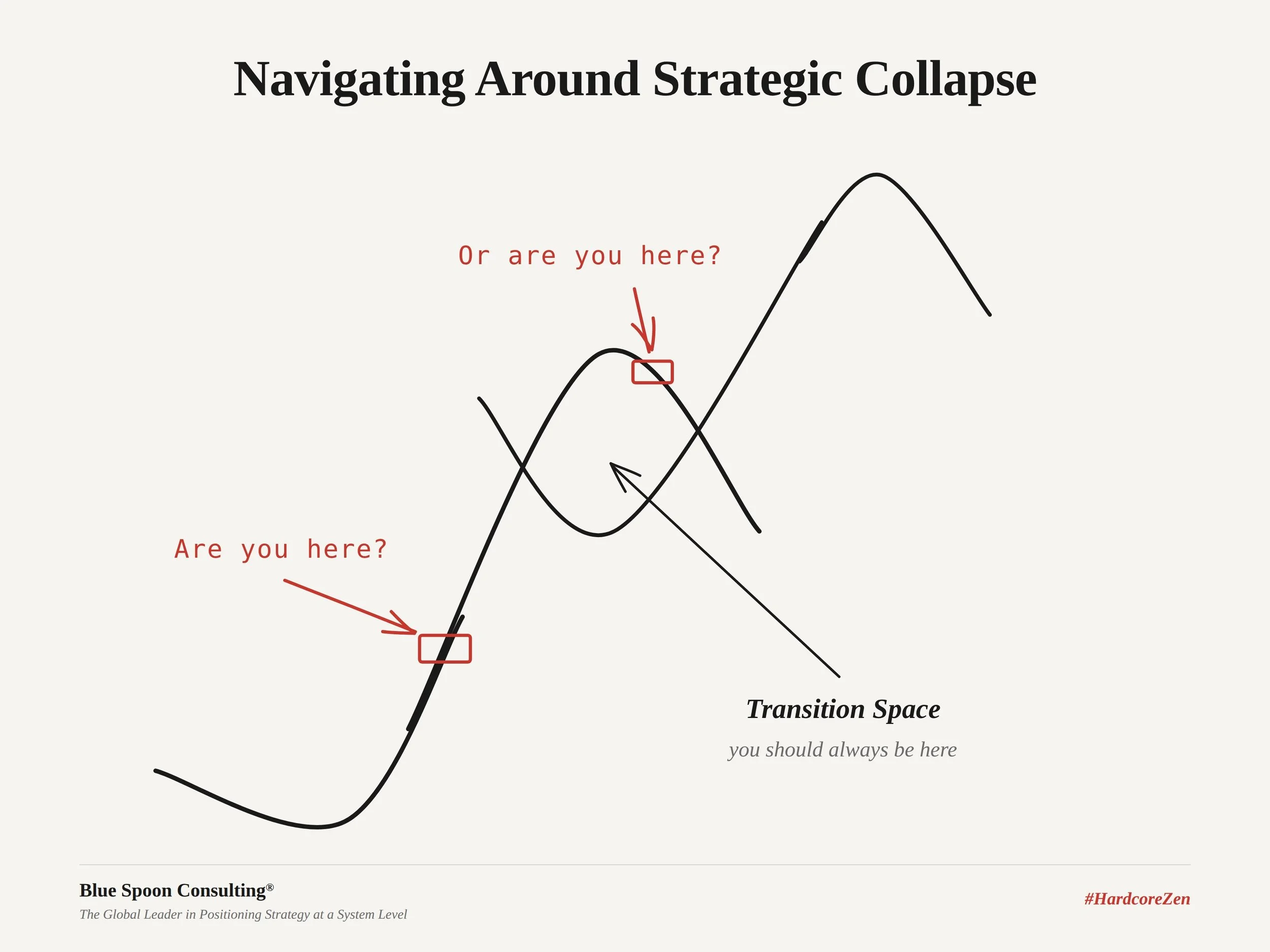
Three cases. Two corporations and an entire sector of professional education. The pattern is everywhere, and it is expensive, and it has a name.
Brandicide.
It is the slow suffocation of an institution that confused the accumulation of assets for a vision of what those assets were for. It is what happens when the operational machinery keeps running long after the organizing story has died. It is the condition Dalio is describing when he says, almost casually, that there are three rules and that a country needs to keep all three to stay healthy. The institutional version of his rules is this: do you know what you are teaching the next generation to be for? Do you have internal coherence, or have you devolved into political factions and turf wars? Do you reach for the operational lever every time the strategic question gets hard? Three rules. Same rules. Different scale.
WPP fails on all three. Walgreens failed on all three. The business schools are failing on all three. And the United States, on the evidence of last week's summit with China, is failing on all three.
Brandicide is not located in any one of these institutions. It moves up and down the scale of organization — from the corner pharmacy to the holding company to the dean's office to the situation room — because the failure is the same failure at every scale. The inability to answer the question that brand exists to answer: what is this thing for?
Brand at the Scale of a Country
Trump traveled to Beijing last week, the first time in a decade that a sitting U.S. president went to China. When he first won the presidency a decade ago, he correctly labeled China a threat and criticized past presidents for their naïveté. In both his terms, however, the United States has emerged from the relationship weaker, not stronger.
The tariffs that were meant to intimidate China did not intimidate China. China retaliated with restrictions on the rare-earth metals that the United States needs to build everything from missiles to electric vehicles, and Washington discovered how much leverage Beijing had been quietly accumulating in the supply chains underneath the rhetoric. To get the rare earths back, Trump agreed to let China buy advanced American semiconductors. The transaction was not negotiated from a position of strength. The transaction was extorted from a position the administration had not realized it occupied.
Then Iran.
The administration started the war in February without articulating what victory would look like — without naming the thing the country was fighting to do. Four months in, the chairman of the Joint Chiefs of Staff testifies in front of the Senate Armed Services Committee that U.S. forces have "sufficient munitions for what we're tasked to do right now," which is the syntax of a man whose superiors have not told him what the task actually is. Senator Gary Peters, in the same hearing, asks Defense Secretary Pete Hegseth the question the administration has been unable to answer for four months: what is the center of gravity in Iran? The center of gravity is the Clausewitzian concept of the source of an adversary's power — the node whose disruption collapses the system. Identify it correctly and pressure produces effect. Misidentify it and you spend the country in wars it cannot finish. I have written about this misidentification problem at length in When Burning Man Comes to Washington. The Pentagon could not answer Peters's question because the administration has not chosen a center of gravity. It has chosen targets.
The Strait of Hormuz has been closed since the first week of March. Brent crude crossed one hundred and twenty dollars. Gas at the American pump crossed four dollars. The International Energy Agency has called it the largest supply disruption in the history of the global oil market. Allies in Asia, including some who are explicitly skeptical of Beijing, have begun turning to China for energy help, because the United States started a war it cannot finish.
Trump arrived in Beijing, the editors of the Times wrote, "without the aura of strength that he cherishes." What he came home with was thinner than the trip itself.
China and the United States issued joint statements about "constructive strategic stability" and a "series of new common understandings" the substance of which neither side described. Trump told reporters he and Xi had made "fantastic trade deals" without saying what they were. The single concrete deliverable was a Boeing order: two hundred jets, announced as a triumph, against the five hundred that had been under discussion before the summit. Boeing's stock fell four percent on the news. China had averaged a hundred and twenty-seven Boeing orders a year from 2005 through 2017. The triumph, measured against the prior decade's routine trade in commercial aircraft, was less than two years of ordinary demand.
Scott Kennedy, senior adviser at CSIS, after the summit:
"Considering the overall framing ('constructive strategic stability'), President Trump's ingratiating tone, the lack of any challenge to Xi's claim that the US and Taiwan are the only source of risk in the Taiwan Strait, no Chinese commitment to help with Iran, the meager business deliverables, and absence of discussion of the global distortions created by China's industrial policy machine and high-tech push, China clearly comes away the winner from the summit."
On Friday morning, before the final meeting, Trump posted on social media that Xi had referred to America as "perhaps a declining nation," and that on this point Xi was "100% correct." He blamed Biden. The post is, on its own, a stunning brand statement. The sitting president of the United States, on the soil of his principal competitor, confirmed in public the brand claim the competitor had been making for a decade. There is no version of strategic communication in which this is a small thing. It is what a country says about itself when it has lost the ability to say what it is for.
The brand of the United States, for eighty years, was the architecture. The alliances. The trade system. The dollar. The security guarantees. The universities and the research labs. The willingness to win the long competitions by patient construction rather than spectacular gesture. That was the brand, because that was the country.
It was not packed and carried off. The alliances are still on paper. The dollar is still the reserve currency. The universities still stand, the labs lit, most of the journals still printing. What is gone is the belief in the architecture, and the will to defend it, and the coherent telling of why the thing was built in the first place.
America treats AI as product. China treats AI as plumbing.
Product strategy competes inside a market. Plumbing strategy decides what the market is. One country has been wiring the data centers, standardizing the platforms, threading the fiber, training the technicians, and arguing about narrative and ethics only after the infrastructure is in. The other has been holding hearings, drafting principles, hosting panels, and trying to backfill the infrastructure when the panels are over. China sequences infrastructure before ideology. The United States sequences ideology before infrastructure.
This is not a war the United States loses by being outspent. It is a war the United States loses by playing the wrong game. The contest that decides the next half-century is not for share inside existing markets. It is for ownership of the substrate the next markets will run on. The winners are the ones who lay the plumbing while everyone else is still launching products.
Dalio's third rule, broken. Dalio's second rule, fraying. Dalio's first rule, eroding measurably year over year.
The brand is what an institution can credibly say about itself. America has stopped being able to say. And the next sentence — the one that names what the country is going to build, and who it is going to build with, and what the architecture is going to be for — has not yet been written.
/ jgs
John G. Singer is the founder and Executive Director of Blue Spoon, the global leader in positioning strategy at a system level. Hardcore Zen is published weekly on Substack.
Blue Spoon runs the Working Whiteboard: ninety minutes with your leadership team. One session, one chart — your market as a system, objectives positioned strategically instead of operationally, original storylines of value. Inquire.