

McKinsey vs. McKinsey

Kevin Kelly saw this coming twenty years ago.
In a 2006 essay he republished on his Substack last week, Kelly — the founding executive editor of Wired, and one of the more accurate long-range observers of how technology and knowledge interact as a biological process — argued that the scientific method was not a fixed thing but a living one. An organism evolving in the dark for centuries, picking up new instruments the way a body picks up new senses. The way our own bodies, in our own lifetime, have picked up digital as a sixth sense. There is now such a thing as UX recoil — the half-second knowing, before you have touched or read anything, that a website was built by people who did not understand the rules the body now lives by. A message read but not answered has weight, and the body carries that weight across the day.
None of this was available to a body in 1985. All of it is available now, and the body's expanded sensorium has reshaped what it means to know where you are, who you are, and where you stand.
The engine of that evolution, Kelly said, was technology. Not technology as gadget. Technology as evolutionary pressure, the same kind of pressure that put eyes on trilobites and lungs on lungfish. New tools enable new structures of knowledge and new ways of discovery. First the tools change what we know. Then they change how we know. Then they change how we change. Then they change who we are.
"At the core of science's self-modification is technology," Kelly wrote. "As in biological evolution, new organizations are layered upon the old without displacement of the old. The present scientific methods are not jettisoned; they are subsumed by new levels of knowing stuff."
Kelly was writing about science. But the law he was reaching for is bigger than science. A method lives or dies by its instruments. New tools do not merely produce new insights. They rebuild the apparatus by which insights get produced. Once the apparatus changes, the people who built careers running the old one are no longer practicing what they think they are practicing. They are running a craft the world has stopped buying, in a building whose foundations have already been replaced beneath them, with a confidence that will not survive what comes next.
Medicine knows this. Law knows this. War knows this. Consulting knows it too.
You can see the recognition in the speed of the announcements, in the size of the AI units, in the new vocabulary on the partners' page. The body of the consulting market has caught the change in the air. It is reacting the way bodies react when the air composition shifts and the lungs that worked yesterday are no longer the right lungs. Fast. In every direction. Reaching for every organ it has.
BCG, McKinsey, Bain: How Every Legacy House Is Responding to AI
BCG announced last week that it has stood up a unit it calls forward-deployed consultants, the name lifted without ceremony from Palantir and the model along with it. McKinsey has Lilli, running across seventy-two percent of McKinsey. Bain has Sage. Deloitte has Zora. Accenture has thirty thousand consultants in a Claude training pipeline. The legacy houses have read the room. They have hired the engineers, built the tools, branded the platforms, briefed the analysts. They are doing all of this in the kind of hurry that only arrives when the work itself stops being the work the world is willing to pay for.
BCG also just published a joint report with MIT Sloan Management Review finding that 45 percent of the organizations already deploying agentic AI extensively are ready to cut middle-management layers, and 250 percent more executives now expect AI agents to have greater decision-making authority within three years. The companies furthest inside the transition are the ones most ready to dismantle the org chart that brought them there.
The report was framed as research. It functioned as marketing.
The numbers are now in every BCG pitch deck for the new forward-deployed unit, cited back to the people who produced them, with the MIT logo on the cover serving the same function the McKinsey blue serif used to serve when a board needed cover to do something difficult. A consulting house publishes a study with a university. The study recommends a transformation. The house then sells the transformation back to the companies the study was published to alarm. The circuit closes on itself and the reader is meant not to notice it is a circuit at all.
The firms that built the postwar corporation are now the firms quietly recommending its disassembly.
Then, on April 29, MIT Sloan announced it was shutting down MIT Sloan Management Review. Final issue September 2026.
SMR was the place serious management ideas went when they wanted to be taken seriously by serious people, which is to say it was the publication of record for the method this essay has been describing. Seventy years of teaching senior managers, the partners who advised them, and the business schools that trained both what management was, wound down in a dean's letter written in the soft institutional tone reserved for dressing wounds in public, explaining the brand collapse as "reflecting broader shifts in how audiences engage with management ideas and publications" and described what was happening as "a thoughtful wind down."
The phrases are doing what bureaucratic phrases always do, which is to anesthetize the act they are naming. Broader shifts in how audiences engage. The institution that defined management for seventy years cannot say we lost our readers. A thoughtful wind down. The publication that taught the world what serious management writing sounded like is being killed in a sentence that would not pass its own editorial standards.
SMR co-published the BCG report. It could not survive the world the report described.
Paul Michelman ran SMR's editorial operation for five and a half years. He now runs BCG's. He hosts a podcast there with an AI co-host named GENE.
Anthropic's $1.5B and OpenAI's $10B: Two Pours, Same Vessel
On the same Monday MIT Sloan was preparing the SMR announcement, eleven and a half billion dollars moved across two press releases and the trade media filed it under deal flow.
Anthropic walked into a room with Blackstone, Hellman & Friedman, and Goldman Sachs and walked out with $1.5 billion in committed capital for a new enterprise AI services company an insider called the McKinsey of AI. Hours later, OpenAI matched the move at seven times the size — $10 billion, TPG and Bain Capital and Brookfield, a guaranteed 17.5% annual return for the investors written into the deal like a clause in a divorce settlement.
No investor overlap between the two ventures. None. The major institutional capital pools in the United States showed up Monday morning and partitioned themselves between the two AI labs that are supposed to be competitors, and by sundown each side had its own funded operation, its own client pipeline, and its own roster of forward-deployed engineers waiting to be airdropped into the operating cores of the Fortune 500.
McKinsey, in the same window, was busy announcing the Lilli expansion and the new AI unit with Google and the "Frontier Alliance" with OpenAI and the framework refresh, all of it aimed at becoming the McKinsey of AI before some other house could get there first. But someone else did. McKinsey is now in competition with its own reflection. The reflection has the better engineering layer. Two companies invented the same company on the same day.
What matters is not the dollar number.
What matters is that Anthropic and OpenAI, ostensible competitors building rival models on rival stacks, looked at the same enterprise market and arrived independently at the identical structure. Same enterprise target. Same enterprise delivery mechanism. Same Palantir-derived forward-deployed engineering layer. The two companies were not in collusion. They were looking through the same enterprise framing lens.
A frontier model does not enter the world neutrally. It reveals a shape — the territory inside a corporation where its logic can actually operate, the space of computability where forward-deployed agents can reach the work and rewire it. Capital, attention, and technical invention then flow into that shape because the shape is where the instrument works. Pour the same water into the same vessel twice and you get the same outline, no matter who is pouring.
Which is what happened. Two pours. Same vessel. Same outline. The lens is the model. The structure Anthropic and OpenAI announced is not a strategic choice. It is the shape that becomes visible when you point a frontier model at the operational core of an American corporation and ask it to do work.
Why 'Enterprise' Is the Wrong Frame — and Why "Constellation" Replaces It
The word around which all of this action orbits is enterprise.
Anthropic uses it. OpenAI uses it. McKinsey uses it. BCG uses it. The new entrants and the legacy houses, drawing from different capital pools and selling against each other the way they have always sold against each other, reach for the identical noun the moment they have to describe what the work is for. Anthropic engineers will be embedded in the core operations of mid-size businesses. OpenAI engineers will redesign workflows inside client organizations. McKinsey will deliver enterprise AI transformation. BCG will help its clients become AI-future built. Four houses, one container, the container so naturalized inside the language that nobody on any side of the table notices they are all still inside it.
The technology being installed dissolves the container.
That is what large language models do when forward-deployed at scale. They do not respect enterprise boundaries because they were not trained on enterprise boundaries. They were trained on the entire textual record of human commerce, which means their natural operating environment is not the company. It is the space between companies.
What the model gives you, when you point it at that space, is a new kind of imagination the human strategist did not previously have access to. Call it computational imagination. The capacity to hold, in a single working frame, the supplier and the customer and the regulator and the payer and the competitor, and to see the workflow that passes through all of them as a coherent thing rather than as five separate things that happen to touch each other. The pre-AI strategist could describe this. No pre-AI strategist could operate on it.
The frame was too large for any one human to hold and too unstable for any one company to map. The model holds it. The model maps it. Once the model is holding the frame, the strategic question changes shape, because the unit of analysis the strategist can now act on is no longer the company, it is the ecosystem of which the company is part.
Install a sufficiently capable agent inside an enterprise workflow and within eighteen months that workflow has tendrils outside the building. Into suppliers. Into customers. Into regulators, payers, partners, competitors. The work that used to live inside one company now runs across many at once, in a register the legacy language of strategy has no word for. Call it concurrent enterprising. Multiple companies operating as a single working economic system, with the workflow itself as the unit of value rather than any of the entities the workflow now passes through.
This is the structure the technology actually wants to build. Not a smarter enterprise. A constellation. A pharma company and a payer and a provider and a patient platform, all running on the same agent fleet, with the strategic question no longer how do I optimize my enterprise but which constellation am I part of, and how is value distributed across it.
The captured tier cannot ask that question. The captured tier was built to optimize one enterprise at a time, and its imagination was trained on the same shape.
Frontier Management: The Altitude the $11.5 Billion Missed
What the moment requires is not another consulting house. It is a different kind of strategic intelligence, one that operates where the technology has already moved and the language has not yet caught up. The constellation. The cross-company workflow. The pharma-employer-provider-patient quadrangle. The supplier-manufacturer-distributor-customer mesh.
Call this work industry invention.
The deeper claim is that what the strategists who can see it and the technologists making the instruments are now in position to build is not a new industry. It is a new economy. And not one. A portfolio of them.
The work of identifying a frontier of human want that no existing category serves, and assembling the actors, the architecture, the language, and the incentives that turn that want into an economic object. It is what happened when somebody decided that television required something called an actor, that aviation required something called a crew, that the internet required something called a webmaster, then a designer, then a community manager, then a data scientist, then whatever comes next. Below is the diagnostic for where the work actually sits.
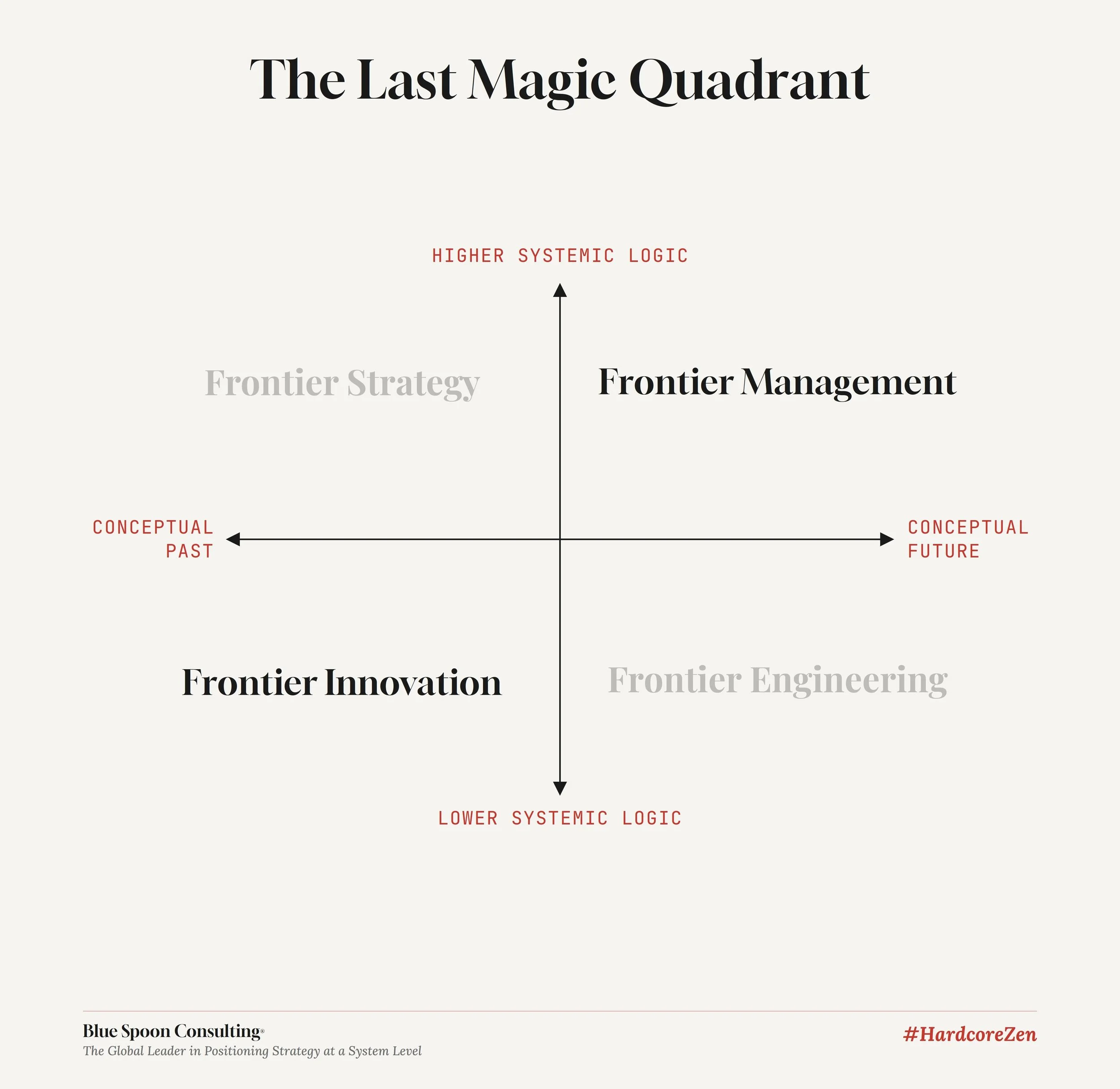
The Last Magic Quadrant positions altitudes of work.
The map has two axes. The horizontal axis is conceptual: past on the left, future on the right, where past means inside the categories the world already accepts and future means inside the categories not yet named. The vertical axis is system logic: lower means optimizing within an existing structure, higher means directing the evolution of the structure itself. The four quadrants follow.
The lower-left is Frontier Innovation, the altitude where most of strategy consulting still operates, sharpening categories the world has begun to outgrow. MIT Sloan Management Review sat in that quadrant for seventy years, doing serious work inside an altitude that has stopped producing the outcomes it was built to produce, and could not see its own position on the map until the map outlived the publication that explained the map.
The lower-right is Frontier Engineering, the altitude where the Anthropic and OpenAI ventures just landed — same instruments, sharper instruments, aimed at the same conceptual past. New tools, old categories.
The upper-left is Frontier Strategy, where the McKinseys and BCGs are racing to position themselves, building forward-deployed units and AI partnerships and framework refreshes that operate on bigger system logic but still inside the inherited language of the market and the industry and the deal. Three of the four quadrants are now contested.
The upper-right is Frontier Management. The altitude where the work is no longer to win inside the category but to direct the evolution of the categories themselves. The body of the economy growing a new sense and the strategist holding the frame steady while it does.
Managing Paradoxes
Kelly's twenty-year-old prediction has arrived inside the part of the economy the trade press still calls strategy, and the houses that survive will not be the ones with the most consultants or the largest model or the best engineers. They will be the ones whose method matches the shape of the actual work, which is increasingly concurrent, cross-company, cross-market, cross-regulatory in ways no deck can hold and no enterprise contains. Everything else is a managed migration to somebody else's stack, sold by the house whose name still appears on the bill.
Kelly:
"Science came into its own when it managed to refuse the subjective and embrace the objective. The repeatability of an experiment by another, perhaps less enthusiastic, observer was instrumental in keeping science rational. But as science plunges into the outer limits of scale — at the largest and smallest ends — and confronts the weirdness of the fundamental principles of matter/energy/information, it may not be able to ignore the role of the observer.
Existence seems to be a paradox of self-causality, and any science exploring the origins of existence will eventually have to embrace the subjective, without becoming irrational. The tools for managing paradoxes are still undeveloped."
The fight named in the title of this essay was never a fight between two consulting houses. It was a fight between two altitudes. The lower altitude just got $11.5 billion of capital wrapped around it last week, with a forward-deployed engineering layer on top to make it look modern. The higher altitude does not yet have a press release. It does not need one.
/ jgs
John G. Singer is the founder and Executive Director of Blue Spoon, the global leader in positioning strategy at a system level. Hardcore Zen is published weekly on Substack.
Blue Spoon runs the Working Whiteboard: ninety minutes with your leadership team. One session, one chart — your market as a system, objectives positioned strategically instead of operationally, original storylines of value. Inquire.