

The Art of The System: How the EMD Serono-Trump IVF Deal Rewrites Healthcare Strategy

The largest and most lucrative market on Earth?
Combining the 'production of cardiometabolic health' + the 'production of reproductive health' + the 'production of health data' into a distinct economic system ("ecosystem").
From EMD Serono's press release yesterday:
"EMD Serono, the healthcare business of Merck KGaA in the U.S. and Canada, and President Donald J. Trump's administration, today announced an agreement to expand access to the company's portfolio of in vitro fertilization (IVF) therapies for the more than 10 million American women struggling to have a baby.
As part of the agreement, EMD Serono will offer Direct-to-Consumer (DTC) sales of its complete portfolio of IVF therapies...at an 84% discount off list prices. EMD Serono will participate in the TrumpRx.gov direct purchasing platform, which will go live in January 2026."
The deal also goes beyond 'the drug market' to integrate and innovate the health benefit market in the new system vision. Per the fact sheet released by the White House:
President Trump announced the creation of a New Benefit Option for fertility benefits. Under this option, employers will have a new legal pathway to offer fertility benefits directly to employees, like they do for dental, vision, and life insurance, representing a massive opportunity to expand access to IVF coverage. The Departments of Labor, Health and Human Services, and the Treasury announced that employers can now offer standalone benefit packages to employees interested in coverage for treatment of infertility, including IVF; they also announced their intent to undertake rulemaking to further expand the ability of employers to offer fertility benefits to their employees; and these benefit packages can address the continuum of fertility-related services, from those that address the root causes of infertility to IVF.
Say what you like about Donald Trump, he understands "creative destruction," the economic concept coined by the Austrian economist Joseph Schumpeter in his 1942 book Capitalism, Socialism and Democracy. At its core, it means: economic progress depends on the continuous destruction of old systems, businesses, and technologies — and their replacement with new ones.
And commanding comes naturally to him. Niall Ferguson in an essay last week for the Wall Street Journal (The Disrupter in Chief Gets Transformational Results at Home and Abroad),
"Not only does he thrive on the job's relentless demands. He goes further. He has emerged this year as the Disrupter in Chief. His "Art of the Deal" approach — the outrageous opening bid, then the wheeling and dealing — has delivered transformational results at home and abroad in the space of nine months. In short, no president has delivered so rapidly on so many of his campaign pledges. It's not just the 217 executive actions in 100 days; it's the stream of social media "truths" and the almost daily exchanges with the press corps.
If you wanted a "vibe shift" last year, you really got one. If you hate Trump, maybe you just hate the times we live in. For Trump is the zeitgeist on a golf-cart."
Big System Deal-Making
Here's a systems thinking thought experiment that "works" according to the rules of Trump, a roadmap to accelerate and amplify big system change, a rough frame to create a different center-of-gravity with the power and leverage to change the practice of medicine at humanity-saving scale, and, in the process, make Big PBM + Big EBC irrelevant (or, on the other hand, save them from strategic collapse):
Step One: Construct a 'new narrative layer' with new words to think new thoughts — e.g., it's not just "women" struggling to have a baby; men also play a role in a new family story.
Step Two: Get out of your main character syndrome — competing to produce "outcomes" isn't just about the 'drug market' alone and in isolation, but an infinitely-expanding galaxy of provider and technology markets needing reorganizing. Whoever does the better job positioning themselves as a keystone to cohere 'the commercial determinants of health' wins big.
Step Three: Build a new 'horizontal layer' (Jeff Bezos used the term at a conference in Italy earlier in October to describe the emerging AI economy) to enable a new narrative layer — this means seeing really big market innovation through the lens of infrastructure-as-a-service, the kind that can displace or degrade the power and control of an embedded economic system (like Big PBMs, which is at the heart of the direct-to-patient superbloom sparked by Trump).
Step Four: Once you build it, assume they won't come — Eli Lilly has roughly 5,000 "users" on LillyDirect, a tiny fraction of the TAM for GLP-1s. "Value" in healthcare is a flow, not an end state. Progressive integration of markets (and industries) is a new management concept (Amazon refers to this as "featurizing").
Less 'out there' already than intentionally designed, the best ecosystems are products of 'differential connectedness' — whoever does the better job combining market sets into new economic systems will emerge the sustainable winner. The key decision isn't doing the past better with new technologies, but how to negotiate among the tornado of opportunities and choose the right thing to do with better system vision.
The pieces matter less than how they are combined.
So this market set — EMD Serono + Novo Nordisk + Dexcom + Oracle + Gallagher — operating as a single economic unit (a single biological organism, a new system of markets) will outperform and out-compete and out-innovate peer market fragments — in the fertility drug market (Organon or Ferring Pharmaceuticals); in the GLP-1 drug market (Pfizer or Roche); in the CGM market (Abbott or LifeScan); in the EHR market (Epic or AthenaHealth); or the health benefit market (WTW or Marsh) — operating alone and in isolation from each other.
A Stark Rupture in the Timeline
There can be little doubt that Trump 2.0 has disrupted not only American domestic politics but also the international order, says Ferguson. "There is no going back to the old ways. The post-1945 order is dead: the bipartisan consensus in favor of free trade and a U.S.-led system of collective security has been buried."
Donald Trump didn't wreck the old order so much as he understands how to exploit the wreckage already there. The complexity mushrooming worldwide is beyond any normal cognitive pattern to "fix" — it is impervious to The Standard Model of thought and action. Trump is able to navigate multiple shifting paradigms because he has better system vision. He 'reads the room' better, which means he is able to see reality better: that the elephant in the room is the room itself.
From A Punk Rock Ethos of Disruption, published by Blue Spoon on November 12, 2024 to help leaders worldwide "work" with Trump wattage:
Say what you will about the content of his character, Trump's brand of imagination and 'surprise messaging' is unique. Like Johnny Rotten, it's the kind with the power to punch through and persuade, to 'harness the carnival' in a way that motivates and moves things, at scale.
For the most part, we are either asking the wrong questions, or our questions are based on the wrong framework. Navigating the 'pivot region' to compete differently takes creative, courageous leadership. It takes leadership that understands the difference between operations and strategy. It takes leadership that doesn't confuse the PowerPoint for power. That process starts by sweeping the old concepts out of the saddle. That comfortable mental furniture used as the centerpiece of product management — principles of branding, positioning, message and even "strategy" itself — are coming apart at the seams, unable to accommodate the seismic instability happening the world over. Existential crises abound and confound.
And while avoiding ambiguity and shying away from complexity is understandable, pretending it doesn't exist is foolish at best and fantasy at worst. Professional survival now depends on breaking the Standard Model of thought and inaction. It all starts with a brick through the window of convention and cliché.
You have to be comfortable making incendiary impact. Which is what Sex Pistols frontman John Lydon and Donald Trump — and Libby Horne, senior vice-president at EMD Serono — understand so well.
In related news, Verily will be launching Verily Me, its first direct-to-consumer health app, this week at HLTH 2025 following Alphabet's interoperability pledge to the White House to improve Americans' access to their health data. Verily Me users can also sign-up to participate in the Lifelong Health Study, which gives researchers at academic institutions as well as pharmaceutical companies access to real-world patient data, which theoretically will be used to develop new products.
But that's not a really novel idea, more fragile status quo than 'creatively destructive'.
For at least a decade, tech companies have tried to develop health apps that help patients be healthier, but no company has been able to deliver that. Apple has its health app, which seeks to combine patient medical history with daily activity and Google has long sought to make a doctor-in-your-pocket product.
"Everyone's tried to do some version of this," said Myoung Cha, chief product officer at Verily, in an interview with Politico last week. "Some people, like myself, have many scars, having learned how hard it is to do this."
But what Silicon Valley Visions keeping missing, or mislearning, is that healthcare is not technology. Gita Gopinath, the former International Monetary Fund chief economist, sees as a coming crash that could "torch $35 trillion of wealth" because the world has become dangerously dependent on American stocks, which are floating on an AI air biscuit (see Zuckerberg Floats an 'AI Air Biscuit' at the White House published by Blue Spoon). From her guest commentary in The Economist last week:
"Though technological innovation is undeniably reshaping industries and increasing productivity, investors have good reasons to worry that the current rally may be setting the stage for another painful market correction. The consequences of such a crash, however, could be far more severe and global in scope than those felt a quarter of a century ago.
At the heart of this concern is the sheer scale of exposure, both domestic and international, to American equities. Over the past decade and a half, American households have significantly increased their holdings in the stock market, encouraged by strong returns and the dominance of American tech firms. Foreign investors, particularly from Europe, have for the same reasons poured capital into American stocks, while simultaneously benefiting from the dollar's strength. This growing interconnectedness means that any sharp downturn in American markets will reverberate around the world."
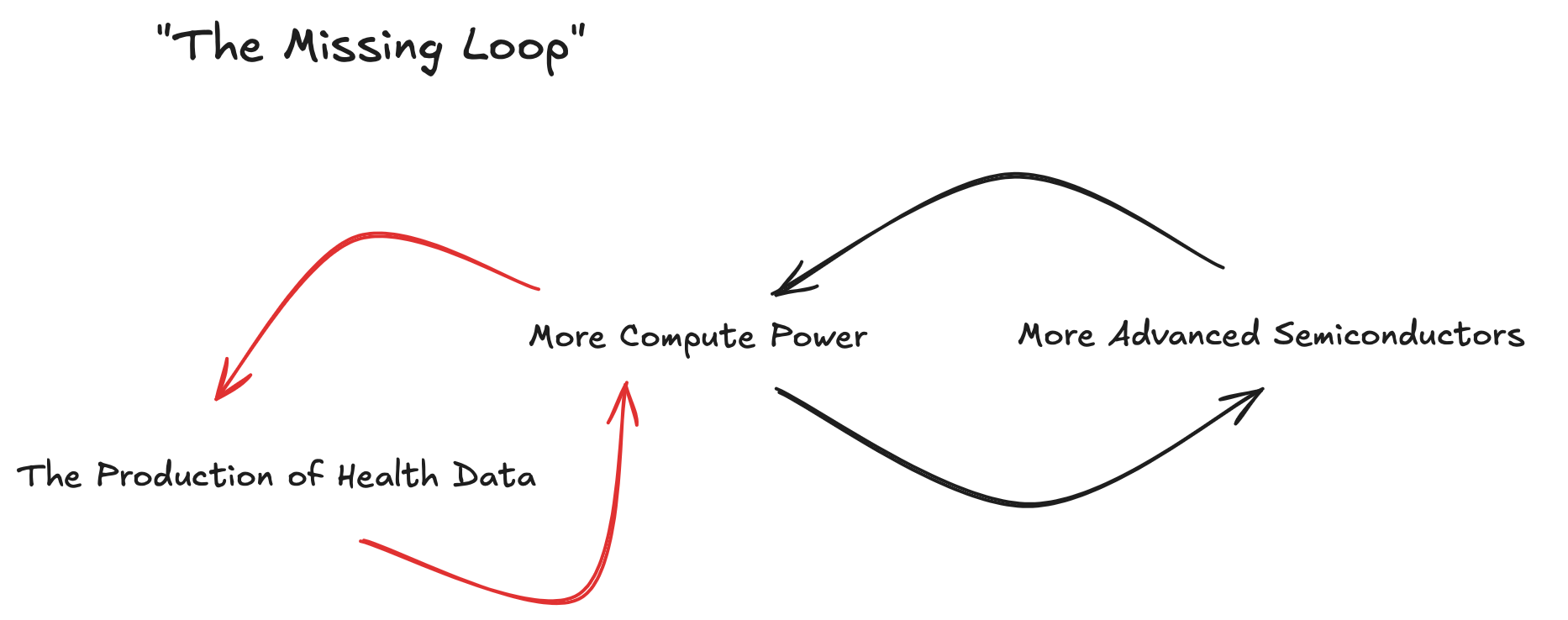
How to Prevent $35 Trillion in Family Health from Getting "Torched"
The Magic Quadrant for Pharma isn't about using Verily Me technology and data for drug development, but economic innovation around specialized cognition, sparking a new feedback loop from the production of health data, content and concepts fused into better strategies, unique stories, and a whole new industry ecosystem (or a portfolio of them). The big winners won't be those who collect the most data, but those who cohere it, shaping the characters and chapters and plot lines into narrative intelligence: the connective tissue between science, markets, and human experience.
A market crash today, believes Gopinath, is unlikely to result in the brief and relatively benign economic downturn that followed the dotcom bust. There is a lot more wealth on the line now — and much less policy space to soften the blow of a correction. "The structural vulnerabilities and macroeconomic context are more perilous. We should prepare for more severe global consequences."
Because $35 trillion is a lot of family health at risk.
/ jgs
John G. Singer is the founder and Executive Director of Blue Spoon and the author of When Burning Man Comes to Washington: A Field Manual for Riding Chaos. Hardcore Zen is published weekly on Substack.