
Why the Next CEO of PhRMA Should Be More Like Quentin Tarantino
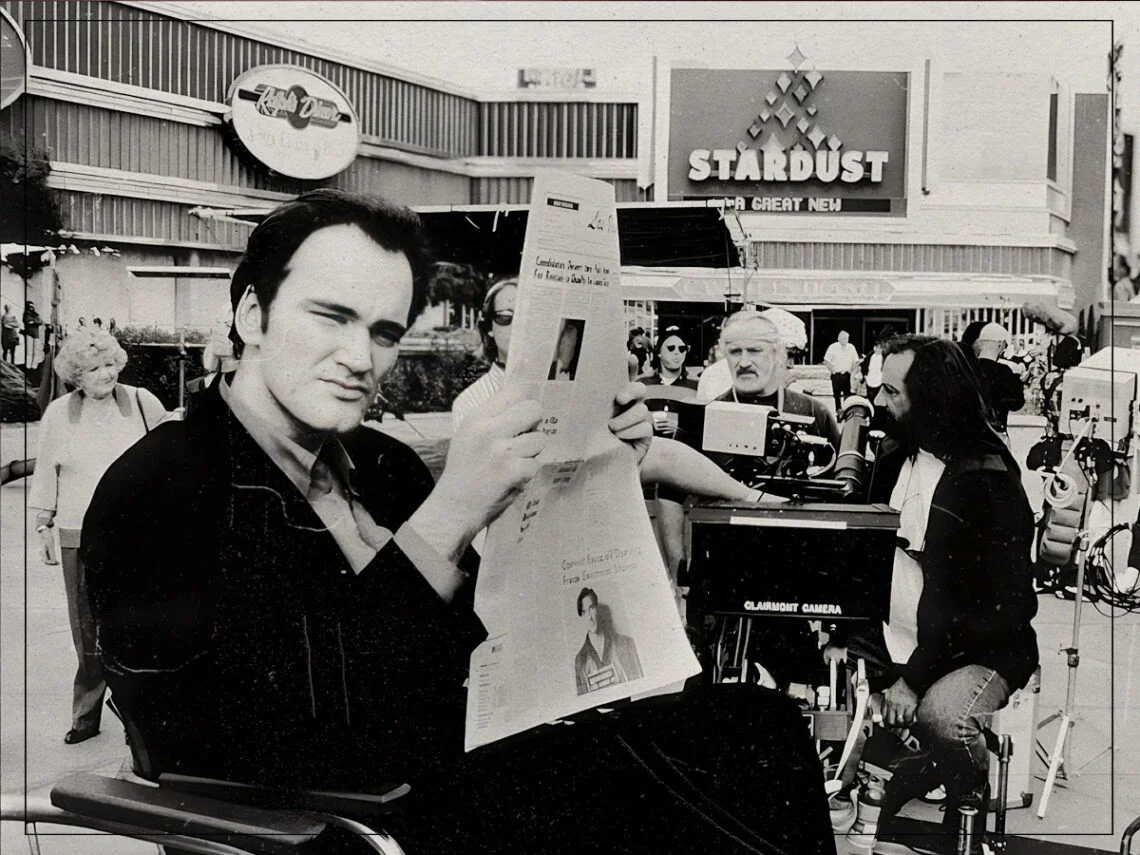
Quentin Tarantino did not break into Hollywood. He broke Hollywood open and walked through the gap.
He did it with a video clerk's education and a writer's ear, and he did it by refusing the premise everyone else accepted — that genres were boxes you picked from, that rules were railings you held onto, that a career in cinema meant making a slightly better version of the film Hollywood already knew how to sell. Tarantino looked at the whole architecture and saw what the architects had stopped seeing. The boxes were not sacred. The railings were not load-bearing. The rules were conventions in the mouths of people who had forgotten they were conventions.
"I write movies about mavericks, about people who break rules," he told Virgin.Net in a December 2003 interview, "and I don't like movies about people who are pulverized for being mavericks."
There is a whole philosophy of innovation inside those two clauses, and it has almost nothing to do with filmmaking.
The first clause names the only subject worth the work of leading. It is the person who refuses the rulebook the industry keeps handing them, who will not water the vision down for committee, who does not spend a career waiting for an invitation to be themselves. The second clause is where the real muscle lives. Tarantino is telling you what he refuses to write: the old morality play in which the rule-breaker is ground into dust for the crime of breaking the rules, the story in which the system reabsorbs the heretic and the audience is told to accept it as fate.
Pulverized is the word to hold onto. It is violent and physical and specific, and it names the exact thing that happens to most bold ideas inside most large organizations. Not defeat, which is honorable, but pulverization, the slow grinding of something alive into something smooth and dead by a process no single person is responsible for. Every senior executive who has ever watched a bold idea die in a legal review or a commercial committee knows exactly what Tarantino is refusing to write.
PhRMA will have a new CEO by the end of this year. The transition is the visible occasion for this essay. But the deeper question is older than this one transition and larger than the drug market alone.
Who leads when the script is gone and the stage is on fire?
Tarantino's approach matters for the next CEO of PhRMA — and for every industry standing at the edge of a frame collapse, which is all of them — because it clarifies the stakes of leadership in a way almost no management literature does.
Leadership is not the willingness to have a bold idea. Everyone has bold ideas in the shower.
Leadership is the willingness to hold the bold idea through the pulverizing, to defend it against the institutional reflex that says slow down, to keep it alive through the risk officer and the investor call and the board retreat and all the other well-meaning processes that exist, in their deep institutional unconscious, to grind bold ideas into smooth ones.
The maverick is not the one with the idea. The maverick is the one who gets the idea out of the building without letting the building eat it.
The Great Fork
The American drug industry is standing at the moment of The Great Fork, and the fork is about one thing: direct-to-employer. Big PBM is vulnerable, lost in its own version of Hollywood, and still pretending otherwise. The rebate economy it built over thirty years, the architecture that gave it power and control over American drug economics, is being openly questioned by the employers who funded it, the regulators who tolerated it, and the patients who lived inside it.
The deal story filling the pharma trade press right now is the rush to license molecules out of China, and the executives running those deals are not wrong to chase them. The science is real. The cost advantages are real. The speed is real.
But chasing Chinese molecules is not a new screenplay. It is the old screenplay with a new supplier. Finding a cheaper, faster, better asset and pouring it into the same American distribution architecture is not changing the Standard Model. It is feeding the model. China is a sourcing innovation, and the Standard Model swallows sourcing innovations for breakfast.
The move that matters is a different kind of move entirely. It is not about finding a new asset to sell into the American market. It is about changing the American market itself, so that the market can ingest and diffuse innovation at the speed innovation is now being produced. The China deals are happening inside the old frame. The move that matters is the one that exits the frame. Confusing the two is the most expensive mistake the industry can make right now.
And for the first time in a generation, pharma itself has the power to make the exit. GLP-1s are the lever: a category so large and so urgent that the old rebate architecture cannot hold the weight, and the companies holding the molecules can now walk around the middle. The first companies through the gap will change the organization of the drug market itself.
This is not a channel experiment.
It is the chance to stand up entirely new care and service infrastructures, to invent a new center of gravity for power and control in American healthcare, and to do it while the incumbents are still writing defensive memos about the last era.
The evidence is already on the table. Employers have stopped believing the PBM middle is delivering value — Mercer's own analysts are now openly asking whether direct-to-employer GLP-1s are "the start of something new." Patients have stopped believing that list price and real price live in the same zip code. Congress has stopped pretending the rebate economy is defensible. The White House has stopped negotiating with trade associations and started cutting deals directly with CEOs. Eli Lilly last month launched programs to expand employer coverage of obesity drugs that route entirely around the old PBM architecture.
Taken one at a time, each is a tremor. Taken together, they are the ground giving way.
Positioning is the whole argument here, and it is worth saying plainly. Positioning is not what you say about your company. Positioning is the story the market tells about your company when you are not in the room. In the old screenplay, pharma was cast as a price-taker, a patent-holder, a defendant. A collection of nouns chosen by other people.
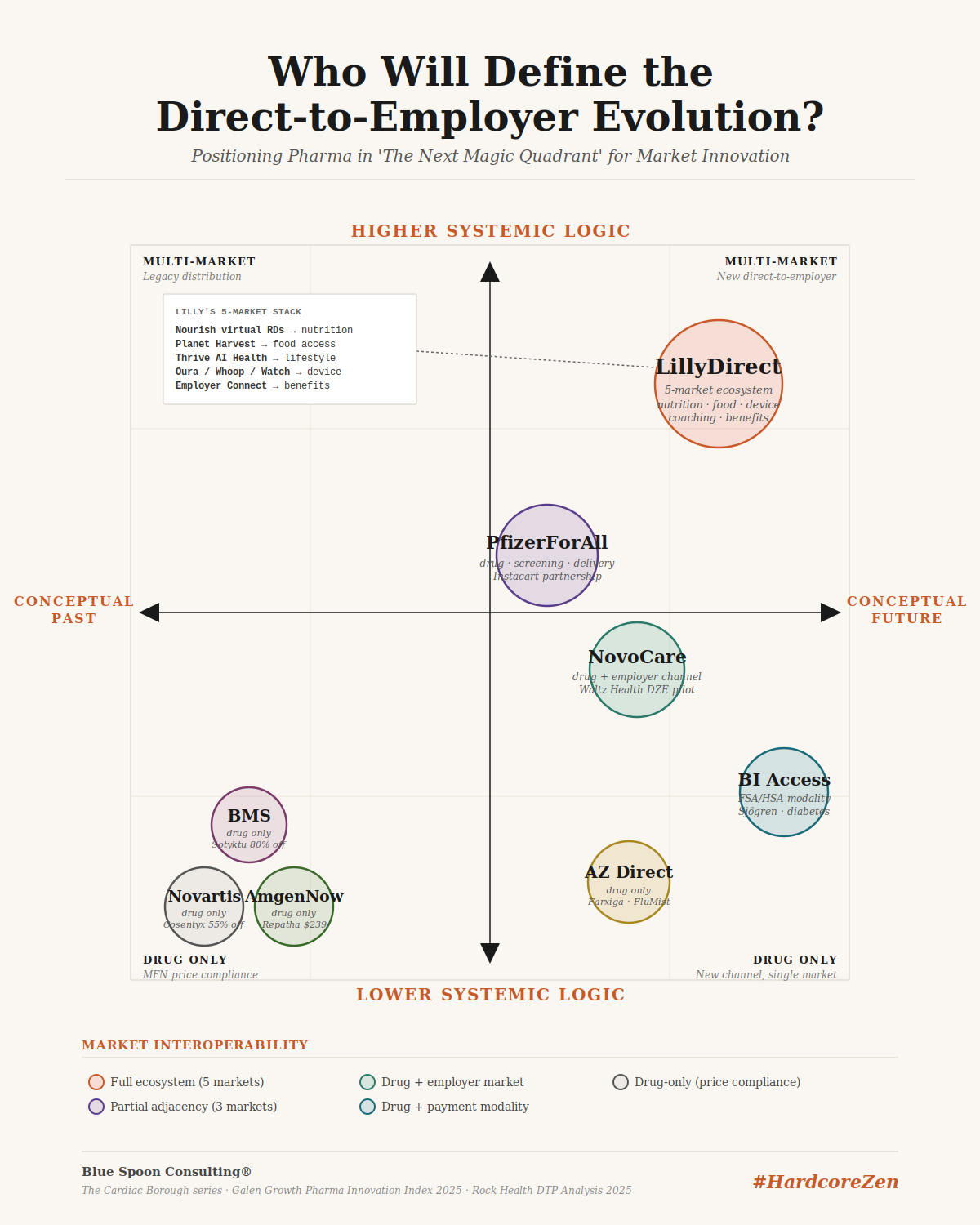
In the new screenplay, already being drafted in scattered pieces by Lilly, Novo, Pfizer, and a handful of others willing to risk the page, pharma is an architect of systems, a builder of channels, a convener of ecosystems in which nutrition, devices, data, and employer benefits markets sit alongside the molecule itself. A better health market stack, cohering around a new industry narrative and working together in a way the old frame never permitted.
The molecule does not disappear from the story. It stops being the only character with lines.
And this is where the single largest untapped move in American pharma has been waiting for an author. The same health market stack that changes the economics of the drug market can change the politics of it, too.
Imagine the next CEO of PhRMA walking into a congressional hearing or a state Medicaid office not alone, not flanked by the usual trade-association lawyers, but accompanied by the nutrition companies, the device makers, the data platforms, and the employer benefits leaders who are now building the new channel with them. Not as vendors. As co-advocates, co-creators, and co-authors of a new industry narrative — a better system of markets that speaks for outcomes instead of prices, for the production of public value instead of the consumption of products, for the whole market stack instead of the single molecule.
Congress has never seen that meeting.
Neither has CMS, neither has any state legislature, neither has a single governor's office. The old screenplay did not permit it. The new one requires it. The first pharma company that walks into a federal or state policy conversation with its ecosystem partners beside it will change the terms of the conversation before anyone in the room understands what has happened. New York City is where that conversation should start.
Policy innovation is the next frontier of pharma positioning, and almost nobody is working on it.
Writing a New Screenplay
Every industry runs on a storyline of value, a screenplay inherited from an earlier era, in which the plot beats are known, the characters are cast, the conflicts are scripted, and the ending is either a managed margin or a managed decline.
Pharma's storyline was written across the second half of the twentieth century, codified by Hatch-Waxman in 1984, extended through the rise of the PBMs, and fully institutionalized by the time Medicare Part D arrived in 2003. The core script was finished before GLP-1s existed as a category. By the 2010s it was no longer being written. It was being performed, quarter after quarter, by a cast who had stopped asking whether the script still made sense.
It stars the molecule as hero. The PBM is the gatekeeper the hero must negotiate with. The formulary is the kingdom the hero must enter. The rebate is the tribute the hero must pay. The lobbyist is the interpreter who explains the whole ritual to a Congress that never fully understood it. The investor is the nervous audience whose applause has to be earned one quarter at a time.
"When I make a film," Tarantino said at the Busan International Film Festival in 2013, "I am hoping to reinvent the genre a little bit. I just do it my way. I make my own little Quentin versions of them."
No business school professor has ever described positioning more cleanly, and none ever will.
Reinventing the genre is not a marketing tactic or a brand refresh. It is the act of refusing the category the market has placed you in and building a new category the market will eventually be forced to learn. Pharma has spent a generation letting other people define its genre: payers, lobbyists, PBMs, regulators, politicians, journalists. Every one of those actors has a vocabulary for what pharma is, and every vocabulary has settled into a story pharma can no longer escape by telling it louder.
The only way out is to write a different movie.
The single most under-invested capability in the industry right now is narrative craft — the capability and the willingness to write a new storyline of value rather than optimize the old one.
Ambition is not a style. It is a strategy.
The question in front of every leader right now is not whether to compete harder inside the current frame. It is whether to think like Quentin Tarantino, a genre-breaking storyteller instead of a defender of the old form, whether to begin assembling the new frame before someone else does it first, and whether the industry's next generation of leadership will be willing to be mavericks without being pulverized for it.
The answer depends almost entirely on who writes the new screenplay, and how quickly.
The foot goes on the gas now, not later. Later is when the quadrant locks and the story gets told by someone else.
The Next Act of American Pharma
If you are a senior leader at a pharma, digital health, or employer benefits business, and your team is ready to stop reciting the old screenplay, the place to start is a Hardcore Zen session. Ninety minutes, no deck, no pitch, just pressure-tested strategic thinking about where your business sits and what it would take to write yourself a different role. For those who want to go further, the conversation becomes an 8-to-12-week Ecosystem Strategy Sprint, the writers' room where the new map, the new narrative, and the defensible position in the Next Magic Quadrant get built.
Start with the session.
Before the quadrant locks.
/ jgs
John G. Singer is the founder and Executive Director of Blue Spoon and the author of When Burning Man Comes to Washington: A Field Manual for Riding Chaos. Hardcore Zen is published weekly on Substack.