

How to Reroute an Industry

Strategy is words before it is money. A market is a sentence before it is an economy, and the capital falls in behind the sentence and does what it says. The sentence is the capital.
That is not the soft claim it sounds like. Aswath Damodaran, the NYU finance professor known as the Dean of Valuation, argued in Narrative and Numbers that the story a company tells sets the multiple investors will pay for it. OpenAI is the live proof: no profit, billions in losses, a valuation near nine hundred billion dollars, the number pulled up by the story alone. And if a strong story can power a valuation, a story every rival is already telling cannot.
Brian Evanko took over as chief executive of Cigna, one of America’s largest health insurers, on the first of July and told Bloomberg, and by extension Wall Street, the story he would run it on. He would put “the customer at the center of everything we do, so being patient-first.” He called it “a strategic choice.”
It is the one thing it cannot be.
A strategic choice is a position no rival is taking, a story no rival is telling. It is a different vision of the market, and a rival cannot copy what it cannot yet see. Patient-first is not that, and neither are its close cousins, patient centricity and patient engagement.
Patient centricity is a word virus. It replicates by repetition and thins with every host it takes. Every insurer, every pharmacy benefit manager, every pharmaceutical company, every medical device company, every healthtech start-up, every hospital system, every healthcare provider in the country is saying the identical patient-first sentence at the identical moment. A sentence everyone is already saying commits Cigna to nothing and separates it from no one. It is not the story that lifts a valuation. And the customer actually at the center of the American Way of Healthcare, the one with the most say and sway, is the shareholder, not the patient.
Evanko reached for the safest words in the industry, the ones no one can argue with, and called it strategy. It is more like the place of dead roads.
The instinct traces back, he told Bloomberg’s John Tozzi and Ike Swetlitz, to a Dairy Queen counter he worked one summer as a teenager, where the customer was always right and a bad Blizzard came back across the counter until the buyer was happy.
At Dairy Queen the model works. The chain clears better than six billion dollars a year on its way to ten, and it belongs, fittingly, to Berkshire Hathaway. Healthcare runs the ethos the other way. Nothing comes back, the price only climbs, and the buyer stays unhappy, because the operating model has devolved to manage dissatisfaction, not resolve it. Cigna’s net promoter score sits at negative eight, its members net detractors of the brand that vows to put them first.
A code for returning an ice cream cone is doomed on import to the practice of medicine, where the patient they call the customer is not the buyer at all. Confined to one moment, they pick among plans their employer, or their spouse’s, already chose, once a year.
This is a business-to-business market, not a consumer one. Cigna sells to employers and to the government, rarely to patients. Between it and the employer sits a layer of benefits consultants, brokers who design the plans the employer offers, and payer and consultant set the price and the coverage long before any employee sees a member ID card, thin paper or plastic with a number on it, the whole of what this enormous arrangement ever puts in a patient’s hand.
Like its peers — UnitedHealth, Elevance, CVS Health — Cigna is a cost-and-risk operation, a vendor that manages drug spend and trend and, on claims, reimburses or denies. Its value proposition runs on actuarial tables, the same ones behind a State Farm auto policy or a Prudential annuity, that go back to an analytical framework Edmond Halley — yes, that Halley — built in 1693, when the astronomer counted one town’s births and burials and read the odds of dying off them the way he read a comet’s orbit.
In other words, the system of record beneath the whole American market of health plans and benefits consultants, better than a trillion dollars a year in premiums, sits on a three-centuries-old instrument, older than the country itself.
This is what remnant context looks like: an inherited frame that outlived the conditions that made it true, a dead logic still on its feet, giving orders down the entire chain of consequences, from the value of a life to the fate of a claim to the shape of economies, local, state, national, and global.
Remnant context caps the transformation any new technology bolted onto it can ever deliver.
A New Reality Studio
What we call reality is the result of a scanning pattern, and healthcare is running a faulty one, a descrambling device run amok. It needs rerouting, even mutation.
Remnant context has gravity. The three-hundred-year-old framework that first reduced a life to a number is now the foundation for modern computation, the Standard Model of a computable reality, and it pulls everything built since into its orbit. The tug is to organize the universe by its logic, to make the world computable the way Halley made death computable. The machines feel the pull, and they obey. They do not lead. They sell.
OpenAI is one of them, for all its frontier billing, selling into the context that exists rather than building the one that does not. It sends Sam Altman to pitch hospitals a workspace for drafting clinical notes and searching the literature, a blueprint for an agentic enterprise: documentation and evidence automation, the paperwork engine of patient engagement run faster, a better operation. Anthropic opens a drug discovery lab, and its output, the drugs and maybe even the cures, produced at industrial scale, would still have to be fed into the payer system, the market access Cigna runs on three-hundred-year-old math.
The bigger the output, the more it proves the point: productivity on the supply side changes nothing when the demand side still puts a value on a life the way it did in the 1600s.
Modern technology propping up an outlived concept, trying to succeed in a remnant context, is not the same thing as using a modern strategy to invent a different context, the rules everyone else has to play by. It is the old logic, quicker and better dressed. The difference looks like this.
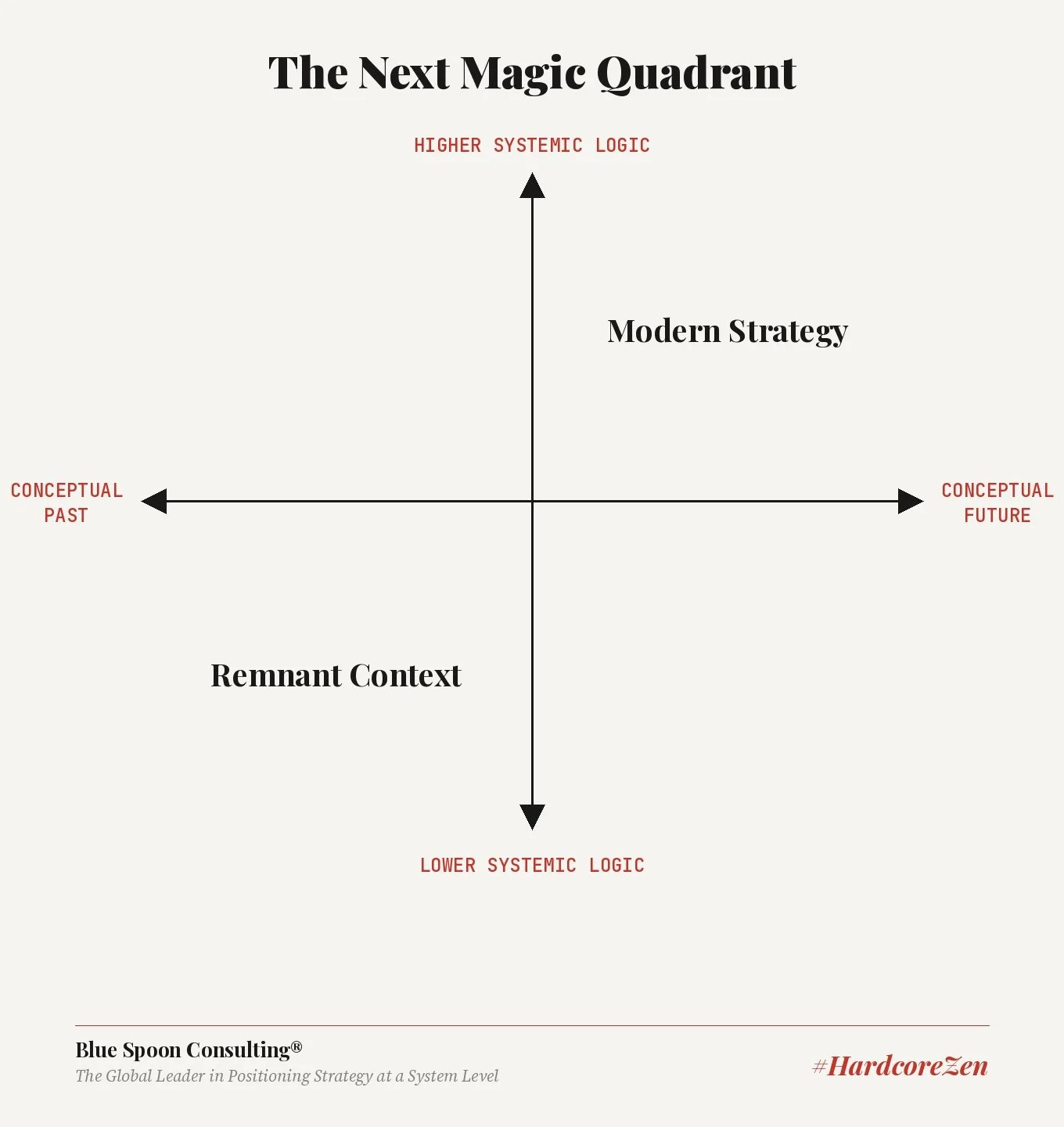
A dinosaur in a fur coat is not a mammal.
Patient-first is remnant context because it is the wrong grain, the level at which the whole industry reads its world, a single body lifted out of the thing that actually produces health. The market innovation move is not the patient-at-the-center sentence said louder, chewed on again, the digestive system now automated. It is a new sentence, a different economic concept from which to reroute not just one industry, but several of them at the same time.
New words write a new context, a new narrative, a new valuation.
Health is made in the household. The caregiving, the adherence, the diet, the aging, the chronic management, the decisions about when to seek care and when to pay for it, all of it happens in families, not in the isolated member on a plan roster. The roster churns. The member shops for a new plan every enrollment period, a different one with every new job, on the books a year, then on to someone else’s.
Family-first is a different grain that moves up a level, from the patient to the household, and the premise of computation changes. It sits in the upper right. It is the conceptual future because no competitor is standing there. It is the higher systemic logic because the family, not the patient, is the real unit of health. It is also the larger market. Caregiving alone is over a trillion dollars a year, unpaid, more than all of Medicaid. The point is bigger: the household is the purchasing-and-decision unit across food, pharmacy, products, and money, and one person, usually the head of household, runs most of it.
Patient-first prices a single claim and never meets the buyer. That is the market it cannot see, and why it stays open.
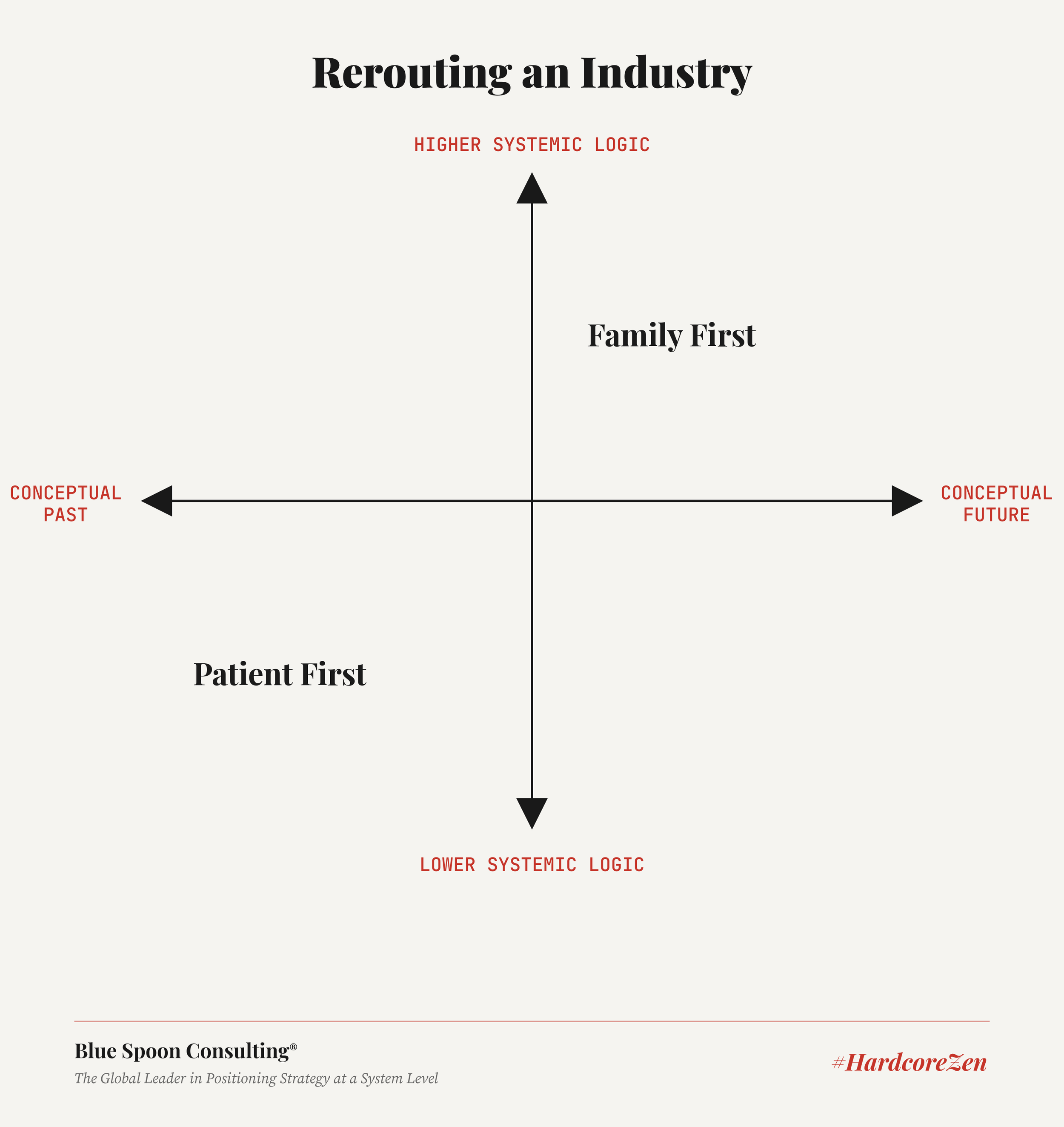
It also closes a gap patient-first steps over: the household, not the isolated patient, is where the real economic weight sits. Family-first is not patient-first with a bigger word. It is a sentence the market has not heard, forged rather than found. It breaks the pattern.
Evanko took his model from a Dairy Queen counter. The better one is Trader Joe’s. The chain runs a twelve-dollar-an-hour cashier through ten days of training not to work the register faster but to break the customer’s pattern at it, to see the dog food come out of the cart and ask what kind of dog you have, to read the day the person is having. It is not sentiment. It is strategy. Trader Joe’s posts the highest sales per square foot in American grocery, double Whole Foods, and has turned a profit every year since 1976.
Trader Joe’s throws a transaction out and positions a relationship in its place. That is the reroute, worked out in a checkout line. Not the pattern run faster. The pattern broken.
The Price of a Sentence
A machine bolted to a remnant context pays off on the Standard Model’s schedule, which is slow, because the frame caps what anything strapped to it can return.
The stock market is betting the machines pay off fast. Consensus has the hyperscalers more than doubling their free cash flow, the Magnificent Seven holding up the index, the whole economy leaning on the one trade, artificial intelligence. That payoff will come late. Strapped to a remnant context, it has to. The machine runs an old frame faster; it does not make it new.
This month the Wall Street Journal asked whether AI can make better drugs on Wall Street’s timeline. Its reporting centered on technical potential: AI powering a biotech renaissance, one that can “improve the feedback loop between discovery and evidence” with richer data and faster trials. That loop is real. It is not the one that is missing. The missing feedback loop integrates discovery and evidence with access, in a new sentence, one that solves for diffusion and breaks from a payer pricing the drug on the old frame.
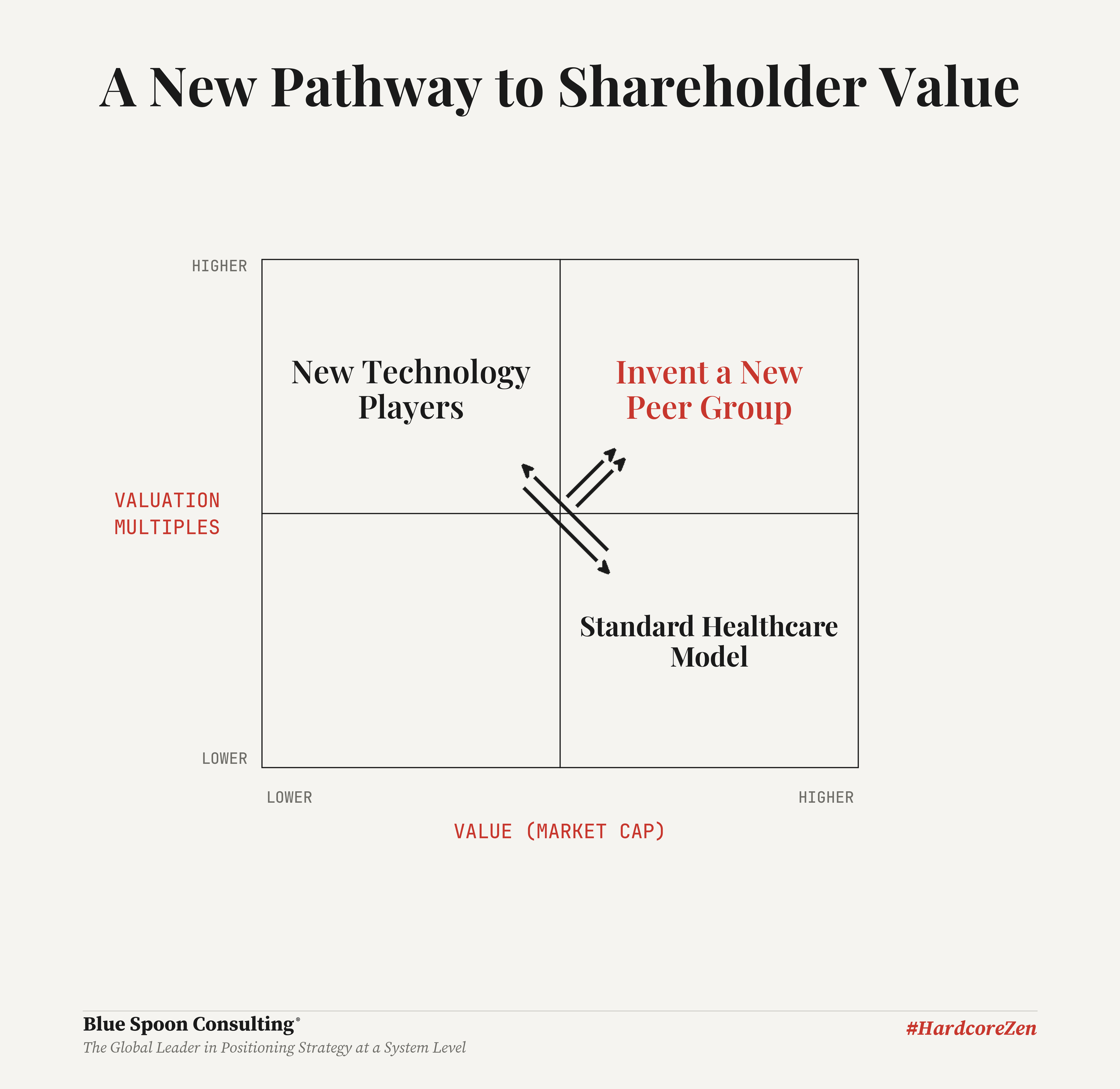
There is a larger thing OpenAI, or Anthropic for that matter, could do with its position, and neither is doing it. OpenAI sells into the hospitals to run the old frame faster, clinical documentation. Anthropic sells into the pharmaceutical companies to run the old frame faster, drug development. Both are the sales arrows crossing the middle of the map. Neither is using its convening power — the keystone position each already holds, at the source of the loop — to bring the hospitals and the banks and the pharmaceutical companies into one room and write a different sentence, one with family as its subject. That is the other set of arrows, the ones that link capacity and run up and out. It opens a new context for market innovation, and the capital flows in behind it.
The move that matters is the upper right, where a company keeps its size and escapes its multiple, and it gets there by refusing the peer group it was sorted into and inventing a new one.
Damodaran, the Dean of Valuation, priced Uber at six billion dollars as a car-service company. Bill Gurley, an early Uber investor, told him the story was wrong, that Uber was a logistics company worth many times more. Same company. The sentence moved the number. That is narrative and numbers, run forward. The multiple follows the story, and the story assigns the peer group.
Family-first starts a different sentence that does not extend the distribution but breaks from it. A company that tells the market it is a health insurer gets priced against health insurers. One that builds the positioning, and the market, for producing health at the level of the household changes the comparison set, and the multiple changes with it. Patient-first keeps Cigna in the lower-right box, valued as one more manager of drug spend and medical claims. A new story is the pathway out of it.
The Bloomberg headline said Wall Street is watching. It is. And it is pricing the story it was handed, patient-first, the one everyone already knows, at the standard multiple. Nothing else has crossed the wire. The upper right — the new peer group, the new space for computability — is empty. It is also unclaimed. And it is the one place the machines finally pay off fast, because a new frame does not cap the return the way the old one does.
Strategic problems do not have technical solutions. Modern strategy starts with a different conceptual framework, a different sentence, one with the power to organize the production of a whole new economic system. The sentence comes first, and the system forms around it. You cannot improve a framework built in 1693 by running it in real time — you can only reroute it.
/ jgs
John G. Singer is the founder and Executive Director of Blue Spoon and the author of When Burning Man Comes to Washington: A Field Manual for Riding Chaos. Hardcore Zen is published weekly on Substack.
Disclosure: Blue Spoon has no financial relationship — equity, advisory, or commercial — with any company named in this essay. The analysis is independent.
Blue Spoon runs the Working Whiteboard: one session, one chart — your market as a system, objectives positioned strategically instead of operationally, original storylines of value. Inquire.