
The Last Magic Quadrant

This essay is also being serialized in three parts in the Hardcore Zen email, leading up to the closing keynote delivered at ISPOR 2026 on May 20. What follows is the full version.
The slide goes up on a Tuesday morning in April 2015 and there are seventeen people in the room who believe what they are about to see. It is the last quiet quarter before the world snapped, before the escalator at Trump Tower. Before the rally in Mobile where twenty thousand people filled a stadium in Alabama and the political press, working from a forty-year-old playbook that said endorsements and donors decided primaries, watched the playbook fail in real time.
None of that has happened yet. The room does not know it is coming.
The chart on the wall is the Gartner Magic Quadrant for Sales Force Automation. Salesforce sits where the chart wants its winners — top, right, alone. Microsoft Dynamics is also a Leader. SAP is also a Leader. Oracle is also a Leader. The dots are arranged with the casual authority of a cartographer who has never been wrong because the cartographer has never been outside. Upper right: Leaders. Lower left: Niche Players. The CIO nods. The Chief Revenue Officer nods.
In a Boston walkup, a company called HubSpot is being mistaken for a marketing tool. In Pleasanton, a company called Veeva is selling a CRM only the pharmaceutical industry uses and is about to teach the rest of the market what vertical SaaS means. In a San Francisco office that does not yet exist, a company that will be called OpenAI is eighteen months from being founded by a group that includes a man named Sam Altman who in 2015 is running Y Combinator. None of them are in the room. None of them are on the chart. The chart is what the room believes.
Within a decade, Salesforce will still be the largest CRM company in the world, and also a company struggling to explain to shareholders why the category it invented is being reorganized faster than it can ship the response. By February 2026 CEO Marc Benioff is on an earnings call saying the word "SaaSpocalypse" six times in his own remarks, joking that the apocalypse may be eaten by the Sasquatch, and announcing a fifty billion dollar buyback to defend the stock. The stock is at one hundred eighty dollars, half its 2024 peak, and the slide is not stopping.
This is how empires fall. Not with the barbarians at the gate but with the generals staring at a map of a country that no longer exists, pointing at dots, certain.
The trade has names for what is happening, but the names are wrong.
They call it disruption, a word Clayton Christensen gave them in 1997 and which by 2015 had been so thoroughly metabolized that it meant nothing, the way paradigm had meant nothing by 1988 and synergy had meant nothing by 1995 and transformation had meant nothing by 2010. Disruption is a thing you put on a slide. Disruption is a thing you charge for. The CEO who pays four hundred thousand dollars for a deck about disruption is not being disrupted. The CEO is being eaten, which is a different verb, and the difference is the difference between an executive who is losing a fight and an executive who is being digested.
What the chart on the wall does not show is that it is itself an instrument of the eating. The Magic Quadrant is a butcher's chart. Two axes, four boxes, a flat diagram laid over a market the way a butcher's diagram is laid over a cow. It assumes the cow holds still. It assumes there is a cow.
By 2015 the cow has walked off the chart and into a different pasture. The pasture is not a pasture. It is a network. The chart's axes are the wrong axes. The chart was drawn for a market that held still, and the network does not hold still, and no amount of careful plotting on the old axes can describe what the network is now doing.
The Sedative
The Magic Quadrant is not a tool. The Magic Quadrant is a sedative.
The chart tells the leader who paid for it that the world is bounded, that competitors are countable, that the future is a matter of moving up and to the right inside a box whose edges have already been drawn. It is a frame designed to produce composure. Composure is what the leader wants. Bruce Henderson figured this out at BCG in 1968 with the Growth-Share Matrix, and Gartner industrialized it in the 1990s, and by 2015 a generation of executives had been trained on charts that all said the same thing. There are two axes. There are four boxes. The future is a point on the page and the point can be plotted. What the leader most wants is not strategy. What the leader most wants is a picture of the world that lets him sleep.
The approach worked beautifully for forty years. Then the world stopped holding still.
The Magic Quadrant is not only a chart Gartner publishes. The Magic Quadrant is a habit of mind. It is an instrument of attention, a way of looking at the world and seeing a finite collection of dots inside a finite rectangle. The chart is the artifact. The habit is the operating system underneath. The habit is the belief that what is countable is what matters, that what is plotted is what is real, that what cannot be drawn on the page does not exist.
And the habit is showing up right now, in the spring of 2026, in the place it does the most damage, which is not the conference room where Gartner is presenting but the room where Silicon Valley is sitting down to tell the rest of us what work is going to mean for the next hundred years.
Dario Amodei, the chief executive of Anthropic, warns of a white-collar blood bath. Sam Altman of OpenAI proposes taxing land and equity to fund a public wealth share. Jack Clark, an Anthropic co-founder, in launching the Anthropic Institute last month as Head of Public Benefit, called the default trajectory "let technology rip, and don't think about the social effects until later." Last week the New York Times ran a long Sunday Opinion essay by Jasmine Sun titled "Silicon Valley Is Bracing for a Permanent Underclass," and the phrase was everywhere by the weekend — in print, on Substack, in the disappearing-message Signal chats of executives boasting about the roles they planned to automate.
None of these people are drawing a Magic Quadrant.
They are giving interviews and launching institutes and writing essays for the Sunday opinion pages. But the same instrument is operating in the back of every one of these statements, drawn in invisible ink, load-bearing. It has the same shape it has always had. One axis goes up and stands for what the machine can do, which is more every quarter. The other axis stretches across and stands for what the human still has, which is less every quarter. The future is a point in the upper right, where the machine has eaten the work and the human is standing there holding nothing, looking at the chart, looking at the corner, looking at the rectangle where a job used to be. The underclass is not a prediction. The underclass is a coordinate. Plot the point and the point becomes the prophecy and the prophecy becomes the policy and the policy becomes the world.
This is the trick the instrument has always pulled. It tells you the future is already drawn. You just have to read it off the page.
The instrument is pulling the trick because it has only one definition of progress, and the definition is technological. More compute, more parameters, more tokens per second, more tasks the model can perform, more domains the agent can enter, more seats it can replace. Technological progress is the y-axis. Technological progress is also the x-axis. Technological progress is the only thing the chart knows how to measure. Economic progress, which is a different thing, never appears on the chart because economic progress is not a vector. Economic progress is the creation of new wants, new categories of value, new occupations, new industries, new things to be good at and new ways to be good at them.
The American economy in 1990 could be mapped completely. General Motors, Sears, AT&T, Citicorp, NBC. Five names a fifth-grader could have given you. Five names that ran the economy. The chart would plot the dots and miss the search industry, the social media industry, the smartphone economy, the streaming industry, the gig labor market, and the data center industry, all of which would arrive within twenty-five years and none of which had a category on the 1990 chart because the categories did not yet have names.
The Silicon Valley consensus is using the same chart. It measures the future in machine capability and human work and assumes those are the only two axes that exist. The chart cannot see the third axis — the generative one, where new categories of human work appear when new technologies enter new economic systems. The consensus is not lying about what AI can do. The consensus is using an instrument that does not have an axis for the thing it is missing.
The economists David Autor and Neil Thompson named the assumption in The Digitalist Papers in December. They called it the lump-of-expertise fallacy: the notion that there is a fixed amount of mastery to be acquired, a finite pool of skill, a closed set of things humans can be good at. The historical record says the opposite. Approximately sixty percent of US employment in 2018 was found in occupational specialties that had not yet been invented in 1940. The airplane did not eat the work of the wheelwright. The airplane invented the airline industry, the air traffic controller, the aerospace engineer, and the freight forwarder, none of whom had a category on the wheelwright's chart.
This is what the Magic Quadrant cannot show. The Magic Quadrant is a snapshot of a world that has already happened, plotted in the language of technological progress, drawn on a page that does not have an axis for industry invention. The territory of work is a generative process. The generative process is what the chart is structurally incapable of seeing.
The strategist's job has changed. The strategist used to predict the future. The strategist now composes it.
The Steering
Now what?
The slide is gone. The deck is closed. The instrument the executive was trained on, the one carried into every quarterly review for twenty years, the one paid for at four hundred thousand dollars a year to have refreshed and re-plotted and re-presented, has reached the end of its useful life. The dots have walked off the page. The categories the chart was tracking have started to dissolve. The room is quiet. The executive is standing there with the printout in hand and the printout is a relic.
Now what?
Look at what just happened to Lululemon. The board, under siege from a founder running a proxy fight and an activist sitting on a billion-dollar stake, named Heidi O'Neill, a twenty-five-year Nike executive, as the next chief executive. The stock fell thirteen percent on the day. "This is not a tuneup. It is a turnaround," said Bill Campbell, the head of research at Paragon Intel. "The mandate is to fix North America, restore full-price discipline, reignite product newness, and put energy back into the brand. O'Neill may help stabilize the business, but she does not look like the obvious architect of the deeper reset this moment demands." Chip Wilson, the founder who built the company, was sharper. In a letter to shareholders, Wilson wrote that a Nike pedigree was "not the symbol of transformative, creative-first leadership."
The market and the founder are not arguing about competence. They are arguing about category. Campbell is saying the moment requires a different kind of practitioner than the search firm produced. Wilson is saying the moment requires a different kind of leadership than the resume on offer. Both are reaching for a vocabulary they do not quite have. Both are pointing at the same hole in the room.
The hole is the absence of a discipline for the work the company actually needs done. Lululemon does not need someone to plot the existing dots more carefully. It needs someone to stand inside the dissolving category and read the conditions producing the next industry.
The board ran a search that asked the question the old chart could answer. Who has run a large apparel business? That question has known dots. The market wanted the question the chart cannot answer. Who can invent the territory the company is about to need? That question has no dots, because the territory does not yet exist.
This is the executive's choice in 2026. The executive can keep using the instrument at hand, plotting dots inside categories that are dissolving while the territory underneath shifts, and hope the shift is slow enough to retire before the chart is fully obsolete. Many will do this. The chart trained them to do this. The boardroom is full of them.
Or the executive can stop predicting and start composing. Put the chart down. Walk to the window. Look at the weather. Read the conditions producing the next industry, and move. Get in front of the storm before the storm has a name.
This is Frontier Management. The work of composing the conditions under which the next industry consents to exist.
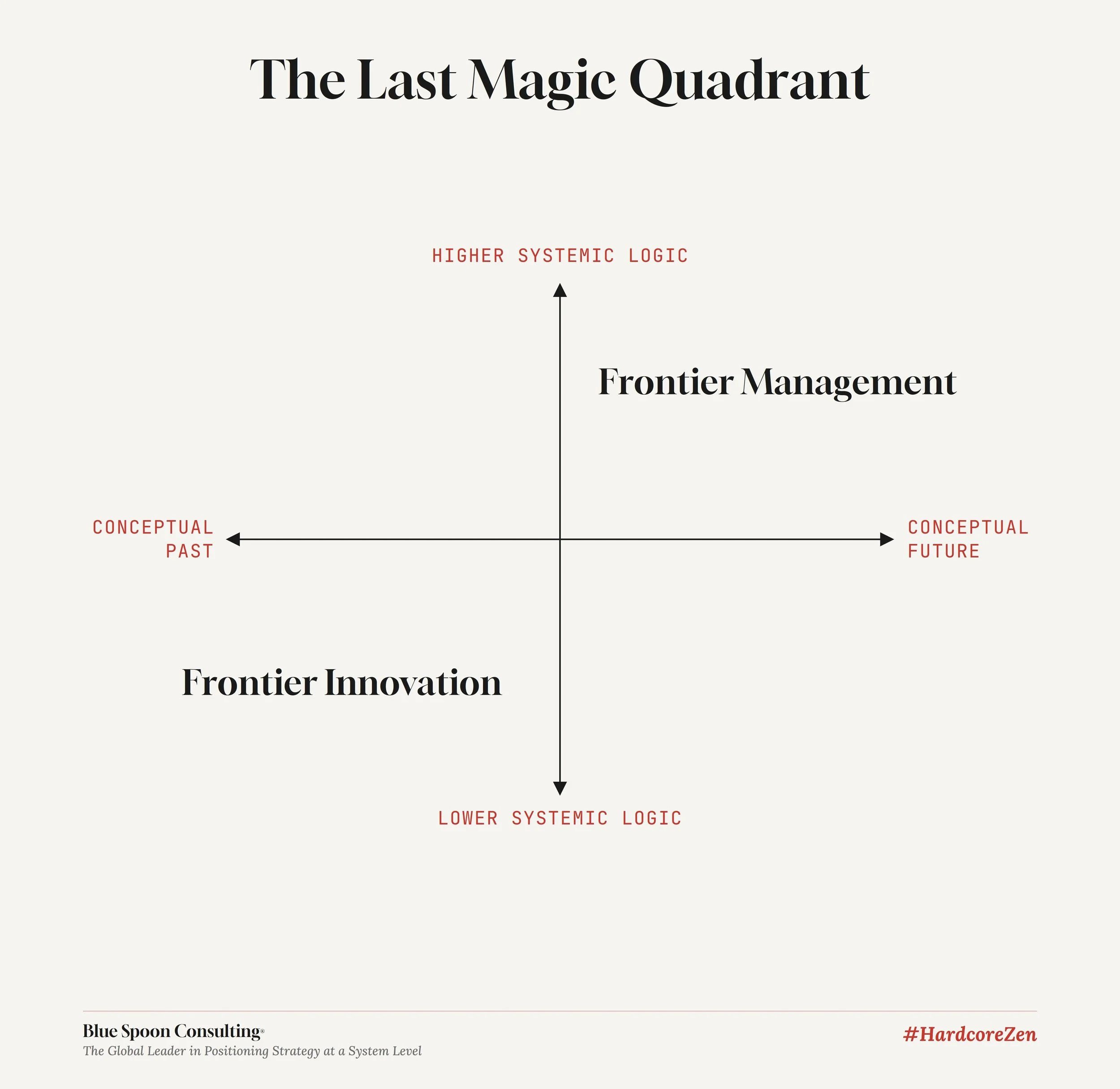
It has other names. Industry invention. Ecosystem-centered strategy. Narrative cartography. The names are still being argued. The thing itself is older than the names but has only recently become legible as a discipline. It begins where the old strategy ends. It is the only discipline that can answer the question the executive is holding.
The frontier could be any of a dozen. Producing cardiometabolic health, where pharma and food and city government and the employer-sponsored insurance pool all hold a different piece of the same opportunity and none of them can solve it alone. Climate adaptation, where the insurers and the municipalities and the building-materials supply chain and the federal disaster apparatus are converging on a market nobody has named yet. Longevity care. AI literacy. Energy resilience. Take your pick. Each one cuts across half a dozen industries the existing categories were not designed to coordinate.
What does the work look like as practice?
It looks like standing in a room with the chief medical officer of a health system, the head of benefits at a Fortune 500 employer, the head of medical affairs at a pharmaceutical company, the executive director of a city department of public health, and the chief actuary of a regional insurer. All five recognize, for the first time, that the health they are responsible for producing in the city is the same health they are responsible for producing in the company is the same health they are responsible for producing in the pharma pipeline is the same health they are responsible for producing in the insurance pool. None of them can produce it alone. What they have just walked into is not a meeting but the founding of a new industry model, a better system of markets. The same scene, with different people in the room, plays out for climate adaptation. It plays out for energy resilience. It plays out wherever the existing categories have stopped describing the territory.
It looks like writing the narrative that names the frontier before anyone else has named it, in language that lets a mayor and a CEO and a regulator and a venture partner all see themselves inside the same story.
It looks like designing the data structures, the funding vehicles, the legal scaffolding, the metrics — the scaffolding capital needs to recognize the new production as production.
It looks like pulling actors into the room one by one over years, the way a coral reef recruits its first generation of fish, until the room itself becomes the industry.
The work is closer to the work of a city planner than the work of an analyst. It does not produce a chart. It produces an ecosystem, which is a different kind of object, with different physics and different metrics and different failure modes. The strategist who works inside it is not plotting dots. The strategist is composing the conditions under which the next industry forms.
The Storm
Three o'clock on the morning of Saturday, May 2, 2026. Spirit Airlines is gone.
The fleet is parked. The ticket counters are dark. The five hundred million dollar government bailout that was supposed to keep the company alive has fallen apart in the last forty-eight hours, the bondholders dug in, the Trump administration walked away.
Spirit had brought the ultra-discount model to the United States in 2006, growing fast and profitably, drawing every other major carrier into the unbundled-fare strategy it pioneered. Less than half a decade ago it was the prize in a three-and-a-half-billion-dollar bidding war between Frontier and JetBlue. By the spring of 2026 it is a tarmac of empty A321s.
Somewhere there is a 2015 chart of the American airline industry. Spirit sits in the upper-right of the low-cost-carrier ring. The chart cannot see the bankruptcy in 2024, the failed merger, the second filing in 2025, the U.S.-Iran war doubling jet fuel prices in a matter of weeks, the bondholders refusing the haircut, the moment at three a.m. on a Saturday when the operation simply stops. The chart can only see the dots. The chart has no axis for the system that is about to surround the company and dismantle it.
A hurricane does not announce itself. It assembles.
The American economy in 2026 is generating hurricanes. Obesity and diabetes are a hurricane. AI labor displacement is a hurricane. The reorganization of pharmacy and food and finance and care is a hurricane. The geopolitics of fuel is a hurricane that ate Spirit Airlines while the chart was still calling it a Leader in low-cost carriage. The strategy instrument the boardroom has been buying for decades, with its two axes and its four boxes and its dots in the upper right, is the clipboard on the beach. It cannot see the system. It cannot read the conditions. It is too late before it begins.
Gartner stock is down sixty-four percent on the year and seventy percent from its high. Twenty billion dollars of market capitalization vaporized. Two single-day drops above twenty percent after earnings. A securities fraud class action filed in February. The Wall Street analysts have a phrase for what is happening: the Great Rationalization. The instrument that organized the executive trade for forty years is being repriced by the same executives who used to buy it, and the repricing is brutal. The November 2025 Magic Quadrant for generative AI model providers placed IBM ahead of Anthropic, which tells you everything you need to know about whether the chart can still see what is in front of it.
The Magic Quadrant will not disappear tomorrow. There will still be Gartner reports in 2030. There will still be executives who pay four hundred thousand dollars for a deck about disruption. The instrument is too convenient, too symmetrical, too soothing to vanish all at once. It will linger the way the astrolabe lingered after the sextant, the way phrenology lingered after Darwin. There is too much money invested in the older furniture to throw it out.
But the work has moved.
The work has moved to the field stations and the institutes and the small firms practicing industry invention as a craft. The work has moved to the strategists who understand that the next decade is not a question of who wins the upper-right box but a question of which boxes get drawn at all. The new expertise is not the expertise of plotting dots. The new expertise is the expertise of standing inside the weather, naming the frontier, gathering the actors, and getting in front of the storm before the storm has a name.
Somewhere right now there is a conference room with seventeen people staring at a slide. The slide is a quadrant. The dots are arranged with the casual authority of a chart that has never been outside. Upper right: Leaders. Lower left: Niche Players. The CIO nods. The Chief Revenue Officer nods. None of them feel the pressure dropping. None of them see the hurricane assembling off the coast. None of them know that the territory beneath the chart has already moved, that the cow has walked off the page, that somewhere off the chart the next industry is forming and will arrive within the year.
This is how empires fall. And this is also, if anyone in the room is paying attention, how the next empire begins.
/ jgs
John G. Singer is the founder and Executive Director of Blue Spoon and the author of When Burning Man Comes to Washington: A Field Manual for Riding Chaos. Hardcore Zen is published weekly on Substack.
Blue Spoon runs the Working Whiteboard: one session, one chart — your market as a system, and what your strategy is quietly betting won’t change. Inquire.