
When Collapse Becomes Construction
And so we arrive at the edge, the moment in every American drama when the camera pulls back far enough to show the whole landscape tilting. Executive leaders everywhere are living their own Wile E. Coyote moment, the point where confidence becomes momentum only until you look down, legs still pumping in midair, suspended over a canyon that logic says we should have seen coming.
The illusion of solidity remains, but the strategic physics have changed. Every major system and market the world over — healthcare, AI, manufacturing, national defense, institutional power — finds itself running on air. And we have kept running and hoping, always hoping, through quarterly earnings calls, through slide decks and strategy off-sites, through operational tweaks made for the latest software, that the ledge would somehow re-materialize before its too late.
Hollywood is now here too, staggering under the weight of its own illusions. For a century it believed the story was its own to write. Then the numbers arrived, merciless and bright, and suddenly the studios found themselves staring at a new world in which Netflix and Warner Bros. aren't competitors so much as tectonic plates reshaping the ground beneath them. Talent, distribution, production….all the old coordinates scatter like startled birds. In another era they would have called it a revolution; today they call it a "strategic recalibration," because even in collapse the industry clings to euphemism like religion. But the truth is simpler than the PR sheets: Hollywood looked down, and the ground was already gone.
And across the Atlantic, Europe is discovering that it too is running on air. Trump's second-term strategy document published in December did not merely unsettle alliances, it exposed the unspoken dependency at the heart of the Western project. For decades Europe mistook American security guarantees for geological features, permanent and unquestioned. Now Washington has changed its weather, and Europe, kinetically-trapped in a disintegrating system of belief, found itself blinking into a future in which its defense, its industrial base, and its geopolitical posture could no longer be outsourced to the American mood. It had thought it was walking on solid stone. Now it realizes the stone was suspended by narrative alone.
In December last year, the editorial board of The New York Times published OVERMATCHED: Why the U.S. Military Needs to Reinvent Itself, the first in a series examining what's gone wrong with the U.S. military, technologically, bureaucratically, culturally, politically and strategically. It captured what happens when a self-licking ice-cream cone finally melts in its own heat, a superpower kinetically trapped in the collapsing architecture of its own convictions. "The United States faces a military that is too old, too slow and too vulnerable," the Times reports, describing a Pentagon upgrading technology platforms instead of reinventing concepts, investing in legacy systems while its adversaries invest in new realities.
"Why have successive administrations, Republican and Democratic, persisted in investing in the old way of war?
One reason is inertia in Congress and the Pentagon. The channels through which funds flow to weapons systems are deep and difficult to reroute. An entrenched oligopoly of five large defense contractors, down from 51 in the early 1990s, has an interest in selling the Pentagon ever-costlier evolutions of the same ships, planes and missiles.
Another factor is military culture. Senior officers tend to be wedded to the technologies and tactics in which they made their careers. When Gen. David H. Berger, who was then the commandant of the Marines, decided in 2020 to get rid of the Corps's tanks (which are difficult to transport and maintain) for the sake of creating a lighter, more agile force that could better counter China, he had to overcome intense institutional resistance. General Berger was right. The war in Ukraine demonstrated how vulnerable tanks have become.
There is also a conceptual failure: the idea that more sophisticated is always better. For decades the American military has relied on systems that are bespoke, complex and wildly expensive."
The assessment underscores the same structural divergence playing out the world over, by management teams confusing new technologies for modern strategy.
America continues to define its strategic aims in narrow, tactical verbs — defend, deter, respond — while China speaks in architectural nouns — unify, integrate, consolidate, realign. America positions itself around moments; China positions itself around systems. One side prepares for a crisis; the other prepares for an era. One writes contingency plans; the other writes blueprints.
And this is the profound difference: America keeps crafting objectives that exhaust themselves in the achieving, while China crafts objectives that create the conditions for the next objective, objectives that generate further objectives, compounding rather than depleting. One plays for the event; the other plays for the structure. One fights for the day; the other builds for the decade.
"There is widespread paralysis in Hollywood… an industry gripped by uncertainty and fear as legacy studios struggle to respond to Netflix's scale and speed," wrote The Hollywood Reporter, as Netflix and Warner Bros. redraw the coordinates of power, describing what insiders have whispered for months.
But the message, the mood, the Oh-shit moment doesn't belong to Hollywood alone. It is the shared condition of the age. The Wile E. Coyotes of the corporate world, the dream factories of Hollywood, the chancelleries of Europe, the vast machinery of American healthcare….entire economic systems and subsystems suspended in the same impossible air, still running on instinct and inertia, terrified to look down and discover the ground is already gone.
This is the true architecture of our age: nations, industries, institutions, all of them animated by forward motion, all of them terrified to stop because stopping would mean acknowledging the canyon yawning beneath them. America races forward on the fumes of AI. Europe retrenches in fear of abandonment. Hollywood replays its treasured myths while the algorithms devour its audience share. The executive class clings to its KPIs like rosary beads.
Meanwhile, America stakes its future on a single engine: artificial intelligence. Or as Ruchir Sharma wrote in the Financial Times, "America is now one big bet on AI. AI better deliver for the US, or its economy and markets will lose the one leg they are now standing on." That is not analysis. That is prognosis. That is diagnosis. A trillion-dollar wager on a technology sprinting toward its own data wall as Meta, OpenAI, and DeepMind all warn that "the supply of high-quality text is limited" and that models are "approaching the boundary of what human-generated data can offer." The frontier of AI is a frontier of scarcity masquerading as abundance.
Healthcare, the ugliest and most indispensable of markets, rumbles too. UnitedHealthcare, the system's gravitational anchor, now whispers on earnings calls that it is "a comparatively small part" of the $5 trillion U.S. health system, a line that sounds less like strategy and more like preparation for antitrust autopsy. The NHS teeters. Drug markets rewire themselves. GLP-1s rewrite the physics of consumer demand. Every payer and PBM is one congressional hearing away from discovering how thin their legitimacy has become.
Manufacturing is not spared. Boeing stumbles through a crisis of engineering and trust. Rivian burns capital at a rate that defies the arithmetic of survival. Target and Red Lobster find themselves trapped in a consumer economy where sentiment moves faster than inventory. Even the mighty semiconductor market, including Taiwan's existential lifeline, lives under the shadow of geopolitical unraveling.
These are not isolated misfortunes. They are symptoms of a world that has outgrown its inherited narrative structures. Finance, media, healthcare, AI, defense, consumer markets, every system built on 20th-century assumptions is discovering that the 21st century refuses to honor them. A global architecture is learning, all at once, that the floorboards are no longer nailed to the foundation.
Europe searching for a strategy. Hollywood searching for an identity. Corporate America searching for a framework. AI searching for more data than the world can produce. The United States, astonishingly, searching for a future.
The Future Belongs to the Builders
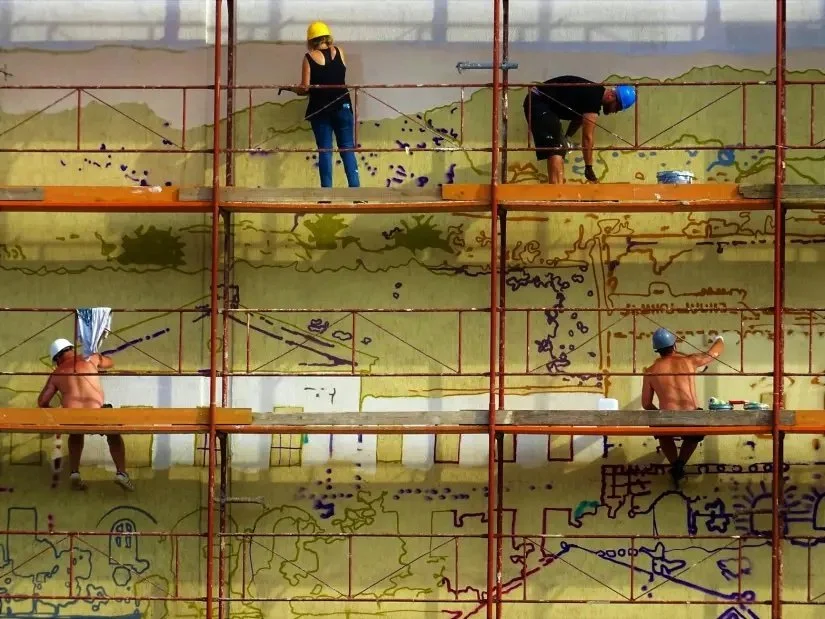
And that is how this year must end, not with despair but with the one truth the systems themselves have forgotten: When the old world loses its gravity, the future belongs to the builders, the ones who can craft new markets, new narratives, new economic systems out of the collapsing scaffolding of the present.
The institutions may be suspended in midair. But that only means the next architecture is ready to be imagined. Look down, if you dare.
But then, look forward.
This final post of 2025 is also the epilogue to my new book, When Burning Man Comes to Washington: A Field Manual for Riding Chaos — and if you want a note the moment it steps into the world, just reply here and I'll make sure your name is on the list when the curtain lifts.
/ jgs
John G. Singer is the founder and Executive Director of Blue Spoon and the author of When Burning Man Comes to Washington: A Field Manual for Riding Chaos. Hardcore Zen is published weekly on Substack.