

What Genentech’s PBM Breakup Really Signaled

Summary: Genentech's decision to decouple from one of the largest PBMs in the United States isn't a procurement story. It's a signal that strategy has stopped meaning improvement and started meaning escape.
"Ten years ago, Dr. Seuss took 220 words, rhymed them, and turned out Cat In The Hat, a little volume of absurdity that worked like a karate chop on the weary little world of Dick, Jane and Spot."
— Ellen Goodman, The Detroit Free Press, November 1966
Despite the theatrics last week in the Swiss Alps — the flags, the threats, the anxieties, The Speech, the nostalgic gunboat pantomime, the breathless shock-or-awe of journalists and "stunned" analysts transfixed by the traveling carnival of chaos that is Brand Trump — the best expression of a karate chop to the old form didn't come out of the international self-indulgence festival at Davos.
It came a week earlier, and nearly 6,000 miles away, in a 489-word news story on January 11 about Genentech's decoupling itself from one of the largest drug benefit managers in the United States, moving its prescription drug plan for 25,000 employees and dependents to a privately-held pharmacy benefit startup. Genentech CEO Ashley Magargee told Endpoints News that the move could save about $70 million through 2028.
"Magargee said Genentech had a competitive year-long search for a new PBM, selecting nine companies for further evaluation before landing on Rightway. She acknowledged that even as a pharma company enmeshed in the US healthcare system, it was hard to untangle from one of the largest PBMs.
"It took us a while to actually review our own medicines for our own employees and what they rely on," Magargee said. "And that's when it became really elucidating how much the traditional model just wasn't serving us or our employees."
Magargee was sold on Rightway's "modular" benefits model. Employees can now see how much they pay for different prescriptions, and what the coverage would be, depending on the source. Genentech also constructed an evidence-based formulary with Rightway, versus the standard model based on rebates. That means that employees pay lower copays for medicines with better data."
What looks, on the surface, like a routine procurement decision, seen through a systems lens, reveals a far more intimate rupture.
Genentech's power move to reconfigure the machinery of which it is a part, essentially casting itself in the third person as the protagonist of its own story, isn't just a simple break with a vendor. It's seeing and thinking at a system level, that what's changed is the world around us is now within us. Networks don't sit "out there" anymore. They colonize their participants, rewriting incentives and norms from within. At this point, strategy stops meaning improvement and starts meaning escape: a clean break from inherited context and a deliberate decision to route around a system that now governs from within.
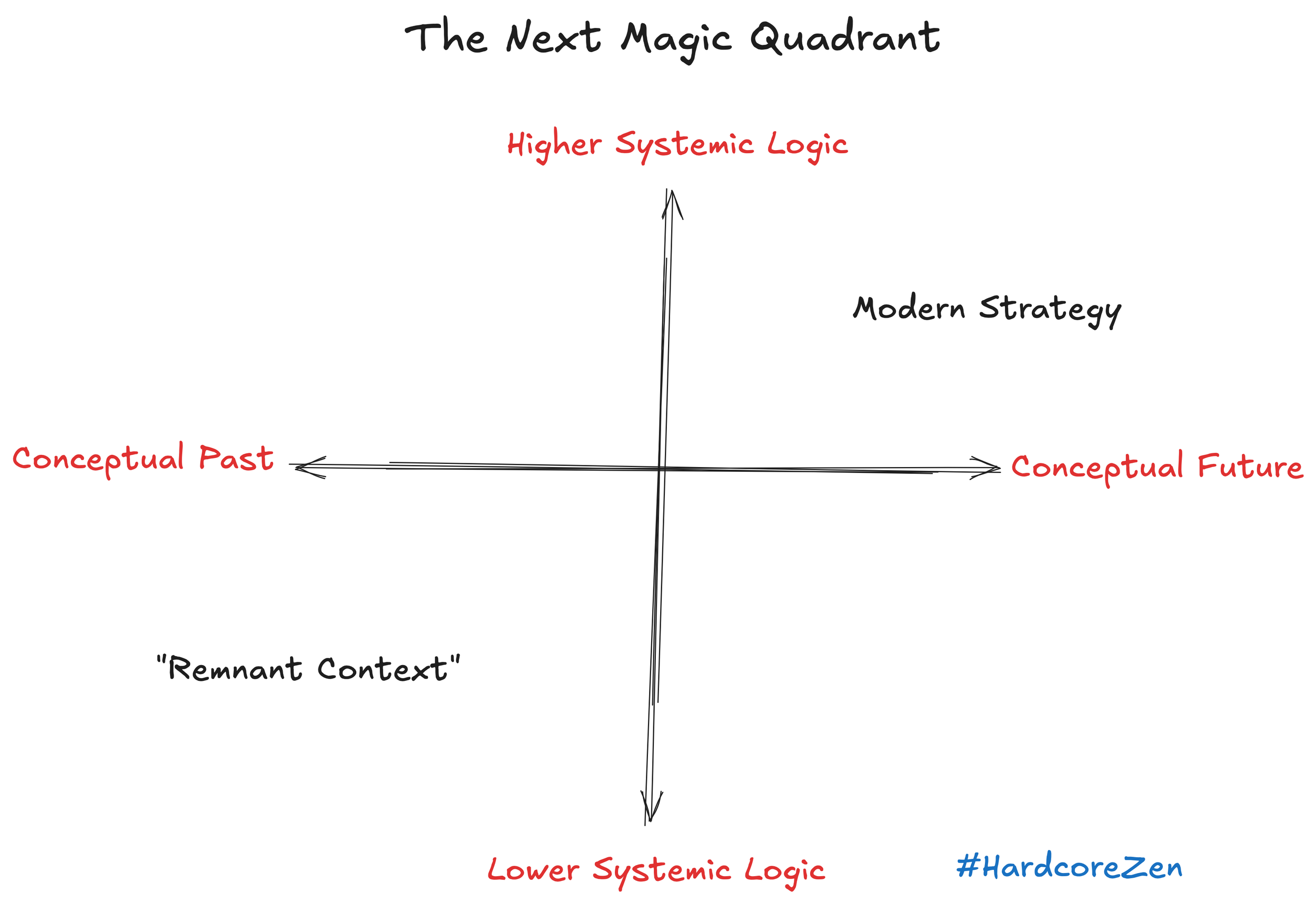
Genentech discovered that the Big PBM it was leashed to wasn't an intermediary but a governing subsystem embedded in its own operations, one whose feedback loops were misaligned with evidence, transparency, and the production of affordable health for its employees. But the bigger story here lies not in one self-funded employer chasing its "drug spend and trend line", it's a dawning recognition about the value of structural agency and the mechanics of modern power: when the environment moves inside you, when intermediaries harden into internal governors, strategy stops being a game of price negotiation and becomes an act of 'creative decoupling' from an embedded economic system.
This is the moment an institution realizes it is no longer competing within a market, but functioning inside a deliberately constructed economic system that governs its behavior, and that survival no longer comes from negotiating better terms, but from redesigning the architecture of that system itself.
Sovereignty (structural agency) now runs through subscriber bases, data streams, payment rails, cloud jurisdictions, mineral basins, and logistics corridors, the Invisible Hand that governs behavior long before politics enters the room. Control is no longer exercised by occupation, but by integration; not by owning territory, but by embedding others so deeply inside your systems that exit becomes economically unthinkable.
At the level of geoeconomics, the world's great powers are no longer carving up maps with gunboats and flags. They are carving up systems and sparking new feedback loops, competing to pull others into their 'market stacks' while locking down long-term control over the physical, technical and data inputs those stacks require so sustain themselves as new ecosystems. (This is why market interoperability should be positioned ahead of data interoperability on any roadmap for innovation.)
What China's CIPS Strategy Understands About Structural Power
China's grasp of leverage from 'higher systemic logic' isn't academic or newly acquired; it's civilizational. For more than three millennia, Chinese statecraft has been shaped by the management of complex, interdependent systems — river basins, grain networks, population flows, tribute relationships — where survival depended less on conquest than on maintaining balance, continuity, and control across vast, internally differentiated landscapes. Power was learned early as something exercised through structure and rhythm rather than blunt force.
That sensibility expresses itself as a preference for parallel systems over frontal confrontation. This includes its long-game strategy for decoupling the world from the dollar.
China is building the Cross-Border Interbank Payment System (CIPS) to clear and settle RMB transactions without relying on SWIFT-controlled messaging and Western correspondent banks. By 2023–2024, over 90 percent of China–Russia trade was settled in RMB or rubles, with the dollar and euro largely displaced. Saudi Arabia and China recently signed agreements enabling RMB settlement for energy trade, and in 2023, China and Brazil settled their first trades entirely in RMB, signaling broader commodity experimentation.
Eswar Prasad doesn't sit in the cheap seats watching this show. He was the former IMF economist who ran the Fund's China desk and now teaches at Cornell. He captures the essence of China's method cleanly in his book The Dollar Trap (Princeton University Press), which examines how the dollar came to have a central role in the world economy: "China's goal is insulation, not dominance." That sentence explains more than a generation's worth of Western misunderstanding about how China thinks. Beijing isn't auditioning to be the next financial emperor; it's building shock absorbers, rerouting dependencies, and quietly making sure that when the system snaps, it doesn't snap back through them.
The aim is not to "challenge the dollar" head-on (that would have been suicidal). Instead, it is pursuing systemic substitution: building parallel rails, parallel clearing mechanisms, parallel institutions, and parallel incentives, while remaining partially coupled long enough to avoid shock. This is not about dethroning the dollar. It's about minimizing points of contact where the dollar can exert control.
And so what looks like globalization's afterlife is actually its mutation.
Nations are no longer asking, How do we conquer? They are asking, How do we plug in, and make it irreversible? The prize is not territory but infrastructure; the objective for a strategy to craft is not about defeating an adversary but achieving operational lock-in: defining the standards and controlling long-term access to attention, data, talent, lithium, copper, rare earth minerals….all bound together in self-organizing and self-generating feedback loops, the strategic physics behind growth that quietly determine who prospers and who begs for bandwidth. This is the frontier management argument made in detail here.
UnitedHealth, CVS, Cigna: Defending an Obsolete Health Insurance Narrative
A defense of operational lock-in was on full display in Washington last week.
The CEOs of UnitedHealth Group, CVS Health, Elevance Health, Cigna and Ascendiun (Blue Shield of California) testified before a House Energy and Commerce subcommittee on Thursday, where they sought to deflect blame for the soaring cost of health care in the United States, arguing that rising hospital and prescription drug prices were driving premiums higher and making health care less affordable for Americans.
"The cost of health care insurance fundamentally reflects the cost of health care itself. It is more of an effect than a cause," said Stephen Hemsley, the CEO of UnitedHealth Group, the largest health care provider in the country. "If insurance costs are going up, even as we compete aggressively against other companies, it signals rising costs of health services and drugs and rising volumes of care activity."
In other words, everyone else 'out there' was the problem.
As the health insurance fingers were pointed at other markets, the executives were not explaining the system so much as pleading for it, arguing over blame inside a structure whose control is migrating elsewhere. This is globalization's mutation rendered in miniature: power no longer sits with any single actor, but at a system level, in the payment rails, reimbursement logic, technology investments, and contractual choke points that govern behavior regardless of intent. Like states clinging to borders after sovereignty has moved into networks, the health insurers spoke the language of the past, an obsolete industry narrative defending the old form, a model built on intermediated control, even as that control erodes.
But the hearing made the truth unavoidable:
Health insurance companies are no longer architects of the system, only its apex operators, locked inside an arrangement that now disciplines them as much as everyone else, and discovering, in real time, what it feels like to lose sovereignty without ever formally surrendering it. Like nations trapped inside global platforms, insurers, hospitals, and pharma companies now operate inside a health-care architecture — and an obsolete "cost" narrative — that governs them all, rewarding deflection over reform and preserving a structure no one claims to control, yet no one can afford to exit.
Which is why Genentech's leadership is so notable.
The new game is about competitive integration. The United States, China, Europe, India, and fast-rising hubs like the UAE are no longer competing to own land. They are competing to own dependence within new economic systems. To decide whose software runs hospitals, whose platforms mediate commerce, whose chips train models, whose standards define compliance, whose capital underwrites growth, and whose minerals keep the whole machine from stalling.
Andrew Latham, opinion contributor to The Hill, writing last week about why Canadian Prime Minister Mark Carney's Davos speech stood out precisely because it acknowledged the stark rupture in the historical timeline we are all struggling to understand and live through (Mark Carney is right about the end of the old order — and that's the problem).
"Italian philosopher and politician Antonio Gramsci warned that when an old order is dying and a new one has yet to be born, politics enters an interregnum — an unstable period in which familiar rules stop working and "monsters" appear. In Gramsci's sense, those "monsters" are not leaders or ideologies, but the zombie institutions that emerge when old norms and rules lose their authority and no new ones yet command it.
That description fits today's global order uncomfortably well. The age of smooth globalization, unipolarity and middle-power brokerage is over; multi-polarity and great power competition are back at the center of international life.
Yet it also exposed a harder truth that Washington remains reluctant to face: In an interregnum, clarity about collapse does not automatically translate into an understanding of what should come next or how to get from here to there."
As Carney put it, the world is no longer moving through a manageable transition but a hard break from the old form, marked by fragmentation, rising systemic risk and the recognition that the era of technocrat-managed globalization, where rules were assumed to deliver stability and compliance was expected to buy safety, is not coming back.
This was not the vocabulary of post-Cold War complacency.
It was the tone of someone who understands that the world order is no longer governed by agreed norms, rules and institutions, but by imposed arrangements and the vagaries of power politics. In that sense, Carney was unusually honest. He sees clearly that the old order is dead. The question is whether leaders will cling to its language like a life raft, or find a unique narrative to 'leap out' of the old form entirely, landing a clean, Seussian karate chop that breaks the grammar of the system instead of endlessly managing its decay.
Davos was weird because it felt so calm and so dangerous at the same time. Everyone in the room knows the flags are theater now. The real borders are invisible, drawn through fiber, firmware, supply chains, and contracts written to outlast governments.
Power no longer marches. It installs.
/ jgs
John G. Singer is the founder and Executive Director of Blue Spoon and the author of When Burning Man Comes to Washington: A Field Manual for Riding Chaos. Hardcore Zen is published weekly on Substack.