
Structural Collapse at Walgreens

Walgreens is trying to squeeze new growth and value out of messaging that is more than 400 years old. And its strategic narrative for the “central role” of retail pharmacy in the United States is no different than that of retail pharmacies in Ghana, West Africa.
Editor’s note
Structural Collapse at Walgreens was first published on July 2, 2024, and updated through that December as the company came apart. The story has now closed. The problem called for an exit from a collapsing system. The ending was an operational solution feeding the feedback loop that sustains the collapse.
Walgreens agreed on March 6, 2025 to sell itself to the private-equity firm Sycamore Partners. Eleven dollars and forty-five cents a share in cash, about $10 billion in equity, up to $23.7 billion counting debt, with as much as $3 more per share depending on what the VillageMD businesses eventually fetch. Measured against the closing price on December 9, the day before the talks leaked, that was a premium of up to 63 percent. Measured against August 2015, when the stock hit its all-time high and the company was worth more than $100 billion, the picture inverts: the deal valued Walgreens at roughly a tenth of that.
The transaction closed on August 28. Stefano Pessina, the largest shareholder and the man who merged Alliance Boots into Walgreens in 2014 to create it, rolled his entire stake back in.
Tim Wentworth is gone. He arrived in October 2023 from Express Scripts, the pharmacy benefit manager, lasted twenty-two months, and stayed on as a director of the private company. His replacement is Mike Motz, who ran Staples US Retail, another Sycamore company, and the Canadian chain Shoppers Drug Mart before that.
Walgreens, Boots, Shields Health Solutions, CareCentrix and VillageMD now operate as standalone private companies. The health ecosystem vision, such as it was, has been taken apart and put on the shelf in pieces.
So a company that could not escape the four-hundred-year-old message strategy was bought by a firm whose expertise, in Wentworth’s own words on the day of the announcement, is a “strong track record of successful retail turnarounds.” That is the same operational discipline that could not solve the problem in the first place.
Going private removes the quarterly audience. It does not remove the PBM. It makes the PBM matter more.
The Private Equity Stakeholder Project, reading the financing commitments Walgreens filed with the SEC on March 10, put the debt share of the buyout at 83 percent, against a 41 percent average for private-equity deals the year before. If that reading holds, the cash to service the debt has to come out of the same prescription business the PBMs are squeezing, on a shorter fuse and with no public market left to explain it to.
Updates since original publication — July 2, 2024
- Oct 15Walgreens announces the closing of 1,200 stores over the next three years, with 800 more under evaluation.
- Nov 29Tim Barry steps down as CEO and board chair of VillageMD.
- Dec 2Stellantis CEO Carlos Tavares abruptly quits as US Jeep and Ram sales collapse.
- Dec 3Intel CEO Pat Gelsinger abruptly retires.
- Dec 10Walgreens moves to sell itself to private equity.
Walgreens is in talks to sell itself to a private-equity firm, Sycamore Partners, in a deal that would take the pharmacy chain off the public market after its shares have been on a downward slide for nearly a decade. Walgreens Boots Alliance and Sycamore Partners have been discussing a deal that could be completed early next year, assuming talks don’t fall apart, according to people familiar with the matter.
Walgreens’s market value reached a peak of over $100 billion in 2015 but had since shrunk to around $7.5 billion as of Monday. Mounting pressures on both its pharmacy and retail businesses had helped send its shares down nearly 70% so far this year before The Wall Street Journal reported on the deal talks on December 10.
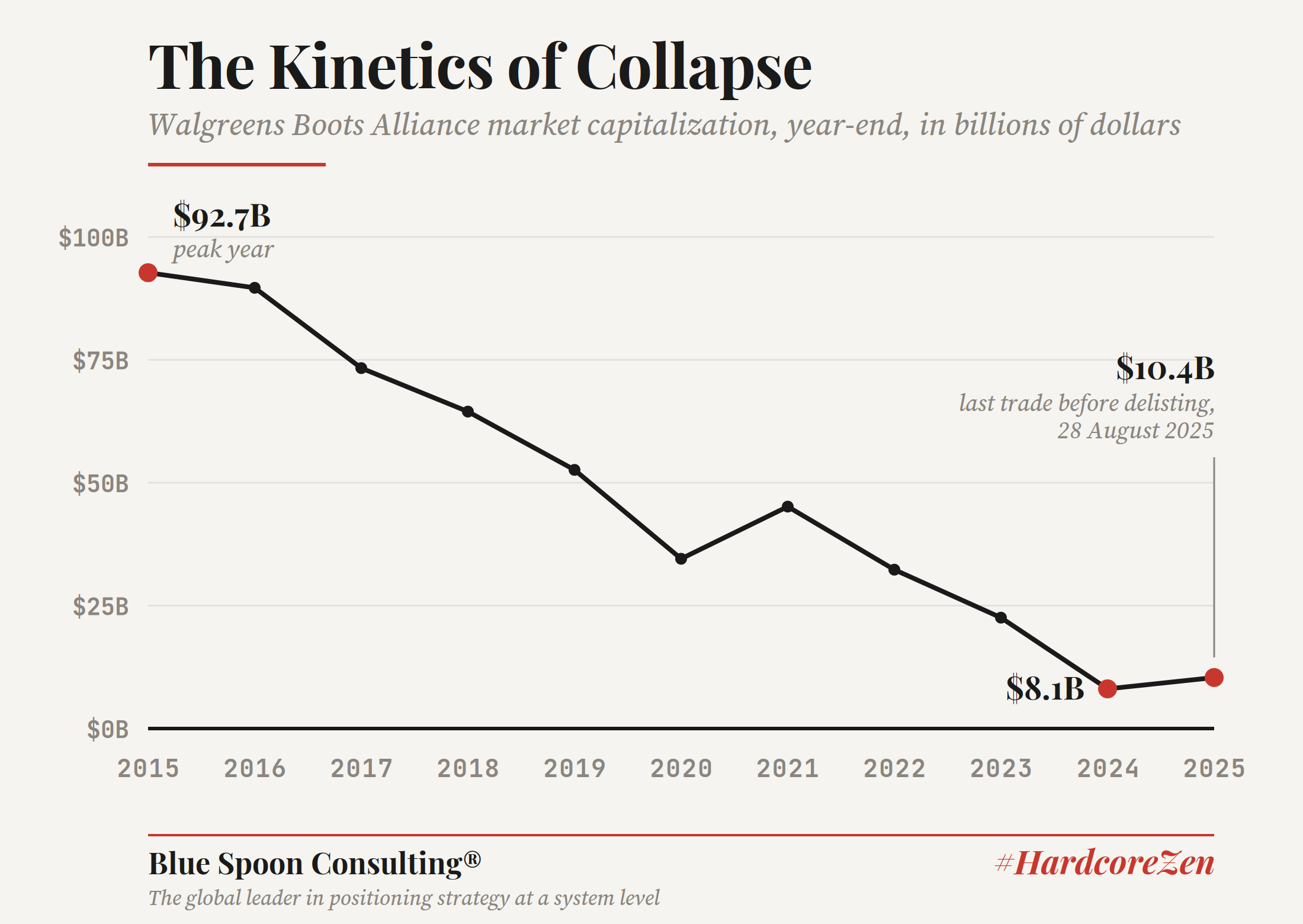
Earnings for its third quarter showed the extent of Walgreens’ troubles, reported Anna Mathews and Joseph Walker for the Wall Street Journal (June 27). The pharmacy chain missed on fiscal third-quarter earnings and slashed its full-year profit guidance. Walgreens also announced plans to close about a quarter of its 8,600 US store locations, and Sebastian James, who had run Walgreens’ U.K. retail pharmacy chain Boots as CEO since 2018, resigned.
Update — October 15, 2024
The number arrived with the fiscal fourth quarter: 1,200 stores over three years, about fourteen percent of the footprint, roughly 500 of them inside twelve months. The quarter carried a $3 billion loss and the full year a loss of more than $10 a share. The stock rose about 12 percent on the news. The market paid for the subtraction.
Walgreens’ stock is at a price not seen since the 1990s. It has lost more than 80 percent of its value over the last three years.
The results, write Mathews and Walker, reflect worse-than-expected consumer spending and a change in a key industry pricing index that is squeezing reimbursement to pharmacies.
“Like other pharmacies, Walgreens has been facing smaller revenue from prescription drugs, which had been a major driver of sales. Pharmacies have also faced greater reimbursement pressure from the firms, known as pharmacy-benefit managers, that negotiate drug prices on behalf of insurers and employers.”
Walgreens Boots Alliance Chief Executive Tim Wentworth in an interview with the paper also said Walgreens is losing money on filling prescriptions for the fast-growing GLP-1 class of diabetes and weight-loss drugs, a category that includes blockbusters Ozempic and Mounjaro.
One main takeaway from Walgreens’s strategy review, he said, was, “retail pharmacy is central to our future and to our overall customer and patient experience. It enables many other things, but it has to change.”
The future Wentworth wants for Walgreens is one in which pharmacies are local hubs for healthcare access (the term of art here is ‘keystone advantage’).
His ‘health ecosystem vision’ aims to position Walgreens as core to maintaining patient health. Part of this agenda includes having pharmacists positioned as expert consultants in the case of minor healthcare needs ranging from advice on over-the-counter products to helping administer specialty drugs on site. “I am confident WBA will be a leader in the future of healthcare, with pharmacy and retail at its center,” he said on his earnings call.
Which sounds great as a bullet point in the PowerPoint.
But the ecosystem vision isn’t framed around a new economy concept that can align and create value for a set of markets, much less deliver any sort of breakthrough narrative, the kind that can spark new shareholder value. Pretty much everyone else the world over sees the same future that Walgreens is pitching and that pharmacists have been reaching for since, well, the 17th century (for the curious, here’s a brief History of Pharmacy from the Jerry H. Hodge School of Pharmacy at Texas Tech University). More bluntly, Wentworth is trying to squeeze more life out of a ‘message strategy’ that is more than 400 years old. And its strategic narrative for the “central role” of retail pharmacy in the United States is no different than that of retail pharmacies in Ghana, West Africa.
In “The digital future of pharmacy in Africa” by Seun Afuye, Abdullah Yusuf and Remi Adesun in African Arguments:
“Amid the drain of Africa’s trained healthcare workers to the West, pharmacists are increasingly playing a frontline role that goes beyond dispensing drugs.
Across Africa, community pharmacies are often the first – and sometimes the only – accessible points of care, particularly in rural and underserved regions. In Nigeria, for example, pharmacies comprise ~50% of the primary healthcare facilities that cater to 70% of registered care visits. Similar trends are seen in Ghana and Cote d’Ivoire, where pharmacies are a vital channel for sexual and reproductive health.
Given Africa’s physician shortage and the ongoing exodus of healthcare professionals, expanding the role of pharmacists can address health needs of local communities and serve as a critical buffer that enables basic patient access.”
Is there untapped ‘positional value’ of retail pharmacy to enact a different future for healthcare?
Absolutely, at least on paper. Using “digital” to transform and automate and optimize and augment? No sales presentation in healthcare today is complete without that unbounded humanity-saving potential of technology that Silicon Valley says is there for the buying.
But that’s not a novel idea either.
A System Feeds Its Survival. Always.
Wentworth took over as CEO after a career spent in the business of managing drug benefits, most recently as the CEO of Express Scripts, the very same company responsible for the deep problems affecting the entire retail pharmacy market, including Walgreens.
Around the same time the Wall Street Journal was sitting down and interviewing Wentworth, investigative journalism by Rebecca Robbins and Reed Abelson was published by the New York Times unpacking the power and control of Big PBM on the practice of medicine, and the strategic effect of that power and control on the economics of the drug market in the United States (see: ‘The Opaque Industry Secretly Inflating Prices for Prescription Drugs’).
What Robbins and Abelson found and reported on was the ‘ground truth’ that everyone who is now or has ever worked in the $5 trillion system of markets loosely called “healthcare” in the United States already knows and understands:
- The PBMs, which are responsible for paying pharmacies on behalf of employers, are driving independent drugstores out of business by not paying them enough to cover their costs. Small pharmacies have little choice but to accept these lowball rates because the largest PBMs control an overwhelming majority of prescriptions. The disappearance of local pharmacies limits health care access for poorer communities but ultimately enriches the PBMs’ parent companies, which own drugstores or mail-order pharmacies.
- They often charge employers and government programs like Medicare multiple times the wholesale price of a drug, keeping most of the difference for themselves. That overcharging goes far beyond the markups that pharmacies, like other retailers, typically tack on when they sell products.
- The largest PBMs recently established subsidiaries that harvest billions of dollars in fees from drug companies, money that flows straight to their bottom line and does nothing to reduce health care costs.
“They’re seeking to extract from the system, without creating any corresponding value for the system,” said Dave Yost, the Republican attorney general in Ohio, who has sued Express Scripts and Optum Rx over their business practices. “The patients are the ones that are suffering.”
Which, of course, Big PBM disputes.
“We’re 18,000 pharmacists, clinicians, researchers, negotiators, caregivers, and more who take pride in being the last line of defense for millions of Americans against rising health costs. Fighting every day to make their medications more affordable and accessible,” says Express Scripts. “That’s not a middleman. That’s an advocate.”
From ESI’s website:
As a leading pharmacy benefits manager (PBM), Express Scripts manages pharmacy services and lowers drug spend for health plans, employers, labor unions and government agencies. Each year, Express Scripts saves approximately $64 billion for the nearly 100 million Americans and thousands of clients we serve — who choose Express Scripts for our proven track record of delivering significant savings and better clinical outcomes.
From ESI’s lawsuit against the FTC:
“The Report is not an analysis of the data and information produced by the PBMs,” the suit alleges. “Instead, it is seventy-four pages of unsupported innuendo leveled against Express Scripts and other PBMs under a false and defamatory headline and accompanied by a false and defamatory press release. The FTC disregarded documents provided by the PBMs showing that the companies lower prescription drug costs for payers. The FTC’s report has injured Express Scripts’ business and reputation, and it has also been cited in multiple lawsuits against Express Scripts, along with investigations from state regulators and Congress, creating additional harm that could increase over time.”
The long argument continues, aided and abetted by all the data that money can buy and produce by all the technology that money can buy and produce.
“Cutting Cost” is the Horseless Carriage of Healthcare
Big PBM is dominant, collectively processing roughly 80 percent of prescriptions in the United States. In 2012, the figure was less than 50 percent. Executives at the PBMs say their size is essential to counteract the companies that make brand-name drugs.
“The biggest driver of cost in this country is the brand manufacturers,” David Joyner, president of CVS Caremark said in an interview. “Size and scale really matters in order to be able to influence and be able to lower the overall cost of branded pharmaceuticals.” Which only reinforces and recycles the obsolete ‘storyline of value’ in which healthcare is trapped — “cost” of drugs is the horseless carriage of healthcare. The problem for big market imagination to solve is positioning ‘the production of affordable health’ as a new economy business concept.
The PBMs also say that tightfisted employers are to blame when patients are charged high out-of-pocket costs or can’t get their medications. “Indeed, many employers skimp on the health benefits they offer workers,” says Joyner. In other words, the client/customer ‘out there’ is to blame.
Let’s call this mess and mass of complexity structural stalemate.
It’s the Mad Riddle of Healthcare, a zero-sum view of competition in a non-zero-sum game. And it’s not something that can be fixed in the conventional sense — a system always adapts and finds a way to keep itself alive (e.g., the “Irish Workaround” Abelson and Robbins describe, where UnitedHealth Group created a GPO “to retain billions of dollars of those savings, without having to share them with employers”).
Most analysts believe Walgreens is employing a solid strategy, writes Anjalee Khemlani at Yahoo Finance, but it will require patience to execute; especially as a key source of revenue, PBMs, are increasingly becoming competition. (Check out related perspective on the “patience thing” published by Blue Spoon: ‘Walmart Checks Out’) JPMorgan’s Lisa Gill said in a note late Thursday that the process would take time. “We continue to believe that in the longer-term, WBA has the potential for growth. If there is a silver lining to this print, we believe that the company is making the necessary steps to stabilize its footprint and working with PBMs and payors to manage reimbursement headwinds,” she wrote.
Bank of America’s Allen Lutz similarly noted:
“It is imperative that Walgreens pushes back more assertively against PBMs to capture a more reasonable return on capital.” But, he added, “It is not fully clear if a more aggressive push by retail pharmacies would yield favorable results. However, the risk from continuing down the current path for WBA may prove worse.”
Here’s where the Walgreens roadmap circles back on itself.
“We are at a point where the current pharmacy model is not sustainable and the challenges in our operating environment require we approach the market differently,” he said on earnings. “We are in active discussions with our PBM and payer partners to align incentives and ensure we are paid fairly.”
This doesn’t sound like a different approach to me.
Talk to Ghana, Not McKinsey
“Pharmacy chains have struggled to boost profits in recent years, squeezed by drug pricing and lower foot traffic as the pandemic waned. Last year CVS Health said it would cut costs thousands of jobs — mostly corporate positions — as it remakes its business as a healthcare-service company,” the Wall Street Journal reported separately (Inside CVS’s Strategy to Improve the Pharmacy Experience).
But “boosting profits” is a bottom-line change. It’s a tweak at the edge, not creative leadership. It’s a quick win. Occasionally necessary operationally and relatively simple to pull off under cover of yet another re-org recommended by a PowerPoint Powerhouse. But cost-cutting is one of those temporary solutions that becomes a permanent problem. And it’s also a sign of strategic atrophy that carries legacy risk to the careers of CEOs, career risk to aspiring CEOs, and real health and financial risk to the lives and livelihoods of potentially thousands of “people” (defined here as “patients” (and their caregivers), or “employees” (and their families), or “stakeholders” (which could mean anyone and everyone, including “customers” and “clients”)).
Just ask the board of directors at Stellantis.
Its Chief Executive, Carlos Tavares, resigned abruptly on Sunday, two months after a profit warning at the maker of Jeep, Fiat and Peugeot cars that has lost around 40 percent of its value this year. Stellantis said in a statement on Sunday that its board, including Chairman John Elkann, accepted the CEO’s resignation “with immediate effect” and that a new interim executive committee, chaired by Elkann, would be established. Per Reuters:
A source familiar with the matter told Reuters that tensions grew after the board felt Tavares was moving too quickly and focusing on near-term solutions to save his reputation, not working in the best interests of the company.
The sudden announcement on Sunday indicated that the fissures between the board and Tavares had to be severe, given that the parties decided it was better to operate with no CEO on a short-term basis, Bernstein analysts said.
Fabio Caldato, a portfolio manager at AcomeA SGR, which holds Stellantis shares, said “new ideas and fresh forces are needed to plan the company’s future.”
A lot of this going around: confusing operational concepts (“efficiency”) for strategic vision. From the Wall Street Journal’s How Stellantis CEO’s Cost-Cutting Mantra Cost Him His Job this morning:
A ruthless focus on efficiency made Carlos Tavares a giant of the automotive industry. It was also his undoing at Stellantis.
Tavares resigned Sunday as chief executive officer of the Chrysler owner after losing the confidence of the board and key shareholders. In a statement, the company pointed to the emergence of “different views” in recent weeks.
Tavares was instrumental in the creation of Stellantis, which was forged by the merger of Peugeot owner PSA Group of France and the Italian-American company once known as Fiat Chrysler Automobiles. The Portuguese executive had already garnered a reputation for cutting costs through business combinations. In 2017, when he ran PSA, he bought the loss-making European operations of General Motors and rapidly made them profitable.
At first, Tavares successfully repeated the playbook in the much larger deal with FCA, significantly boosting profitability. Now, though, the cost-cutting strategy has hit a wall, leaving his legacy in question.
The next day, Intel announced that Pat Gelsinger had retired, effective the day before, and had also left the board. No named successor, two interim co-chief executives, an interim chairman. Multiple outlets reported the board had run out of patience with the turnaround and pushed him out.
Gelsinger is the inverted case, which is what makes the pair worth reading together. Tavares cut, and lost the job when cutting hit its wall. Gelsinger was trying to build something — a domestic foundry business on a ten-year clock, against TSMC and Samsung — and lost the job for not delivering it fast enough. By August he had already announced more than 15,000 job cuts and paused construction on several plants, which is what a builder starts doing when the board’s clock runs shorter than the market’s.
Two opposite strategies, the same ending. The variable that decided both was time, and neither board had any.
For related reading: Death By Reorganization — Literally — at BP or Former Nike CEO John Donahoe’s downfall is a brutal lesson in corporate leadership.
If there’s a Big Remake to make happen in healthcare, it will need different policy, economic and business constructs for what lies ahead, which won’t happen so long as you/me/we wander the wasteland of our past. The stakes are high, particularly of the career risk for not seeing and understanding the kinetics of collapse. To wit, CEO of Chicago-based VillageMD steps down as Walgreens considers selling stake in business, news that broke over Thanksgiving. Via Walgreens’ home-town newspaper The Chicago Tribune:
The CEO and co-founder of Chicago-based primary care provider VillageMD has resigned, a move that comes as Walgreens Boots Alliance considers selling its stake in the business.
VillageMD spokesperson Molly Lynch confirmed Wednesday that Tim Barry has stepped down as CEO and board chair and that the company’s board has appointed VillageMD Chief Operating Officer Jim Murray to serve as interim CEO “effective immediately.” Lynch did not answer questions about why Barry departed.
Deerfield-based Walgreens said in a statement: “We look forward to continuing to partner with Jim Murray as he assumes day-to-day leadership responsibilities.” Murray has been “integral in helping lead the company’s turnaround as VillageMD makes meaningful progress and positions itself for profitable growth,” Walgreens added. A Walgreens representative also did not answer questions about why Barry resigned.
No one should be surprised by Cornell Entrepreneur of the Year 2024 Barry’s exit.
The next cycle of innovation in the business and economics of healthcare “works” in a different orbit for creative and intellectual energy. It centers on leapfrogging the current state altogether with different economic concepts, a roadmap that can take the truly revolutionary achievements in science from the pharmaceutical industry and construct new industry ecosystems, from scratch.
It’s strategy born from a more original narrative.
Without new words to think new thoughts, vision and ambition to intentionally force a genuine alteration of consciousness, it’s a safe bet the kind of big system failure now consuming Walgreens (and Intel and Stellantis, for that matter) will repeat itself as an infinite loop. Until that structural break happens, Walgreens is unlikely to escape the flywheel of 400-year-old messaging.
Perhaps as part of its latest business remake Walgreens should ask Ghana for guidance. Perhaps entrepreneurs in Ghana should be teaching entrepreneurialism at Cornell.
/ jgs
John G. Singer is the founder and Executive Director of Blue Spoon, the global leader in positioning strategy at a system level.
Blue Spoon runs the Working Whiteboard: ninety minutes with your leadership team. One session, one chart — your market as a system, objectives positioned strategically instead of operationally, original storylines of value. Inquire.