


There is a man in a studio in Notting Hill who has spent fifty years proving that the most dangerous idea in any creative enterprise is the conviction that you already know what you are making.
His name is Brian Eno.
He was the art-school provocateur who electrified Roxy Music before the band's second album, then walked away to become the producer who gave U2, David Bowie, and Talking Heads the sound they could not find on their own. He invented an entire genre of music — ambient — and then kept going, building generative systems in software and tape and light that produce compositions no one had heard, paintings no one had seen, films that rearrange themselves before every screening. What Eno has been saying all along, and what the institutions now failing most visibly have refused to learn, is that the composer who knows what the music should sound like before it plays has already lost to the one who designs the system that generates music he has never imagined.
"I was setting up systems that generated sounds," Eno said at Cannes Lions in 2016. "I could control the systems, I could make rules for them, I could give them certain inputs, but then I let them run. And they produced a music that I had never heard. It's different from the classical view of a composer, of someone who has a conception of the music in their head and then they realize it in some way. What I was doing was having a conception of a way of making music, and then building that and letting it happen."
What Eno described is not a metaphor for how complex systems work. It is how complex systems work.
A study published this month in Nature found that strong directional selection in humans was not the rare event biologists had assumed but pervasive, identifying 479 gene variants shaped by natural selection in the last eleven thousand years. More striking was the finding that coordinated shifts across collections of genes, not isolated mutations, drove the most complex adaptations. Evolution does not compose a single breakthrough and wait for the cascade. It runs multiple loops simultaneously and lets the interactions produce traits no individual mutation could generate alone.
China has always understood this. Iran, in its way, understands it now.
These are not countries that got lucky or cheated. They are operating closer to how competitive systems actually evolve under pressure: coordinated, distributed, emergent. The United States keeps betting on the isolated breakthrough, the single spectacular mutation, and wondering why the organism isn't adapting.
There is also a man who spent four years as President Biden's National Security Advisor, the person in the room for every decision on China, Ukraine, the semiconductor export controls, and the CHIPS Act, and who has now, writing from the Kissinger chair at Harvard's Kennedy School, delivered in the pages of Foreign Affairs this month what amounts to the most comprehensive American theory of technological power since the early Cold War.
His name is Jake Sullivan.
And what Sullivan is saying underneath the diplomatic furnishing is something remarkably close to what Eno said in his studio. The United States has been composing classically, conceiving the breakthrough in its head and assuming the brilliance of the conception would carry everything else. China has been building the generative system, controlling the inputs, owning the production nodes, letting the outputs compound, and the distance between these two theories of power now defines the central strategic contest on Earth.
This is an essay about two competing theories of strategic advantage — frontier innovation, which prizes the breakthrough, versus frontier management, which prizes the system designed to ingest, scale, and distribute an infinite flow of breakthroughs. And it is about the mounting evidence, visible now in governments, corporations, and entire industries simultaneously and globally, that the West is betting on the wrong one.
A Different Theory of Power — and What It Means for Modern Strategy
Sullivan does not care which party you belong to. His argument is about architecture.
The United States assumed for decades that China was running the same race, just a few steps behind; theirs was a copycat economy, ultimately dependent on Western technology. That assumption is dead. China organizes itself around a different theory of power entirely, one that positions production, scale, and control of critical inputs at its center. While America sprints toward the next discovery, confident the cascade will follow, China captures the cascade itself.
China produces more than seventy percent of the world's lithium-ion batteries. It controls roughly three-quarters of global battery cell manufacturing. It dominates processed rare earths, pharmaceutical precursors, and the full upstream of the electric vehicle supply chain. These are not innovations. They are positions at a system level, structural chokepoints from which technical evolution can be directed, throttled, or weaponized at will. After capturing the battery supply chain, Beijing raced ahead in battery innovation, not the other way around. The production came first. The breakthrough followed.
You can watch the misunderstanding in real time.
HHS Secretary Robert F. Kennedy Jr. told Congress last week that China is "eating our lunch" on new drug approvals and clinical trial starts, and that the American answer is to fast-track approvals, reduce clinical trials from two to one, and use AI to compress application review from sixty days to two hours. Every word of that response is a frontier innovation answer to a frontier management problem. China is not beating the United States because its drug approvals are faster. It is beating the United States because it captured the contract research organizations, the precursor ingredients, the manufacturing capacity, and the trial infrastructure that the entire global pharma pipeline depends on.
Speeding up drug approval is optimizing the last mile of a supply chain whose first nine miles are controlled by someone else.
"It is no longer enough to be the first to discover new advancements if others are faster at deploying them, or to lead in design if the inputs and capacity vital to production sit beyond the control of the United States or its allies." That is Sullivan making the case, in the language of national security, for what is essentially frontier management: the organizational capacity to absorb, scale, and distribute innovation faster than it can be invented. America designed the breakthroughs. China designed the system that turns breakthroughs into structural power. And structural power, once captured, does not give itself back.
Capability Without Composition: Boeing, Meta, WPP, and the Same Strategic Failure
Eno's entire body of work rests on a single premise, which doubles as the central insight of modern strategy regardless of context: the point of a creative, competitive system is not culmination but continuation. A generative composition does not build toward a climax. It sustains a field of possibility — multiple loops running simultaneously, each one generating conditions the others can exploit, the way coordinated shifts across collections of genes produce complex adaptations that no single mutation could achieve alone.
So far, Iran is doing a better job of this than the United States.
Washington's own defense analysts now describe the conflict as "a war of endurance, not firepower" and the emerging American posture as "mowing the grass." Iranian leaders believe they can outlast American political will, and seventy years of the American Way of War — Korea, Vietnam, Iraq, Afghanistan, each won on every battlefield and lost at every conference table — has given them every reason to believe it. They are converting weakness into leverage, proximity into pressure, patience into power, while Washington cycles through sorties that justify the previous sortie and truces that collapse before the ink is dry.
The United States and Israel have destroyed Iran's navy and grounded its air force with a precision that would have seemed impossible a decade ago. By every metric the Pentagon knows how to measure, this campaign is being won.
By the only metric that matters, what the region is supposed to become when the shooting stops, no one in Washington has a coherent answer, because there is no generative system to give the technical output direction. There is only the output, repeated, intensified, self-justifying. Every sortie requires the next sortie. The operational logic becomes its own purpose. This is not strategy. This is the single-gene theory of competitive advantage applied to a conflict whose resolution demands coordinated adaptation across every dimension, diplomatic, economic, regional, civilizational, simultaneously.
The moment you optimize for the single output — the hit, the finale, the quarterly number, the AI login frequency, the sortie count — you kill the system that was producing value in the first place. Meta last week announced it will cut ten percent of its workforce while simultaneously installing software on remaining employees' computers to capture their mouse movements, keystrokes, and screen content for AI training data. The company is cannibalizing its own workforce to feed the model, harvesting the institutional knowledge of the people it is about to fire so the system can replace them.
That is not a strategy for building a generative system. That is a strategy for extracting the last value from a system you have already decided to destroy.
Boeing spent two decades after its 1997 merger with McDonnell Douglas subordinating engineering judgment to financial extraction, moving headquarters away from the factory floor, chasing free cash flow targets and share buybacks while its production system quietly rotted. When a door plug blew off an Alaska Airlines 737 MAX 9 in January 2024, it was not a mechanical failure. It was the physical expression of an institution that had spent a generation optimizing for the wrong output. The FAA found the company had failed 33 out of 89 production audits. Boeing had extraordinary operational capability. What it lacked was the generative system — the engineering culture, the quality feedback loops, the institutional knowledge — that made the capability worth having. Eno would call it a composition with no architecture, just volume.
And then there is WPP, a company that sold narrative for a living and lost its own. Three consecutive years of revenue decline. Shares down fifty-three percent. Relegated from the FTSE 100. And now, as of this month, Goldman Sachs hired to explore the sale of Burson, the six-thousand-person PR agency created barely two years ago by merging BCW and Hill & Knowlton. The company that once justified its existence as the architecture connecting creative, media, data, and communications is selling the pieces individually, because no one can articulate what the architecture was for.
Repudiation is not strategy. Knowing what you are leaving is not the same as knowing where you are going.
Four institutions, four sectors, and the same structural failure in each: capability without composition. They could execute at extraordinary scale. What none of them could do was lead with frontier management — the intentional design of a generative system, a coordinated architecture of feedback, adaptation, and strategic intent, that gives the capability direction. They understood operations. They did not understand the nature of competition at a system level, which is never about the single output, the single gene, the single sortie. It is about the coordinated shift across every dimension at once.
Installing the Operating System
But someone has.
In 1978, sitting in a German airport waiting for a delayed flight, Eno noticed that the terminal's acoustic environment had no design at all. The announcements, the ambient noise, the dead air between them, all of it was accidental. So he designed one.
Music for Airports was not a composition. It was a system of overlapping tape loops of different lengths, each cycling on its own clock, producing combinations that would not repeat for longer than anyone would be alive to hear them. Eno placed his work in airports and hospitals and on the walls of the Sydney Opera House, not as product but as atmosphere, an alteration of the conditions of experience for people who never asked for it and never knew it was happening. Beijing learned the same trick at civilizational scale. It is bundling telecommunications hardware, cloud services, surveillance systems, and low-cost financing across the developing world, and what it is installing is not a product. It is an operating system for dependency. Washington is still trying to win on specs.
Jeffrey Ding at George Washington University wrote the book on this, literally. Technology and the Rise of Great Powers, published by Princeton, won the Lepgold Prize for proving what Sullivan is now arguing from the Kissinger chair: it is not who makes the discovery but who spreads it through an economy. The Soviet Union matched or exceeded the United States in several categories of raw innovation during the Cold War. It lost because those innovations never propagated, never created the feedback loops between production and further discovery that sustain system leadership over decades.
Consider what Iran has done with the Strait of Hormuz.
Washington wants the war to end — culmination, the single output, the decisive result. Iran understands continuation. It seeded the strait with GPS-guided mines that a Pentagon assessment estimates will take six months to clear after the fighting stops, meaning the war's operational residue will constrain global energy markets long after the last sortie is flown.
And while Washington briefs Congress on clearance timelines, Iran's deputy speaker of parliament announced that Tehran has begun collecting toll revenue from ships transiting the strait, converting a military chokepoint into a revenue-generating system, an architecture that compounds. The system is already propagating. Last week, Indonesia's finance minister floated the idea of imposing tolls on the Strait of Malacca — which carries thirty percent of global trade, double the volume of Hormuz — explicitly citing Iran's lead. Thailand responded by fast-tracking a land bridge to bypass the strait entirely.
One country's generative output is rewriting the strategic calculus of an entire region, and no one in Washington designed for any of it. That is not warfare. That is frontier management practiced by a regime that understands emergence better than the Pentagon does.
Narrative, with Structural Intent
A system of diffusion requires what Eno has always required: an origin story — the constraints, the inputs, and the selection criteria that give a generative system its direction before the first output is produced. "What really matters," he said at Cannes, "is what you put in at the beginning, and how you select what comes out at the end."
Eno is describing the discipline that every institution in this essay abandoned. A strategy is not a feeling. It is not a performance. It is a narrative with structural intent: How can we design, create, or improve (what) for (who) to (aim). Those three elements — the what, the who, the aim — are the minimum architecture for any positioning that holds.
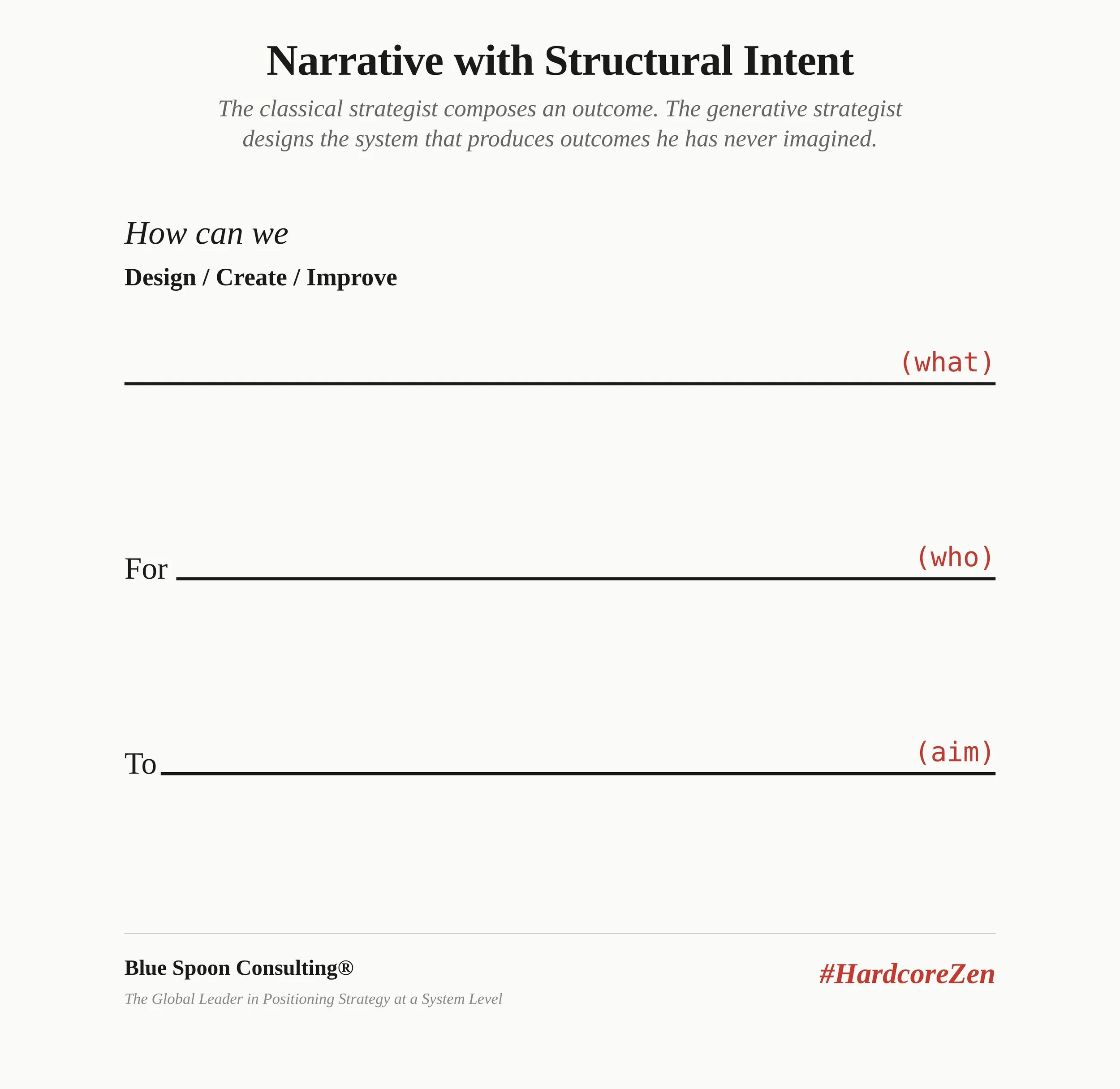
Most institutions can fill in all three. Almost none can fill them with words that carry structural force, words that organize action, that survive contact with the market, that hold up when the money moves and the competitors adapt. They fill them with dead language, mission statements, talking points, aspirational fog. A generative strategy goes further. It asks: What system, operating within what constraints, will produce adaptive answers to those three questions across time, under conditions we cannot predict? That is where positioning becomes narrative, and narrative becomes the operating system for everything that follows.
This is the work Blue Spoon calls Hardcore Zen, the craft of designing generative systems for organizations that have run out of classical compositions to play.
The tool is never the strategy. The system that receives the tool is the strategy. Ninety-five percent of enterprise AI pilots fail because they never understood the difference. They bought the instrument and called it a composition.
The ones who keep composing classically will go on winning every engagement in wars they have already lost, building machines of extraordinary precision for purposes they never named.
The questions were always there. They do not disappear because no one asked them. They simply go unanswered, at a cost that compounds, until the only strategy left is explaining why there never was one.
/ jgs
John G. Singer is the founder and Executive Director of Blue Spoon and the author of When Burning Man Comes to Washington: A Field Manual for Riding Chaos. Hardcore Zen is published weekly on Substack.