
Who Gets to Set the Terms of the Age?

OpenAI published 'Industrial Policy for the Intelligence Age' on April 7, 2026 — a fourteen-page document proposing a public wealth fund, AI rights, and worker protections for the intelligence economy.
There is a particular kind of document American companies have learned to produce in the last twenty years, and it is neither a white paper nor a manifesto but something lodged, carefully, between the two. It has the length of a policy brief and the ambition of a political pamphlet. It is written in the first person plural and signed by no one in particular. It arrives at your inbox looking like a conversation starter and turns out, on second reading, to be the opening statement of a negotiation the other side did not know had begun.
The cover usually says something disarming. Let's Talk, for example.
That is the phrase on the cover of Industrial Policy for the Intelligence Age: Ideas to Keep People First, published by OpenAI earlier this month. Fourteen pages, no footnotes, no individual author, no methods section, no data. The word conversation appears six times. The word ideas appears eight times. The closing section is titled Starting the Conversation.
The text proposes, though propose is too hard a verb for the register, a Public Wealth Fund that would give every American citizen an equity stake in the growth of artificial intelligence. It proposes a Right to AI on the model of literacy and electricity. It proposes worker voice in deployment decisions, portable benefits, efficiency dividends, mission-aligned corporate governance, and auditing regimes for the most capable models. Many of the proposals are good. Some of them are excellent. All of them are offered — the word the document prefers — as initial and exploratory, a starting point for discussion, a set of first thoughts the authors invite others to build on, refine, challenge, or choose among.
Read it once and the tone is generous. Read it twice and the tone is the point.
A document that insists this hard on its own tentativeness is doing rhetorical work. What the document is asking for, beneath the softened verbs, is a seat at the table where the social contract for the intelligence age gets written. What the document is assuming, beneath the invitations, is that there is already such a table, that it belongs to the people who built the technology, and that the rest of us have been invited to join a conversation whose terms of reference have already been set by the authors of the invitation.
This is a move with very few precedents in American life.
Companies write white papers. Companies lobby. Companies testify. Companies do not, as a rule, publish the social contract. The closest analogies are the moments when a railroad baron or an oil man or an automaker grew large enough to believe that the country's future and the company's future were the same sentence, and in each of those cases the country eventually disagreed. The question worth asking when a document of this kind arrives is not whether its proposals are good. The question is whether the author is in a position to make them — whether the invitation comes from somewhere the rest of us should agree to take seriously as the source of our terms.
The same day OpenAI published its document, Ronan Farrow and Andrew Marantz published an investigation in The New Yorker titled Sam Altman May Control Our Future — Can He Be Trusted?
The piece draws on memos compiled by Ilya Sutskever and Dario Amodei, the two men most responsible for the technology that made the Industrial Policy document possible, before they left OpenAI to build elsewhere. The memos, Farrow and Marantz write, amount to an accumulation of alleged deceptions and manipulations. One of them opens with a list under the heading Sam exhibits a consistent pattern of. The first item on the list is lying. An OpenAI board member, quoted in the piece, describes Altman as unconstrained by truth, a man who combines a powerful need to be liked in every interaction with what the board member calls an almost sociopathic indifference to the consequences of deceiving the people who like him.
Two documents. One day. One is a social contract for the age, offered in the register of the friendliest possible invitation. The other is the researchers who built the age saying, in writing, that the man behind the invitation cannot be trusted with a social contract.
What Alaska Knew in 1976
The proper response to a document that arrives with this much weight is to ask where its argument actually comes from and whether the argument is strong enough to survive detachment from its author.
OpenAI's Industrial Policy for the Intelligence Age is, at its core, a proposal to apply a sovereign wealth logic to a new extractive boom. That logic is fifty years old. It belongs to Alaska. It has worked, modestly and unromantically, since 1976, and it works because the state of Alaska took the position — before the extraction began — that the asset under the ground belonged to the people who lived on top of it, and that the people who lived on top of it should therefore hold equity in its extraction through a vehicle administered in public trust.
The Alaska Permanent Fund is not a beautiful idea. It is a workable one, which is a rarer thing, and its workability is the entire reason anybody is still talking about it half a century later.
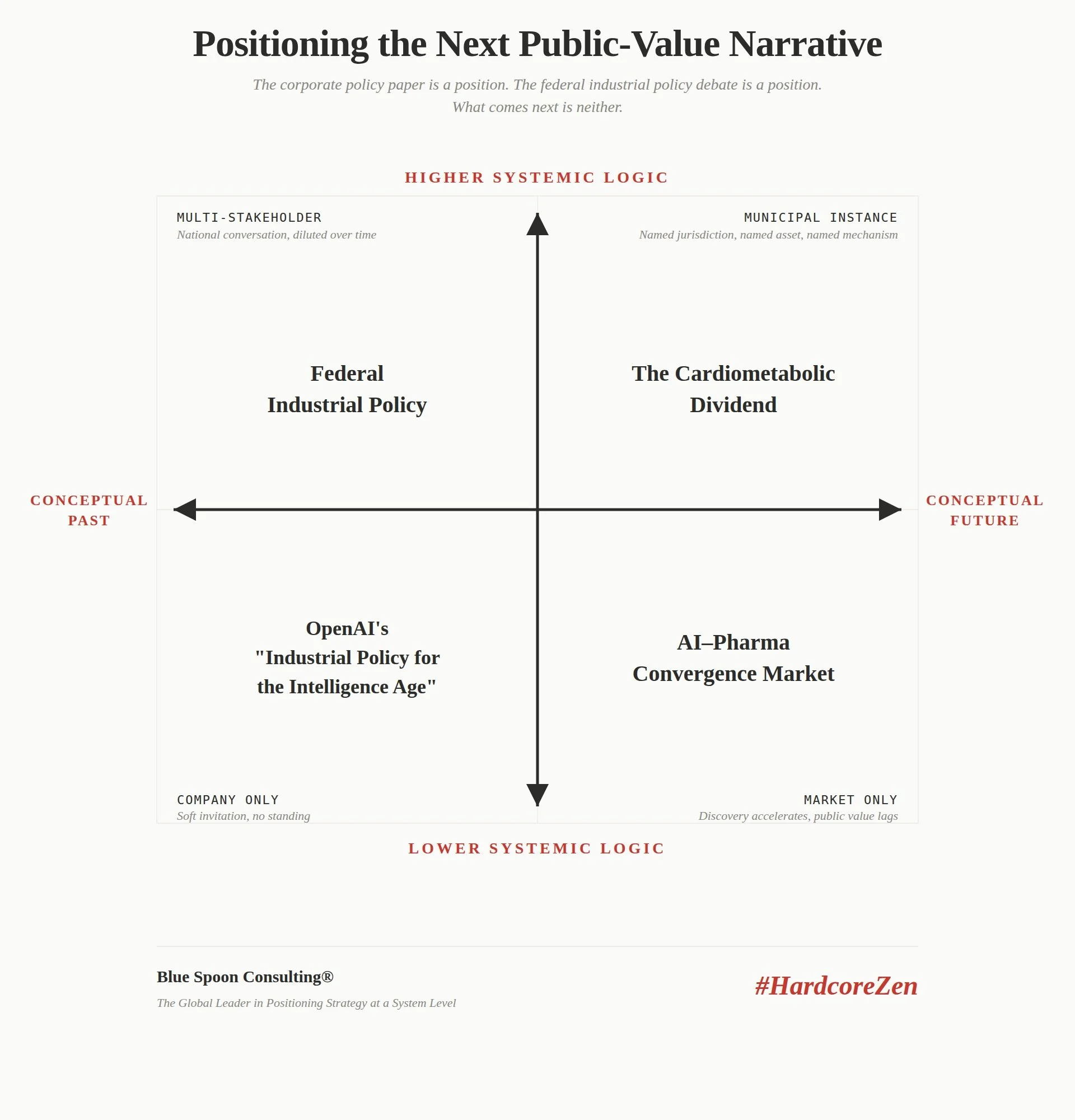
What OpenAI's document proposes is that the United States government construct something on this model for the intelligence age. The proposal is made at the federal altitude, in the conditional mood, and with the language — initial and exploratory, a "first contribution" for discussion — of a text that knows it will not be implemented in the form it is offered. This is not an accusation. It is a description. Industrial Policy for the Intelligence Age is a conversation starter. It is written to be read, cited, and eventually diluted into whatever Congress can be brought to do, which is usually less than was asked for and later than was needed. The authors know this. Everybody who writes at the federal altitude in Washington knows this. The document is working on a timescale that begins after the next election and ends, if the argument is lucky, sometime in the 2030s.
There is another way to do this. It does not require an act of Congress. It does not require a conversation. It requires a city that understands three things at once: that its citizens are the asset; that the biological data those citizens generate has the potential to be a civic endowment, a new asset class on the balance sheet of the city, a durable return stream to the residents who produce it; and that a city can position itself as the gravitational center of a pharmaceutical-as-healthcare market that is already looking for somewhere new to organize itself.
Anthropic appointed Vas Narasimhan, the CEO of Novartis, to its board last week. The move reflects two things at once: Anthropic strengthening its governance as it eyes an initial public offering as soon as this year, and its expanding enterprise push into healthcare and life sciences. The convergence of AI and pharma is no longer speculative. It is happening at both the drug-discovery layer and the governance layer, and it is happening now.
But discovery is not the bottleneck.
Discovery is already producing targets faster than the system can absorb them, and AI accelerates the production of targets further.
The drug industry pipeline now generates more candidates than the existing distribution architecture can move into the population, and the gap between what is being discovered and what is reaching patients is widening every quarter. Discovery has stopped being the hard problem. Distribution has become it. The hard part is the architecture that turns a molecule into a therapy, a therapy into a standard of care, a standard of care into a public good, and a public good into measurable improvement in the health of a population.
What is missing is the third party at the table to complete this new ecosystem story, the innovation diffusion layer, the production of public value layer.
The city is the enterprise the moment is waiting for — the convener with the standing to assemble the value architecture across the data, the market, the AI layer now being built on top of both, and the population that produces the biology underneath all of it.
A tax revolt is under way in America.
Republicans want to cut taxes by hitting foreigners with tariffs. Democrats want to cut taxes by squeezing the richest few. Senators Cory Booker and Chris Van Hollen have each introduced plans that would eliminate federal income tax for tens of millions of Americans. Statehouses are following. Florida is flirting with abolishing non-school property taxes. California is mulling a one-time wealth tax on billionaires. The share of Americans who believe the taxes they pay are fair is near the lowest on record.
The mood is not partisan. It is national, it is structural, and it is the mood of a country that has concluded, rightly or wrongly, that the existing fiscal machinery no longer works.
You cannot cut your way to growth. You cannot tariff your way to growth. You cannot tax empty apartments your way to growth.
Mariana Mazzucato, the economist at University College London who has spent the last twenty years building the intellectual case for state-led market design, has been making the underlying argument throughout: when the state takes risks the market will not take, and the bets pay off, the state should own a share of the upside. Her forthcoming book The Common Good Economy names the principle directly — reciprocity in place of extraction. Reciprocity is what the Alaska Permanent Fund institutionalized in 1976. It is what a city now has the standing to apply to a new asset class in a new jurisdiction.
New York City as an Asset Class: The Cardiometabolic Dividend
In March Blue Spoon published a four-part strategic essay series called The Cardiac Borough, culminating in a piece called The Cardiometabolic Dividend.
The series argues that New York City should position itself as an enterprise customer and equity stakeholder in a biological data economy, on the explicit model of the Alaska Permanent Fund, and that the asset it should take an equity position in is the cardiometabolic and biological data produced by its own population across its own institutions. The argument has a named jurisdiction, a named asset class, a named precedent, and a named mechanism. It does not wait for the federal government to move. It does not need to.
New York sits on top of the densest concentration of cardiometabolic and biological data in the world. Eight and a half million people. Eleven academic medical centers. A Medicaid program that touches one in three residents. A public hospital system, a surveillance apparatus inside the Department of Health and Mental Hygiene, an EMS record that captures the acute end of the metabolic curve in real time. The data is fragmented across those custodies under different governance regimes and markets, and the fragmentation is the problem the Dividend is proposing to solve.
The Founders understood this.
Benjamin Franklin founded the first public hospital in 1751 and the first medical school in 1765. George Washington ordered the first state-sponsored immunization campaign in American history to save the Continental Army from smallpox. Thomas Jefferson vaccinated his family at Monticello and then used the presidency to push the vaccine south and west, container by container, letter by letter. James Madison signed the Vaccine Act of 1813. John Adams signed the Marine Hospital Service into law. The American state was building public health infrastructure before it had finished building itself, because the Founders understood that a nation is its population, and a population that cannot be kept alive cannot be governed, cannot be taxed, cannot be counted, cannot produce.
Public health was not charity. It was the precondition of the republic.
The recombination of its health holdings — under public trust, on terms the municipality sets, with equity flowing back to the population that produces the underlying biology and enables new markets, new products, new therapeutics — is work one of the largest urban economies in the world has both the standing and the obligation to do. The Bronx is not a tragedy. The Bronx is a latent asset class. The question is whether the city recognizes itself as the rightful assembler of the asset or continues to let the fragments deepen and be mined separately, at zero cost, by enterprises headquartered three thousand miles away whose own researchers are now on the record questioning the fitness of their own chief executive to steward the technology that is doing the mining.

This is not hypothetical. It is operational. It is written down.
The Cardiometabolic Dividend is a different kind of instrument. It is not a tax. It is not a cut. It is the assembly of an asset the city already produces but does not yet recognize itself as owning, and the convening of an industry that is already moving toward the city and does not yet have a counterparty with the standing to meet it. It is the instrument the city has not yet reached for, and it is the only one on the table that is additive rather than subtractive.
The pharmaceutical industry spent roughly $250 billion on R&D last year. A municipality that holds equity in the data underpinning the next decade of cardiometabolic discovery does not need to capture a large share of that spend to fund its public health system in perpetuity.
Why OpenAI Can't Write the Social Contract — and Cities Can
The New Yorker piece, read alongside all of this, is not a scandal story.
It is a governance story, and its governance lesson is the oldest lesson in the book: legitimacy does not come from the person who claims it, and it cannot be manufactured in a document, however generous the document may be. Legitimacy comes from the institution that already holds it by virtue of the consent of the governed, and the work of strategy — the actual work, the work beneath the positioning and the slide decks and the fourteen-page PDFs — is the work of identifying the keystone partners and building downstream from them.
In 2022 and 2023, Farrow and Marantz report, Altman publicly welcomed AI regulation while his company privately lobbied to dilute the European Union AI Act. In 2024, after congressional testimony in which Altman called for exactly the kind of safety testing that California's SB 1047 would have required, OpenAI publicly opposed the bill and, according to the New Yorker's reporting, began issuing threats in private. The pattern is not incidental. It is the signature of an institution that believes it is writing the contract under which the rest of us live, and that believes the contract is subject to revision by the author whenever the author's interests change.
This is not a failure of character. It is a failure of location.
OpenAI is in the wrong position to write the social contract for intelligence because it is not the institution that holds the legitimacy to write it, and no amount of generosity in the document can substitute for standing in the thing.
A city has standing. A city has a comptroller whose job is to say no. A city has a public hearing requirement. A city has regular elections in which the people who live inside the asset class get to vote on whether the people administering it are doing it correctly. A city cannot publicly welcome one thing and privately lobby against it because a city's lobbying record is the public record.
This is not an argument that cities are morally superior to technology companies. It is an argument that cities occupy a position technology companies cannot occupy no matter what they write in their policy papers, and that the correct altitude for the Public Wealth Fund logic is therefore not the federal government but the municipality, and the correct asset class is not the abstract upside of AI-driven growth but a specific, named, generative biological asset that the city already produces and is currently giving away.
Who Writes the Story of the Intelligence Age?
The Cardiometabolic Dividend is in the world right now. It is at bluespoonconsulting.com/cardiac-borough, and it does the work OpenAI's document declines to do: names the jurisdiction, names the asset class, names the convening authority, names the distribution mechanism, and shows, in four parts and in operational detail, how the instrument is actually assembled.
It is not a white paper. It is not a manifesto. It is not fourteen pages of conditional verbs and soft invitations. It is a working framework for strategy to stand up a new industry ecosystem, a municipal instance of the Public Wealth Fund floated by OpenAI, but offered from the layer where execution actually lives, to a city that already sits on top of the asset.
The Cardiometabolic Dividend was submitted this week to OpenAI's industrial policy process, in the spirit of offering a more robust frame than the one the document itself proposes.
The question is not whether OpenAI should be trusted to write the social contract for the intelligence age. The question is why anyone thinks the social contract for the intelligence age is OpenAI's to write in the first place.
It is not.
The social contract for the intelligence age belongs to the institutions that hold the consent of the governed, that sit on top of the asset classes the intelligence is being built to mine, and that have the standing to convene the industries now circling those assets. It belongs to municipalities. It belongs to comptrollers. It belongs to public health departments. It belongs to Medicaid programs. It belongs to the eight and a half million people who live inside the Cardiac Borough and who produce, every day, the biological substrate of the next healthcare economy.
Franklin did not invent inoculation. He named it a public good and moved the country toward it. Washington did not invent the immunization campaign. He ordered it and made the Continental Army the proof. Jefferson did not invent the vaccine. He picked up a container, a letter, a presidency, and turned the vaccine into policy. In each case the work was not the discovery. The work was the framing of the discovery into something a nation could organize itself around.
If Industrial Policy for the Intelligence Age was the opening statement of a negotiation the other side did not know had begun, the Cardiometabolic Dividend is the other side beginning to answer.
Markets do not run on code. Markets run on stories. The company that writes the story writes the market. The jurisdiction that writes the story writes the economy. The leader who writes the story writes the age.
/ jgs
John G. Singer is the founder and Executive Director of Blue Spoon and the author of When Burning Man Comes to Washington: A Field Manual for Riding Chaos. Hardcore Zen is published weekly on Substack.