

How Trump Ranks in the Burning Man Index™
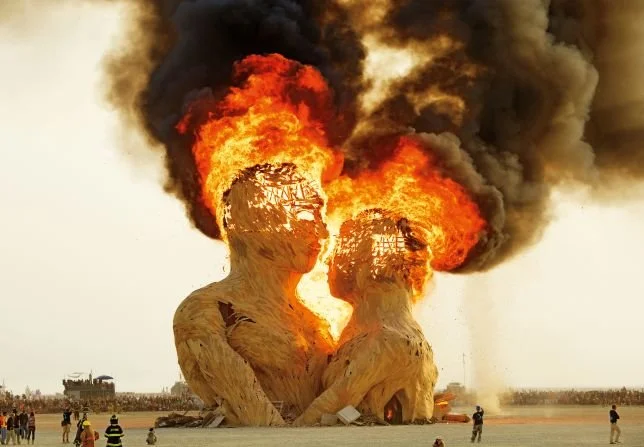
There is a moment in every system’s life when the old instruments stop working. The compass needle spins. The altimeter reads altitude while the plane is underground. The consultants pull out their 2x2 matrices and discover that both axes have collapsed into the same dimension, which is to say the dimension of pure, ungovernable chaos.
And the matrices, those trusty little squares that organized the thinking of every MBA Whiz Kid taught by practically every business school in the world, reveal themselves for what they are: ghost frameworks, mute as gravestones.
We are in such a moment.
And if you want to understand what that moment looks like, not abstractly, not in the polite euphemisms of McKinsey decks and Gartner quadrants, but in its full, operatic, terrifyingly concrete reality, you need an instrument built for fire, not forecast. The Burning Man Index™, Blue Spoon’s quarterly measure of how close a brand or institution stands to system collapse, has a clear answer. And the highest-scoring entity in American public life is the forty-seventh President of the United States.
What the Index Measures
The Burning Man Index was not built to be clever.
It was built because the Standard Model frameworks for assessing organizational and brand health have a fatal blind spot: they can’t describe what happens when a system’s proximity to collapse becomes its defining operating condition, when fragility isn’t the failure mode, it’s the environment.
Walter Kiechel, in The Lords of Strategy, gave a name to the slow-motion failure conventional strategy methods have never been able to arrest: “systemic performance declines”.
This is not about a bad quarter, nor a fixable execution gap, but a slow, distributed loss of capability across the whole machine — talent, trust, incentives, capital discipline, narrative coherence — until an organization is “working” yet still getting worse. And once decline becomes systemic, you don’t “optimize” your way back; you have to change the coordinate system. You need an exit.
Standard Model strategy assumes companies live on a spectrum from stability to crisis, and leadership’s job is to nudge the needle toward stability. The 2x2 growth matrix has been the strategy world’s load-bearing wall since 1970. High growth, low growth, high share, low share. It assumes a stable frame of reference. It assumes the ground isn’t moving.
Stuart Kauffman, the complexity theorist whose work on self-organization informs Hardcore Zen, would put it differently. In Kauffman’s framework, living systems (i.e., life itself) exist at the edge of chaos, that narrow band between frozen order and total disorder where complexity, adaptation, and innovation are maximized.

Too much order and the system dies of rigidity. Too much chaos and it dissolves into noise. The sweet spot is the edge, where a system is organized enough to function and disordered enough to adapt.
The Burning Man Index operationalizes this insight for the world of brands, organizations, and ecosystems. It asks a deceptively simple question: How close is this entity to the point where controlled adaptation tips over into uncontrolled collapse? And, critically: Is the brand approaching that edge intentionally — brands like Amazon, NVIDIA and China, that understand how to navigate complexity with creativity — or is it being swept toward it by forces it can neither understand nor manage, brands like Germany, now trying to decouple its economy from China, and Express Scripts, its business model a ‘dead man walking’?
For the pharmaceutical industry, the healthcare ecosystem, the digital health landscape, the arenas where Blue Spoon lives and works, this question has never been more urgent.
Consider Moderna, which currently scores a 38 on the Burning Man Index. From $18 billion in pandemic revenue and a $450 stock price to $1.9 billion, $2.8 billion in losses, and a stock that has shed over 90% of its value. A week ago the FDA refused to file the company’s billion-dollar mRNA flu vaccine, then reversed course a few days later. Meanwhile, seven states have moved to ban mRNA technology entirely. RFK Jr.’s HHS has replaced the CDC’s vaccine advisory committee with skeptics and cut the childhood immunization schedule from 17 shots to 11. The NIH is telling researchers to scrub “mRNA” from grant applications. Parental vaccine hesitancy has nearly doubled. And Moderna’s cancer vaccine just showed a 49% reduction in melanoma recurrence.
A score of 38 captures what no conventional framework can: a company whose core platform is simultaneously under existential political attack and producing some of the most important clinical data in a generation.
But Moderna’s score is not the most interesting number on the board right now.
Donald J. Trump: An Index Score of 91
Let us be precise about what it means to give Trump a Burning Man Index score of 91 out of 100.
Moderna, a company whose core technology is under political siege and clinical vindication, scores a 38. Trump scores nearly two and a half times higher. Not because he is failing. The Index is not a report card. A high score can indicate either that a system is approaching catastrophic collapse or that it is operating at the very edge of chaos where maximum transformation is possible. A 91 means you are right at the threshold. One degree cooler and you have revolutionary adaptation. One degree hotter and the whole thing comes apart.
What makes Trump’s score so extraordinary is not the number itself but the mechanism by which he achieves it. Amazon scores high on the Index too, but Amazon’s proximity to system stress is a byproduct of relentless ecosystem expansion; Amazon pushes boundaries because it is building a $700 billion-a-year self-generating economy. Trump’s proximity to collapse is the product itself. He is not disrupting the system on the way to somewhere. The disruption is the destination.
Trump’s entire political brand is built on accelerating system stress, not avoiding it. He doesn’t just tolerate proximity to collapse, he courts it as a strategy. The government shutdowns, the tariff brinkmanship, the institutional norm-breaking: these are features, not bugs. In Burning Man Index terms, he scores extremely high on proximity to collapse, but with an unusual twist. He instrumentalizes that proximity rather than being a passive victim of it.
Consider the record since January 2025.
He signed 26 executive orders on his first day, the most in presidential history. He installed the Department of Government Efficiency under Elon Musk, which proceeded to eliminate entire federal agencies — USAID, the Corporation for Public Broadcasting, much of the Department of Education — while firing or displacing over 300,000 federal workers, a 9% reduction in the civilian workforce. The Energy Department laid off engineers who maintained nuclear weapons before scrambling to rehire them. Veterans Affairs had to bring back staff from the Veterans Crisis Line. A neonatologist who oversaw infant formula quality was fired and then reinstated. NASA scientists were cut. FEMA’s urban search-and-rescue teams were delayed 72 hours during the Kerrville floods because of new bureaucratic requirements imposed from the top.
Then there were the tariffs.
The Supreme Court struck down his signature IEEPA tariffs this month, ruling 6-3 that the President had exceeded his authority. Trump responded by calling the justices “fools and lapdogs,” then immediately signed a new executive order under a different legal authority to reimpose tariffs at 10%, threatening to raise them to 15%. Manufacturing jobs contracted by 108,000 in 2025. Total job creation collapsed from 2.2 million in 2024 to 181,000. The trade deficit didn’t budge.
His approval rating as of this writing sits at roughly 36-39%, with a net approval of approximately -15, approaching his all-time second-term low. Among independents, it’s 26%, the lowest of either term. Strong approval among his own Republicans has dropped from 64% to 49%. Almost 70% of Americans predict 2026 will be a year of economic difficulty.
A conventional strategist looks at these data points and sees a political brand in crisis. A conventional 2x2 matrix says: low approval + high disapproval equals positioning in a quadrant of failure.
But that framework is wrong.
This is where it gets interesting through a systems lens. Trump’s movement has remarkable emergent, self-organizing properties: the MAGA ecosystem generates its own content, enforcement mechanisms, loyalty structures, and adaptive responses without centralized coordination. But Trump himself operates as a strange attractor that constrains the system’s degrees of freedom. He demands loyalty convergence rather than letting the system explore the adjacent possible. So you get self-organization in service of rigidity, a system that’s highly adaptive tactically but increasingly brittle structurally.
Here is the thing ghost frameworks cannot process: Trump is not being dragged toward the edge of chaos. He’s turning collapse-risk into a deliberate instrument of leverage. He manufactures instability as a positioning strategy. Every institution he touches — the federal bureaucracy, the judiciary, the healthcare system, trade relationships, NATO, the tax code — gets pushed closer to its own collapse threshold. And in the smoke and confusion that follows, he positions himself as the only entity with the will and the shamelessness to operate in the burning zone.
In a self-organizing systems, entities that can tolerate the most disorder and complexity have a structural advantage (think UnitedHealthcare). And depending on how creative and ambitious its leaders, they can explore more of the “adjacent possible”, Kauffman’s term for the space of opportunities that opens up when existing structures destabilize, or when markets are combined in strategically imaginative ways (think Merck + Verizon). While everyone else is scrambling to restore the old order, the high-disorder-tolerance entity is already colonizing new territory.
Trump’s genius, and I use the word clinically, without admiration, is that he has an almost unlimited tolerance for disorder.
The government shutdown that broke records in October 2025? He used it to push through more layoffs. The Supreme Court striking down his tariffs? Within hours he’d found another statute. DOGE claiming $214 billion in savings while independent analyses suggested the cuts actually cost taxpayers $135 billion? The factual discrepancy is, from a systems perspective, irrelevant to the strategy. The point was never the savings. The point was the destabilization.
Navigating the Burn
The Burning Man Index was not designed to generate despair. It was designed to generate clarity.
When Kauffman described systems at the edge of chaos, he was not describing a death sentence. He was describing the conditions under which innovation, adaptation, and genuine transformation become possible. The edge of chaos is where new species emerge. It is where markets are reborn. It is where the organizations that understand the dynamics of self-organization (i.e., Amazon) can find opportunities that are invisible to those (e.g., The Democratic Party, with a score of 18 on the Burning Man Index) still clutching their ghost frameworks, the matrices first conceptualized in the 1970s.
But navigating the edge requires something the old strategy frameworks do not teach: the ability to hold paradox. To understand that the same forces creating destruction are also creating possibility. To see that the man scoring a 91 on the Index is simultaneously the system’s greatest threat and, precisely because of the disruption he generates, the system’s greatest catalyst for overdue change.
The healthcare coverage crisis may finally generate the political will for structural innovation that decades of incrementalism could not. The pharmaceutical industry’s tariff exposure may accelerate reshoring and displacing Big PBMs, something that strategists have talked about for years without acting.
None of this is guaranteed. That’s the point.
At the edge of chaos, outcomes are nonlinear. Small actions can have enormous consequences. The right positioning decision made now can be the difference between transformation and collapse.
The old tools will tell you to find the quadrant of safety. The Burning Man Index tells you there is no quadrant of safety. There is only the edge, and your willingness to navigate it with open eyes.
The man in the Oval Office understands this better than most.
/ jgs
John G. Singer is the executive director of Blue Spoon, the global leader in positioning strategy at a system level. Blue Spoon works with organizations to design new market narratives and exit strategies from collapsing systems.
He is the author of When Burning Man Comes to Washington: A Field Manual for Riding Chaos, which introduces Hardcore Zen, a unique method for leading system-level change. His latest work, The Burning Man Index™, scores 27 institutions on their proximity to narrative collapse — the moment an organization’s story stops matching the world it operates in.
To explore a Hardcore Zen whiteboard or arrange a guest lecture, email here.