

When Everyone Builds the Same Company

Anthropic's revenue is set to more than double to $10.9 billion this quarter, its first operating profit. The model is selling at its peak. Which is exactly what the top of the slope looks like.
Two laws of nature hold the universe together. Nothing travels faster than light. And everything runs down over time toward an end state of absolute uniformity, the condition physicists call heat death.
The name misleads. Heat death is not hot. It is the moment heat has spread so evenly that no corner of the universe is warmer than any other, every gradient gone, every difference dissolved into a thin cold sameness, the perfectly predictable, the state from which nothing surprising can come again. And difference is the only thing that ever lets anything happen. A gradient — hot beside cold, dense beside empty, rare beside common — is what powers work, what you build structure on, what life runs on.
Erase the differences and there's no energy left to draw on, no structure can hold. Order decays. Difference dissolves. Left alone, every system drifts toward the average and stops.
Technology is the great accelerant of the second law. It takes whatever is rare and drives it toward common. The clearest case is the one where the stakes are life and death and the budgets are bottomless: war. On that ground the leveling is called transparency. In The Dangerous Delusion of Modern Warfare, The Economist's departing defense editor calls this new transparency, after eight years on the beat, "warfare's defining technological trend" — the ground going legible, sensors and cheap drones and networks turning every hiding place into a lit stage. Once everyone can see everyone, the edge that came from being scarce, hidden, exquisite, dissolves. The field goes flat because the field goes transparent.
And the running-down now happens at light speed.
The Turkish TB2 drone ruled the opening of the Ukraine war until Russia's jammers took its measure, and the edge was gone in months. America's Excalibur, a GPS-guided artillery shell, hit seven targets in ten. Then Russia learned to jam it, and inside a few months it hit almost nothing — six in a hundred. New generations of weapon rise and fall without the front line moving more than a few meters. Whatever you build, the field absorbs it and flattens it before it reaches the front. A frontier model is matched in a quarter. A drone is countered in a week. Innovation does not hold, because innovation is an artifact, and every artifact is on the slope, sliding toward common, faster every year.
The advantage is never in the artifact. It lives in the system that wields the artifact best — and crediting the weapon for what belongs to the system has fooled military minds before, and could fool them again.
Christian Brose says the same thing in the present tense. He runs strategy as president of Anduril, the defense company named for a reforged sword, and last week he sat for a long Times interview to describe a war the country is sleeping through. The edge, he says, does not live in the weapon. It lives in the institution that learns and re-fields faster than the other side can adapt. Anduril owns three hundred and thirty thousand acres of test range, in locations it won't disclose, and breaks its own drones every day, on its own money, because the standing asset is the learning loop and the drone is the consumable. "There's no points for being autonomous," he says. "There's points for being effective."
The autonomy is a means. The artifact is a means. What wins is no longer the platform but the cycle that replaces it — the side that learns and re-fields fastest, not the side with the best weapon. The war reorganized around the loop, not the machine.
Blue Spoon built the framework that maps the split. The field of strategy — the people paid to build durable advantage — has stampeded to one side, the side where the artifact lives, and left the other empty. The Last Magic Quadrant, introduced in this year's ISPOR closing keynote, maps innovation against management on two axes, and one corner sits vacant: the upper right, frontier management, the altitude where you decide what a system is for. The technical artifacts of frontier innovation crowd the lower corners, where the building happens, where everything runs down at the speed of light. The corner that compounds stays vacant.
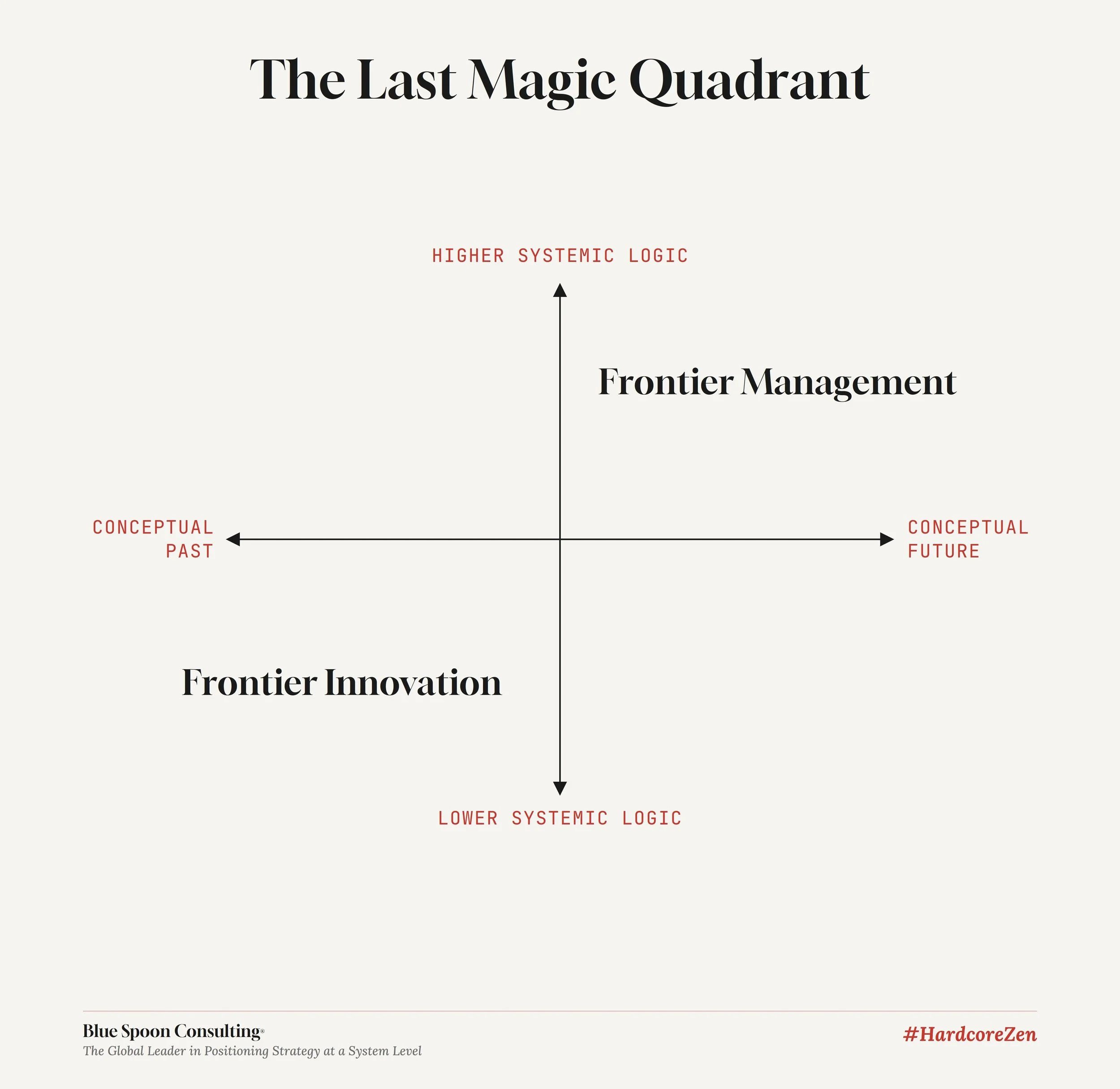
Frontier innovation builds the exquisite object — the best model, the best drone, the best molecule — and crowds the lower corners, where everything runs down. Frontier management does the opposite.
The universe's default is sameness, because there are vastly more ways to be disordered than ordered. Spill a deck of cards and it lands in a mess, never a stack. The stack is improbable, and it stays a stack only because a hand holds it there. A frame is the hand: the skill of deciding what the system is for and holding that shape against the field's pull toward the average, the same skill Brose names when the learning loop is the asset and the artifact is the consumable.
Drop the hand and the pull takes over. In war it shows up as targeting standing in for strategy.
The Perpetual Pummel: From Maven's 5,000 Daily Targets to CVS's Formulary
Today the American targeting system Maven, fused with models like Anthropic's Claude or France's Mistral, is reckoned to push toward five thousand targets a day, a number one officer conceded is past what a human can manage. More targets is not a plan. The fantasy of the knock-out blow curdles into what The Economist's defense editor calls the "perpetual pummel" — more strikes, then more again, throughput sold as victory.
The same rules of nature govern the most embedded economic system in the country: the drug market.
In the United States, a pharmacy benefit manager sits in the channel between drugmaker and patient and decides which medicine reaches the counter. For most of a year CVS Caremark steered patients off Eli Lilly's Zepbound toward a cheaper rival; this month it reversed course, after the price came down, and made Zepbound and Novo's Wegovy co-preferred on the same formulary. Equal footing. One of those drugs is more effective and treats conditions the other cannot. The formulary flattens that difference to nothing — two molecules, each the product of billions in research, pulled down to interchangeable line items priced against each other, because the system that owns the gate runs everything through it toward the average.
That is the thin cold sameness, and it is also a form of gravity. An embedded economic system bends every player toward its center, and the player at the center sets the terms. Lilly won its place back the only way the system allows, by cutting the price, by feeding the flattening. The exit is the other thing it is doing: selling to employers directly. Not a cheaper molecule but a different gradient, terms it sets for itself instead of terms set for it.
Feeding the flattening is the small version of the mistake. The large version cost eleven and a half billion dollars and arrived in May, when two companies built the identical business in a single month and each called it strategy. Strategy was the one thing neither of them built.
Anthropic moved first, a billion and a half from Blackstone, Goldman, and Hellman & Friedman into a new services company. OpenAI answered at seven times the size, ten billion dollars and a hundred and fifty engineers walked in the door. The two ventures, the same enterprise target and the same Palantir-derived embed, were the subject of McKinsey vs. McKinsey, Blue Spoon's essay which mapped how two rivals invented the identical company in a single month.
What they built was not a consulting business. It was an instrument for dissolving the wall around the enterprise — the Forward Deployed Engineer planted inside the client until lab and customer run as one body, the Blackstone and Goldman money fusing the lab to its capital. One enterprise opening itself to take in another until the two interoperate as a single organism, the move at the heart of ecosystem strategy. But it is only the weave, only the build, the perpetual pummel in a suit.
So the eleven and a half billion is a confession.
It says, in the language a balance sheet speaks, that the model alone does not hold its value, that the value was always in deciding what the model is for inside one specific business. The labs found the demand for that work and then staffed it with the one input that cannot scale to meet it: the embed costs as much as eight hundred thousand dollars a year and pencils only at seven-figure contracts, and the hundredth job costs what the first one did. They commoditized the model, stacked a second commodity on top, and went to war over who builds the better object in a market that already went flat.
The model business is booming, which is the part that fools everyone.
Anthropic's revenue is set to more than double to $10.9 billion in a single quarter, its first operating profit. The trouble is durability. Reuters called it "dangerous" to assume, and the cracks already show: Uber burned its full-year AI budget by April, Amazon pulled an internal leaderboard that was driving up usage, and Microsoft is backing off Claude Code as token costs outrun what the work is worth. The pricing and margin structure is not worked out, and there is no network effect to hold the ground once the next model lands. The boom is not evidence against the slide. It is what the top of the slope looks like, the fullest the gradient ever gets, and the gradient only discharges from there.
The deeper tell is in who keeps the money. Palantir, whose embed both labs copied, runs operating margins near sixty percent, because Palantir sells the frame and the labs sell the hours. TSMC builds the chip inside every device on earth and takes a small slice of what those devices earn, because the value was always up the stack, in the hands that decide what the silicon is for. A foundation model is the same shape of asset: enormous, essential, and unable to presume it controls what anyone does with it.
Frontier Management: The One Corner That Doesn't Slide Toward Sameness
Two laws of nature hold the universe together. Nothing moves faster than light, and everything runs down to sameness. The labs just proved what happens when the two meet: the running-down arrives at light speed. The model goes flat in a quarter, the drone in a week. There is no knock-out blow on a transparent field. There is only the pummel, and the slide toward everything looking the same.
The one thing that does not slide is the improbable, the conceptual architecture, the frontier management positioned to hold its order while the field flattens around it. The departure from the expected can be plotted and built on purpose. Blue Spoon's Narrative Surprise Curve measures it: a story holds in exact proportion to how far it breaks from the average the room walked in expecting.
Peter Checkland spent fifty years on the distinction underneath all of this.
The British management scientist, who developed soft systems methodology at Lancaster University and died last month at ninety-five, separated hard systems, where you engineer the efficient path to a fixed goal, from soft systems, where the goal itself is contested and the worldview is the substance. His argument: "human activity systems do not exist, only perceptions of them exist, perceptions which are associated with specific worldviews." The system is not in the world. It is in the point of view you bring to it.
The artifact sits on the field, copyable, sliding toward common. A point of view does not. A machine, built to find the average, cannot manufacture it.
Weeks before it stood up its services arm, Anthropic was working in the upper right of the Last Magic Quadrant when it told the Pentagon what its technology was not for, deciding the use, imposing a point of view on the tool. Then it built a consulting business and slid back down into frontier innovation, the lower corner where everyone fights over the better object.
The same company, both corners, inside a single month. Not a failure of nerve but a failure to reach escape velocity: the descent has not started yet only because the artifact is still selling at its peak. Anthropic's revenue is climbing. Which is the cruelty of the slope: it climbs hardest just before it gives way.
Markets do not run on code, and they do not run on the model. They run on the decision about what the model is for, the corner that compounds, the corner almost nothing escapes.
Gravity kills.
/ jgs
John G. Singer is the founder and Executive Director of Blue Spoon, the global leader in positioning strategy at a system level. Hardcore Zen is published weekly on Substack.
Blue Spoon runs the Working Whiteboard: ninety minutes with your leadership team. One session, one chart — your market as a system, objectives positioned strategically instead of operationally, original storylines of value. Inquire.