
Visa Goes to War Against a Copy of Itself
Dee Hock founded Visa nearly sixty years ago. His real invention wasn’t the card but the form of the organization behind it. Now the system he built is asking the United States government to tariff a copy of itself.
Dee Ward Hock was born in North Ogden, Utah, in 1929, the son of a utility lineman. He had a two-year degree from Weber College, then a junior college in Ogden, and seventeen unremarkable years in consumer finance to his name: branch manager, assistant manager of public relations, regional supervisor. By his family’s account he had essentially retired on the job — going through the motions, making happy-to-glad edits in documents that changed nothing, the kind of performance theater that fills a great many calendars today. In 1967 his bank put him in charge of its credit card operation.
The card was BankAmericard, launched by Bank of America in 1958 and franchised out to other banks, because in that era American banks were forbidden to open branches across state lines. It worked, and then it very nearly destroyed itself.
Rival banks launched competing cards and a mass-mailing orgy followed: preapproved plastic sent to any list a bank could buy, whether or not the recipient had asked for it or could pay. Children received cards. Pets received cards. Convicted felons received cards. There was no reliable way to authorize a purchase or clear a sales draft between two banks, and losses were mounting fast enough to threaten every network at once. In 1968 Bank of America gathered its licensees in Columbus, Ohio, to sort it out. The meeting collapsed into finger-pointing within hours.
Hock had already reached a conclusion that almost nobody else in the industry held. In Birth of the Chaordic Age (Berrett-Koehler, 1999), his account of how Visa was built, he described having long thought the term “bank credit card” was a misnomer and a marketing blunder — that the card’s real future was as “a global device for the exchange of value.”
Money, Hock decided, was no longer coin or paper or even a debt a bank recorded on its books; it had become nothing but guaranteed data, value in a form people had agreed to accept. And if money was only information, then the object in a customer’s wallet was not a lending product at all but a token in a system for moving that data anywhere on earth.
And a device for the exchange of value is infrastructure, and infrastructure has to work for everyone or it works for no one.
Hock was working out how to position a new system vision in his own mind. Once this zero story — the originating narrative from which the system unfolds — is positioned correctly, the innovation agenda becomes obvious and the opportunity enormous: an instrument that settles any transaction, in any currency, anywhere, around the clock. No organization able to run it existed. This was years before the computers and networks that could carry it did.
A System of Enterprises
Looking back, Hock was not forecasting capex for an enterprise. He was inventing space for computability for a system of enterprises: a place that could not exist without vastly more computation than the world then had. The zero story came first, at the level of the whole system, and the machinery was built afterward to fill the room it had opened.
So Hock built an organization that belonged to no one.
Handed a committee assignment out of that failed meeting in Columbus, he turned that narrow task into a new ownership structure entirely. In 1970 National BankAmericard Inc. came into being: nonstock, owned by its member banks through nontransferable rights of participation rather than shares anyone could buy or sell.
Bank of America gave up control of what it had created, letting go of the product to make room for the system.
This was an act of frontier management. The member banks competed ferociously for the same customers while honoring one another’s transactions under rules they wrote and owned together. Authority sat at the periphery. Nobody owned the middle. By 1976 it had one name, chosen because it read the same in every language: Visa.
Hock called that ownerless form of management chaordic — chaos and order at once, self-organizing rather than commanded. He liked to point out that Visa moved more than a trillion dollars a year and you could not buy a share of it. That held until 2008, when the association demutualized in what was then the largest public offering in American history, and its purpose narrowed from moving value to protecting the toll charged on it — a toll that now rides on more than $17 trillion in payments a year.
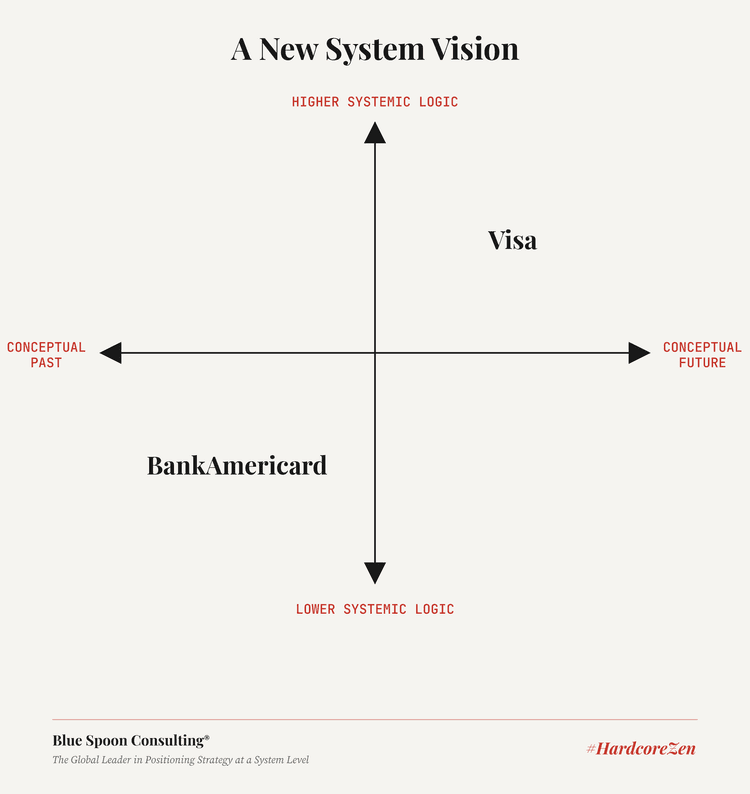
But the real power of Visa was never the card. Hock pioneered the assembly rules to design a new economic system, from scratch, and to birth a new organizational form that lets fierce competitors interoperate on rules none of them can rewrite alone. The cards were an application. The form was the thing. Hock, almost single-handedly, rerouted an industry.
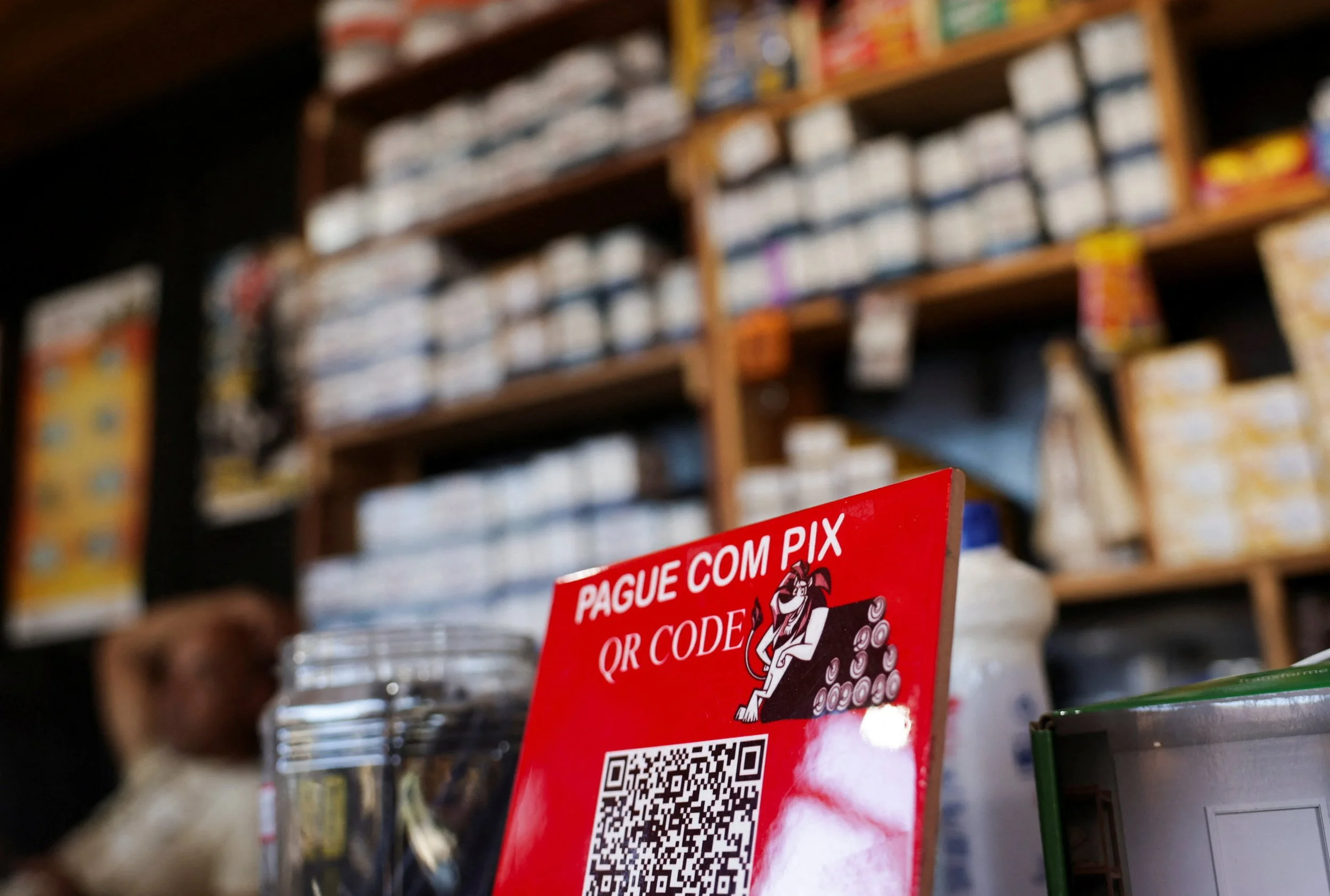
Last week the United States imposed a tariff aimed at Pix, Brazil’s instant-payment system, the free, central-bank-run rails that eight in ten Brazilians now use to move money in seconds. Pix is the same organism as Visa, rebuilt half a century later. Same purpose, same architecture, same norms, one material difference in who is the keystone: where Hock had a private cooperative, Brazil has a public central bank.
And the loudest voice for the tariff, the incumbent asking Washington to discipline a public device for the exchange of value, is the company Dee Hock built to be a private one.
More to the point, Visa has lobbied the United States government to punish a copy of itself, and won.
Marketcrafting for Public Value
Pix launched in November 2020. Brazil’s central bank designed it, operates it, and requires large financial institutions to offer it. It settles in seconds, runs every hour of every day, and costs individuals nothing. Five years on, roughly a hundred and seventy million Brazilians use it — about eighty percent of the population — and it carries more than half of all payment transactions in the country, moving about $6.7 trillion in 2025.
Systems like this exert a gravitational pull.
Every merchant who accepts Pix makes it more useful to the next customer, every customer makes it more necessary to the next merchant, and the pull compounds until standing outside it costs more than joining. A bank that refuses to offer Pix is not making a pricing choice; it is opting out of an economy.
Financial inclusion followed at scale: more than seventy million people entered the formal financial system through it.
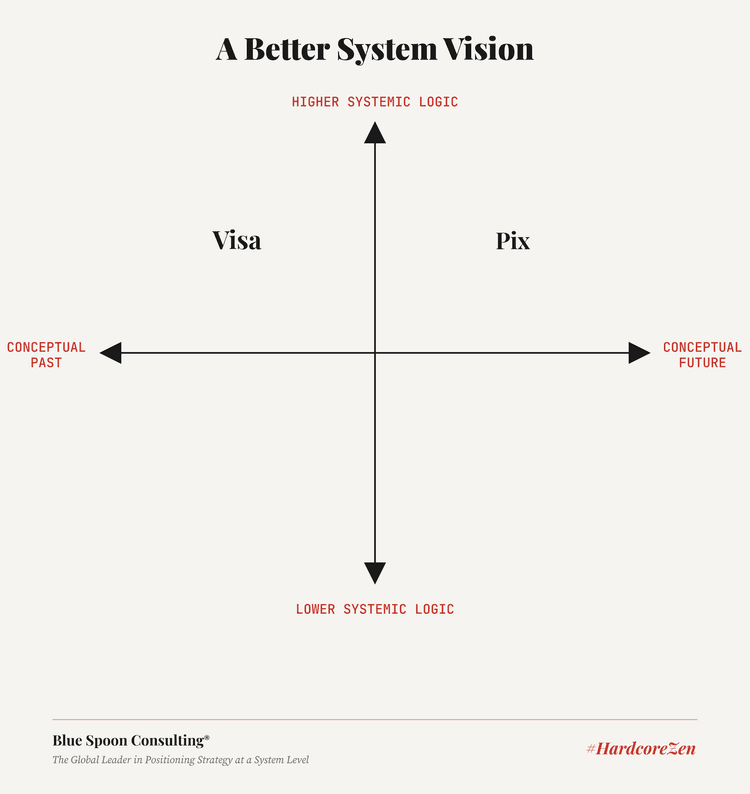
Nobody at the Banco Central do Brasil set out to beat Visa on features or pricing. They changed what the payments market is made of.
Before Pix, the market was a set of private toll roads and the competition was over who collected the toll — the fee Visa and Mastercard take on some $28 trillion in annual volume, and are now fighting to defend. After Pix, the road is public — free at the point of use, capped for merchants — and competition and growth moved to the flow of new markets self-generating on top of it: lending, credit, commerce, payroll, government disbursement, and the technology vendors serving all of them. Cash withdrawals have since fallen by nearly half, and credit card transactions are up a hundred and twenty-seven percent.
Pix pulled the previously unbanked into the formal system, and banks converted those maturing cohorts of new entrants into credit card customers. Pix did not kill cards. It manufactured the future card market by doing the inclusion work first.
Mastercard saw the danger to its position years ago and files it with the SEC every year: the risk that governments and technology companies build platforms that “disintermediate us from digital payments” — cut the network out of the payment entirely. The International Monetary Fund, looking at the identical system, reached the opposite verdict, titling its 2023 assessment “Pix: Brazil’s Successful Instant Payment System.” The two features the U.S. Trade Representative (the White House’s trade-enforcement office) calls unfair — mandatory participation by large banks, and a central bank that both runs the network and writes its rulebook — are, in the account of the Bank for International Settlements, the research body of the central banks’ own institution in Basel, the two ingredients that made Pix work at all.
That points to what the fight is really over.
What Pix hands Brazil’s central bank is a keystone advantage — the source of the nation’s payment-data loop, the one rail every wallet, lender, and merchant has to cross. Own that layer and you set the terms for everything built on top of it. The American objection is not, at bottom, about a fee. It is about a rail of enormous strategic value sitting in public hands.
Gabriel Galipolo, who runs the central bank, describes it as marketcrafting for public value: Pix is public infrastructure, he says, not a competitor to Visa and Mastercard. He dismisses Washington’s complaint, pressed on the card networks’ behalf, as absurd: “It would be kind of like saying that creating basic sanitation hurt the revenues of those who own water trucks.” The injury is real — revenue does disappear — but the pipes were not built to take his customers. They were built to make the question of who delivers water stop being the question.
After years of pressure from the Information Technology Industry Council, the trade group that represents Visa and Mastercard, the Trade Representative ruled in June that Brazil’s practices were “unreasonable” — the statutory trigger under Section 301, the Cold War-era trade law that lets the president punish foreign practices deemed unfair to U.S. commerce.
On July 15th it finalized the penalty, and on July 22nd a twenty-five percent tariff took effect across more than three thousand Brazilian products. Sugar. Clothing. Machinery. The determination mentions Pix more than twenty times.
The United States has done something trade law was never built to do. It has tried to tariff an ecosystem, and sent the bill to Brazil’s coffee and sugar — and, by the time it clears customs, to the American consumer who buys them.
Thus proving the first general law of strategic anxiety, a chronic condition of widespread panic afflicting management teams the world over: when linear hope fails, the exponential scramble begins.
Assembly Rules
Visa defending a $17 trillion business is not only rational; its managers have a fiduciary duty to do it.
Both card networks have warned investors that instant payment systems threaten their model, and they are right; fee compression is real and the political weather has turned. The tariff is that defense working as intended. But defending the toll is only the smaller of two available moves. The larger one is to build the next system, and the smaller move consumes the capability the larger needs.
After leaving Visa, Hock spent years trying to carry the same approach into other industries, including American healthcare, and never quite got there.
In March 1993, Hock sought out the Santa Fe Institute, the research center built to study how complex systems organize themselves. He had read about its work on the edge of chaos — the finding that living, adaptive systems hold themselves in the tension between order and chaos — and recognized it as the thing he had engineered into Visa two decades earlier without a name for it. In a dinner speech there, he said the word in public for the first time: chaordic.
The man who had actually built a self-organizing economic system went to the people who study self-organizing systems, and what he brought them was not a theory. It was a working instance, and the assembly rules behind it — how you convene rivals, how you write a constitution none of them can capture, how you spark an economic system from nothing, and how it grew to move $17 trillion a year.
Dee Hock died in 2022. But the assembly rules did not leave with him. He had refined the work of designing a new economic system until it ran almost like a template. They are still sitting inside the company he built, legible to anyone willing to read them, waiting to be used on a market that does not exist yet.
The tariff is Visa asking the government to defend the past, to protect the last economy Hock invented. His assembly rules are there for the taking, an invitation to go build the next one.
/ jgs
John G. Singer is the founder and Executive Director of Blue Spoon and the author of When Burning Man Comes to Washington: A Field Manual for Riding Chaos. Hardcore Zen is published weekly on Substack.
Disclosure: Blue Spoon has no financial relationship — equity, advisory, or commercial — with any company named in this essay. The analysis is independent.
Blue Spoon runs the Working Whiteboard: one session, one chart — your market as a system, objectives positioned strategically instead of operationally, original storylines of value. Inquire.