


For six years Leonard Nimoy hosted a television show from the edge of dark water, in a beige jacket, telling America what might be down there.
The show was called In Search Of…, a half-hour series about things nobody could explain — the paranormal, the missing, the monstrous — and it ran from 1976 to 1982, a hundred and forty-four episodes at twenty-three minutes apiece, every one of them opening with a spoken disclaimer laid over the titles, a confession dressed up as a credit: what follows is built in part on theory and conjecture, the producers mean only to suggest some possible explanations, not necessarily the only ones. Then the theme music came in and Nimoy walked out to a loch or a swamp or a runway in the Pacific and looked into the middle distance, doing the nation’s wondering for it. Bigfoot. The Bermuda Triangle. Amelia Earhart. Atlantis. The producers had wanted Rod Serling, who made The Twilight Zone, for the job; Serling died first, which is how the voice of Spock became the country’s chief investigator of the unexplained.
The format was durable enough that the History channel revived it in 2018 with Zachary Quinto, a second Spock, and the fourth episode of that season sent him out in search of “Artificial Intelligence” — filed alongside “Monsters of the Deep” and “Life After Death,” in the same tone of voice, with the same disclaimer running over the front of it. Quinto plucked a swarm of small drones out of the air in a Carnegie Mellon robotics lab, toured Uber’s self-driving-car operation in Pittsburgh and spoke to AI researchers at Facebook.
That treatment is where the agentic era has been living ever since. Sightings. Reenactments. Earnest investigators at the shoreline with instruments, describing the wake. Theory and conjecture, some possible explanations, not necessarily the only ones.
Everybody has a photograph. Nobody has the animal.
The Ground Truth Hurts
IBM warned its investors a week ahead of schedule this month that the quarter had gone wrong, and lost sixty-seven billion dollars between one bell and the next, the worst day in the company’s recorded history. The previous record was October 19, 1987, when the whole market fell and IBM fell with it. This time it went alone.
By every account published since the selloff, the board knew the quarter had come in soft, and the debate was about what to do with the knowledge: wait and explain, or warn and absorb. Sit on the number until the scheduled results and let the executives walk investors through it in context, or go out ahead of it and take the hit in daylight.
Directors put that choice to Arvind Krishna, IBM’s chairman and chief executive, and he chose to go out early, eat it, and collect, he hoped, some credit for nerve. Krishna’s letter to investors ran before the Tuesday open. It was pages long, most of it margins and segments, but four words were the ones the market read: “This quarter we faltered.” He went on to name the cause — the company, he wrote, “did not adapt and move quickly enough.”
A whole letter of operating data, priced off a confession. The market didn’t price the data, it priced the sentence.
By the close the stock had fallen a quarter, to $217 from $290 the session before, and Big Blue, the company that helped run the moon shots and the Social Security system, was worth barely two hundred billion dollars. The company that built the AI that beat humans on live TV in 2011 — that led the last AI moment — is now priced as an AI-era casualty at a tenth of Broadcom, a former parts supplier.
The quarter came in six hundred and sixty million dollars light on revenue. The market removed sixty-seven billion dollars of value. A hundred dollars erased for every dollar it came up short.
“The punishment doesn’t fit the crime,” Debanjan Saha, CEO of DataRobot, wrote on LinkedIn. “This selloff wasn’t about a quarter. It was the market repricing a question: can a 115-year-old enterprise company lead the agentic era, or merely survive it?”
Saha came up inside Big Blue, and he’s right about the punishment. He has the crime wrong, and it’s sitting inside his own sentence, in a word worn so smooth by handling that nobody hears it land anymore.
Last week, in “How to Reroute an Industry,” I took apart patient-first, the most repeated and least differentiating string of syllables in American healthcare, a phrase that outlived its meaning and kept transmitting anyway, which is worse than silence because the noise occupies the frequency where a signal would go. This is remnant context: a kind of gravity that keeps a dead narrative in orbit and, from there, still sets the direction of an entire industry — generating sentence after sentence fitted to a world that has already moved on, each one crowding out whatever might have replaced it.
Technology services has its own remnant context, and enterprise is it.
Saha’s question concedes the whole architecture of the answer before the answer opens its mouth: that the unit of account is the enterprise, that IBM’s work is to install capability inside the four walls of a bank, then an insurer, then a ministry, then a retailer, booking the difference each time, world without end. Every large technology services company alive sells “enterprise-wide transformation powered by artificial intelligence” — the phrase is Gartner’s, the label on the analyst’s first-ever Magic Quadrant for the category, published in January — and the market is marking the whole tribe down together.
Accenture had its own worst day on record four weeks before IBM had its, an eighteen percent drop in a single June session to its lowest close in nine years. India’s IT sector — TCS, Infosys, HCLTech, Wipro, three hundred and fifteen billion dollars of it — is putting up 2.8 percent revenue growth in constant currency; its stock index is down twenty-eight percent on the year against a six percent decline in the broad market, the worst-performing major sector in the country.
Nine brokerages surveyed by Reuters see no relief. Citi counts a fourth consecutive year of subdued growth. JPMorgan sees nothing better than three or four percent for the foreseeable future. Nomura calls it a perfect storm.
Gartner, the house that draws the Magic Quadrant, is itself down more than sixty percent on the year, sold off in February when its own consulting revenue shrank and clients moved money from advice toward infrastructure. The scorekeeper is in the same hole as the scored, and for the same reason.
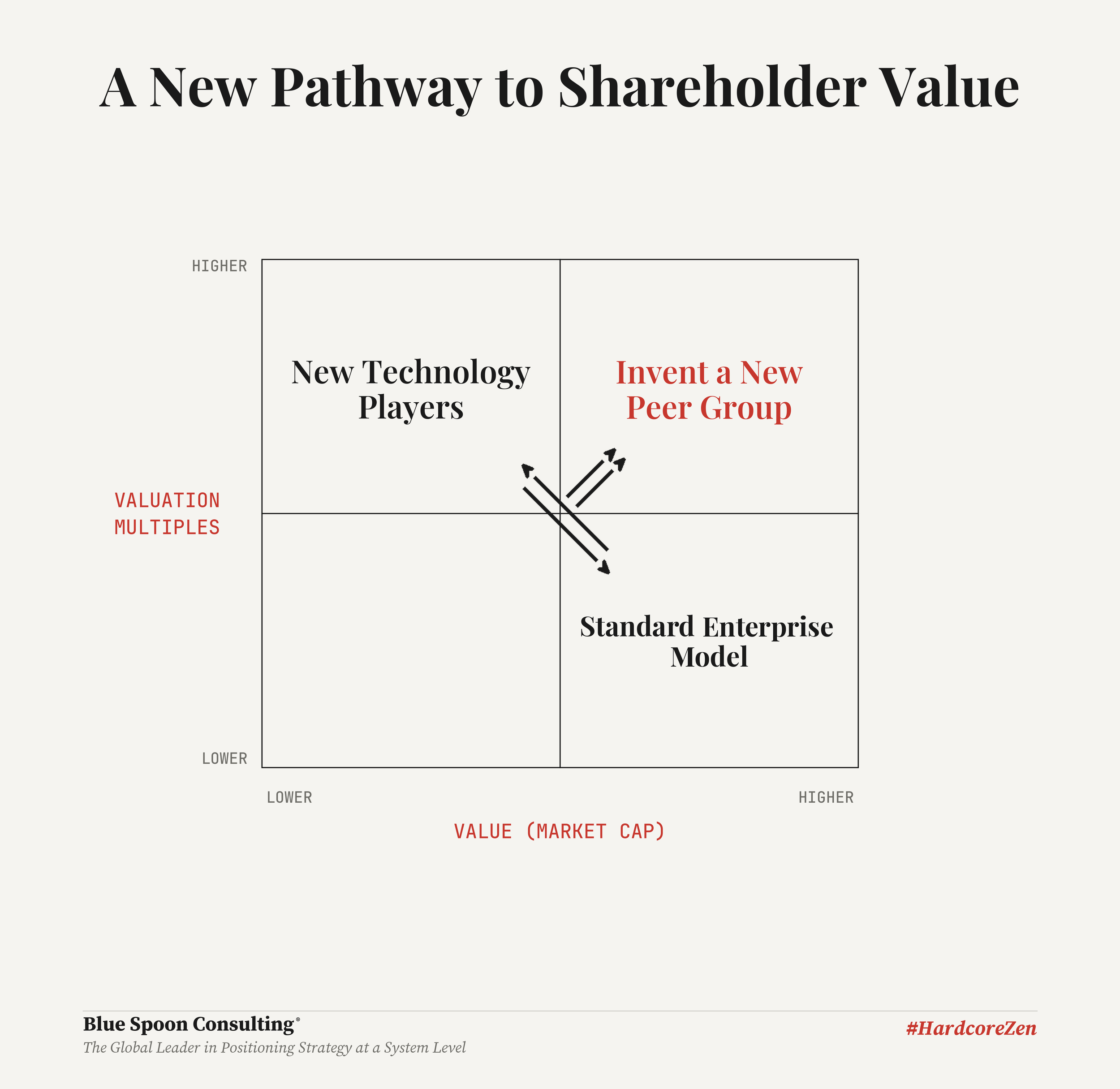
So the stock market is asking IBM to win a race in a stadium where the whole field is running the same lap in the same shoes, and IBM took its lane and ran. It accepted the enterprise-wide question and never once questioned the enterprise-wide premise underneath it — that the enterprise is the unit, that the job is transformation sold one company at a time.
That was the mistake: not the answer it gave, but its agreement to be measured on the question at all.
Convening Power
The way out of a field running identical laps is not a faster lap. It is a different race. A market that did not exist until somebody made one.
And economic innovation on this order runs on something technology cannot supply: a whole system changing at once, not one business optimizing. Difference wired together until it catches. An ecosystem ignites the way a chemistry does, unlike parts brought into contact so that each one sets off the next, and the spark jumps across the gap between them — hospital and drug manufacturer, banking and grid, insurer and grocer.
The precondition is not compute. It is standing within reach of enough unlike players to wire them into a circuit, and being the one whose call every one of them will take.
IBM can put the chief executives of the largest banks, retailers, insurers, health systems and governments on earth into one room on a Tuesday and every one of them shows up. That standing cannot be bought. No AI lab has it, whatever the balance sheet says, because standing doesn’t come out of a training run. It takes a century of showing up, and IBM has the century. And with that century sitting on the books, leadership is asking whether the company is too dependent on large accounts, whether it ought to court midsize customers and spread the risk, which is a plan to become smaller more safely.
The dependency isn’t the bug. IBM is not over-indexed on giant clients. It is catastrophically under-indexed on what its giant clients are worth to each other.
In 2021, in an essay called “The Technopolar Moment,” the political scientist Ian Bremmer argued that the biggest technology firms had stopped being vendors and become something closer to sovereigns, running the substrate a modern society sits on. What separates a sovereign from a vendor, in that telling, is the agenda: a sovereign governs the terms other players operate under, sets the direction of the whole system and decides where the innovation goes, the way a country does — everyone else builds inside the world it defines. A vendor merely fills the orders that world generates. IBM was a sovereign once and gave it away by degrees, kept the room and surrendered the agenda — which is to say it kept the access and went back to taking orders. Convening power with no story attached is a Rolodex, and a Rolodex depreciates.
So the reroute for IBM is the same shape as the one I made last week for Cigna, one ring wider. That move was to quit optimizing patient-centricity and reposition the household as the actual unit of health production, out where the economics live. IBM’s is to quit selling into enterprises and start constructing systems of enterprises.
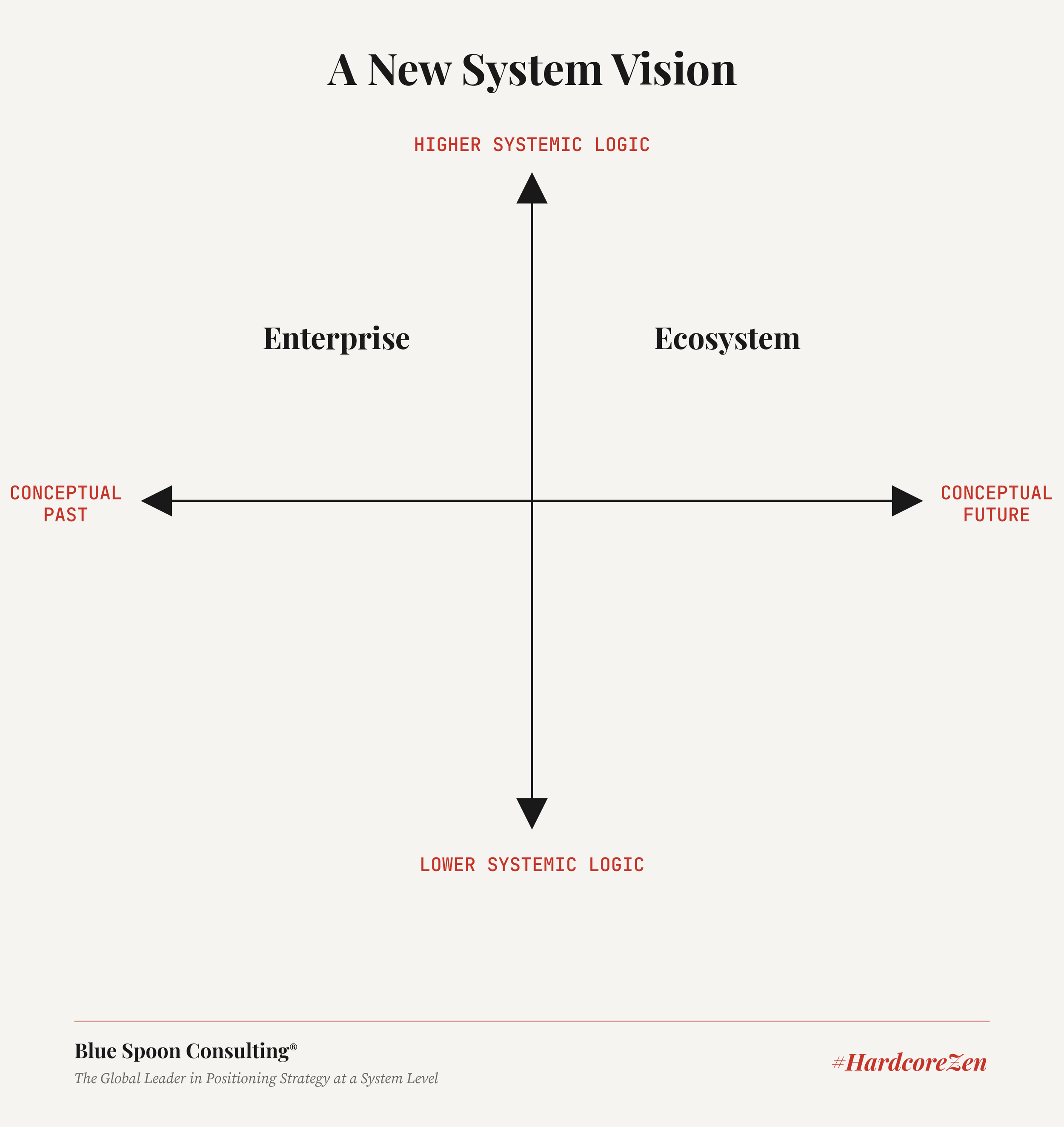
The next growth curves form in the space between the words — and standing up a portfolio of them, rather than defending the one you have, is the whole of what frontier management is for: hospital and drug manufacturer, banking and grid, insurer and grocer. The value is in the and, and the and is structurally unavailable to anyone seeing and selling one enterprise at a time, because a seller has no standing to set terms between parties. Only a convener does.
Some ecosystems grow on their own, the way a platform accretes developers once it has enough of them. The kind that reroutes an industry doesn’t. It gets designed, with intention, and the work starts by abandoning monovation, the belief that innovation issues from one source and can therefore be purchased from one vendor, which is the whole premise of enterprise software and the exact premise the agentic era just ate.
Big Blue Finds Bigfoot
In May 2010, under Samuel Palmisano, then IBM’s chairman and chief executive, the company published Capitalizing on Complexity, the fourth of its biennial Global CEO Studies — 1,541 chief executives and senior public-sector leaders across sixty countries and thirty-three industries, the largest known face-to-face sample of its kind ever assembled. Each of them took the call and sat down for a conversation about strategy and vision with IBM, the kind of access no one else could command.
What Palmisano wrote in his opening letter to fellow CEOs was less a finding than a description of entanglement: the world had become “a global system of systems,” no longer legible one market, industry or nation at a time. Events and opportunities, he wrote, were “converging and influencing each other to create entirely unique situations.”
Leverage lives in the correlations, not the parts. A world prone to system-level failure is, by the same logic, open to system-level opportunity — and both the failure and the opportunity sit a level above the enterprise.
The most valuable form of business-model innovation the study named was neither the enterprise model nor the revenue model but the industry model — redefining an existing industry, moving into a new one, or standing up one that had not existed. The winners it singled out, the “Standouts,” did not optimize inside their own walls. They convened and they co-created, and they saw complexity as a strategic medium to move through, as raw material for new value rather than a threat to be managed down.
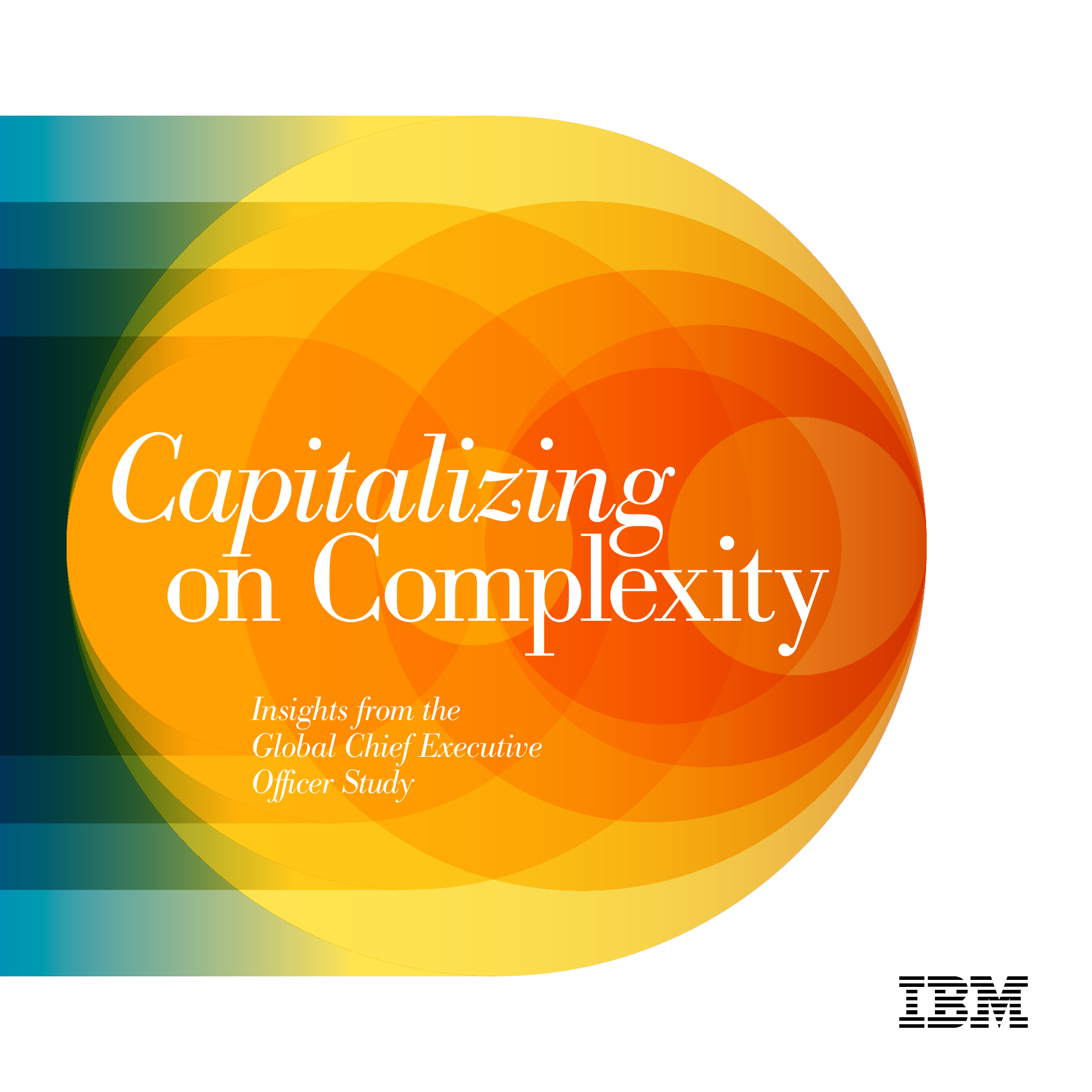
The title reads differently with sixteen years on it. Capitalizing on Complexity. Not surviving it. Capitalizing — building the workflow that turns a field of unlike players into a position only the convener can hold. IBM wrote that report, set its chairman’s signature under it, mailed it to every chief executive on earth, and then spent every year since selling the reverse: enterprise transformation, one company at a time, the very one-industry-at-a-time thinking its own study had declared obsolete on the first page.
That is remnant context of the cruelest kind. Not an industry’s dead phrase transmitting on a frequency where a signal should go, but a company’s live insight — right when it was written, right now — left on a shelf to decay while the company that produced it went back to taking orders.
The Wall Street Journal’s take over the weekend was that Krishna is stuck in the middle: too slow for the AI-native firms, too tied to the legacy book to walk away from it, marooned where media and music and the car companies were marooned, where many try and few come through. True enough on its own terms. But the middle only kills you if the axis is real, and this axis — legacy vendor at one end, AI-native vendor at the other — is the enterprise premise in a new coat.
IBM’s own 2010 study already stepped off that framing. The move was never to sprint to a faster end of the vendor spectrum. It was to stop being a vendor.
Space for Computability
Blue Origin does not sell rockets. It sells a destination: people living in space. And once you want it, you need the rockets to get there. IBM sells the vehicle and calls the destination transformation, which is another way of saying there isn’t one.
Technology wants more technology.
It doesn’t get sold at civilizational scale by justifying the next purchase on its own payback, but by describing a place that cannot exist without vastly more of it than exists today: space for computability. Ecosystems are what invent that space, and the job to be done, the thing business development in technology services is actually for, is not account coverage but market genesis: selling the story that stands up a new economic system, designing the workflow that wires the players together, and making the place real enough that the demand for everything else follows.
Inventing a market is a creative act before it is an operational one. Capitalizing on Complexity even filed the case study.
Axiata, the Asian telecom group, took its leadership team to a summit in Tokyo and, in place of a planning session, had each of them write a press release dated years into the future describing growth they had supposedly already delivered — an exercise engineered to force the admission that none of them could get there alone. That is market genesis in a single room: name the destination first, uncover the system the destination requires, then build that system together.
The thing that kills a company in IBM’s position is not the quarter. It’s the flinch after the quarter, the long careful retreat that gets mistaken for prudence. Loss aversion is the best-documented bias in decision-making: people will risk more to avoid a loss than they ever will to reach a gain. It is exactly how a company talks itself into shrinking — the downside of the bold move looms larger than the upside, so the safe move wins the room even when the safe move is the fatal one.
A New Origin Story
IBM held its earnings call Wednesday, and Krishna promised deeper detail. Deeper detail on the margins, the bookings, the shape of the second half. His letter had already given the headline — conviction in the portfolio, conviction in the “strategic transformation of the business” — and left the big word undefined. Transformation is remnant context too, another dead phrase still transmitting: a word for a journey with no origin and no destination. Transformation from what to what?
Nobody on the call asked, because that question isn’t on the script.
Survival is never the alternative to leadership. It is what happens to a company that answers the question it was asked, and the question IBM was asked has an enterprise-shaped answer that gets smaller every quarter.
So it will keep searching for its transformation, its new growth story, the way Nimoy searched for the creature at the edge of the water: earnest, well funded, pointed at the wrong element. The thing IBM is looking for is not in the enterprise market at all. It is sitting in the account book, in the chief executives and heads of state who would all take the call, and in the destination waiting to be narrated. Not IBM’s destination: theirs, articulated jointly, a system vision none of them could see alone and none could reach without the others.
Blue Origin sells the place and the rockets follow. IBM has the room and no place to point it toward.
The stock market prices you; a market saves you. IBM has spent the week in conversation with the first and none of it positioning the second. That is the only move in the whole affair that pays at the scale of growth that matters to a business as large as IBM: a new economic system called into being on purpose, by a company with the power to convene it.
/ jgs
John G. Singer is the founder and Executive Director of Blue Spoon and the author of When Burning Man Comes to Washington: A Field Manual for Riding Chaos. Hardcore Zen is published weekly on Substack.
Disclosure: Blue Spoon has no financial relationship — equity, advisory, or commercial — with any company named in this essay. The analysis is independent.
Blue Spoon runs the Working Whiteboard: one session, one chart — your market as a system, objectives positioned strategically instead of operationally, original storylines of value. Inquire.