
Iran is Out-Thinking the United States

What Roosevelt understood in 1942.
Iran’s continued defiance of the United States represents more than a tactical success. More and more, Iran treats separate theaters as components of a single strategic system. The result is an emerging sphere of Iranian influence built not through conquest but through persistent disruption.
Robert A. Pape, “Iran and the New Rules of Global Power,” Foreign Affairs, July 24, 2026
Ahead of his fireside chat of February 23, 1942, Franklin Roosevelt asked Americans to take out a map of the whole earth, spread it before them while he spoke, and follow along with the references he would make to the war’s “world-encircling battle lines.”
The address was timed to Washington’s Birthday and delivered eleven weeks after Pearl Harbor. That evening, while the broadcast was going out, a Japanese submarine surfaced off Santa Barbara and shelled an oil field for twenty minutes, the first attack on the American mainland since 1812. The country was frightened and badly informed (censorship still held the true damage at Pearl Harbor, and the Navy would not publish a full accounting for another ten months). Support was not the problem. Roosevelt’s approval stood at 84 percent that January. The country would fight. It could not see what it was fighting.
Then he told them why the map.
“This war is a new kind of war. It is different from all other wars of the past, not only in its methods and weapons but also in its geography. It is warfare in terms of every continent, every island, every sea, every air-lane in the world.”
Roosevelt was not giving a geography lesson. He was solving for vision, and the map was the narrative device that carried it, snapping the mind of a nation up to a different level altogether.
He was up against the great misconfiguration in the American mode of thinking: fragmentation as the American default and operational rigor as its method. Frederick Winslow Taylor had made it a management science thirty years earlier, stopwatch in hand on the floor at Bethlehem Steel — break the job into parts, time each part, optimize the parts. By 1942 it was running the factories, the schools, and the mobilization itself. It still is in 2026. McKinsey’s CEO practice now calls the pursuit of operational excellence a liability for the next generation of leaders, most of whom were trained in nothing else.
A public that reasoned in fragments, that understood national interest as self-interest, that could not take in a global war as one object, could not be governed toward one. So Roosevelt handed out the larger frame before he made the argument that required it. He was not describing the war so much as the orbit of thought the country had to be moved into before it could fight a new kind of war.
Roosevelt was trying to kill the parochial arithmetic, the old math whose whole function is to prove and preserve the value of the past, generating evidence to support the world it came from.
He wanted a nation of separate interests to see in systemic terms.
Managing the Edge
Iran is winning, to the extent it is winning, because it thinks about systems better than the United States does now.
Tehran knows how to capitalize on complexity; Washington still tries to take it apart. That is the thing separating strategic success from strategic collapse in any endeavor, war or business or government, and it has nothing to do with technical invention and production at industrial scale.
Iran is not managing Lebanon, Iraq, Yemen, and the Strait of Hormuz as separate campaigns. Hezbollah, the Iraqi militias, the Houthis, cheap drones and missiles ranging onto American bases, the Strait of Hormuz as a control point and a new commercial model — all of it runs on one system logic at several addresses. What comes out the other end is almost management innovation, a sphere of influence assembled without conquest. In his Foreign Affairs essay, Pape calls this “persistent disruption” (something President Trump is also very good at).
The machinery underneath Iran’s success is the second precision revolution.
The first was American: the 1991 arsenal of laser-guided munitions, satellite navigation and infrared sensors that took Iraq apart in five weeks of bombing and a hundred hours on the ground, a technical capability built on an industrial ecosystem only the United States could assemble and manage. The second is what happens when the same capability becomes accessible to everybody — navigation chips, inertial measurement units, optical sensors, artificial intelligence, a twenty-thousand-dollar drone that destroys a thirty-five-million-dollar Apache.
Anyone can buy the good stuff now. That is why “victory through superior firepower,” a system of belief the American military-industrial complex has organized itself around since 1945, now belongs to the conceptual past, a form of strategic drift, an operating model outliving the conditions that made it true.
That is the whole difference between a monopoly on precision that lasted thirty-five years and a strait you no longer control. The same belief is how the United States is running the AI race with China — out-build, out-compute, out-spend. It is the firepower doctrine in a new uniform, and it will fail the same way.
In a 1998 primer called Coping with the Bounds, Thomas Czerwinski observed that overwhelming force linearizes a conflict. Pile on enough of it and war starts behaving like arithmetic. Targets destroyed, the OKR of war, becomes the measurement of success.
Czerwinski held the Chair of Information Warfare and Strategy at National Defense University, the Pentagon’s own graduate school, where the Joint Chiefs send colonels and generals to learn strategy. He is widely seen as one of the people who brought complexity theory into American military thinking. Coping with the Bounds speaks to the nature of competition, not only of war. Complexity never leaves the contest, only the picture of it. What gets assumed away is a competitor with the skill to manage itself as a complex adaptive system.
Iran is still Iran. The same state with the same weaknesses is being run differently, which means its strategic success is a management choice rather than a transformation, available to anyone who understands what it means.
Excellence in Pieces
In July, Trump told the country the United States has “the strongest and most powerful military by far anywhere in the world,” and that America was winning big in Iran with the results due very shortly. On Friday he predicted the Iranians would weaken and then peter out. On Sunday he said he had been prepared to launch “the biggest military attack since World War II,” and that allies had talked him out of it.
Trump is right about the powerful military part. That is the problem.
All the data suggests we are winning against Iran in exactly the way we won against Iraq and Afghanistan.
Washington fights Iran-in-Yemen, Iran-in-Iraq, and Iran-at-Hormuz as three files. They sit under one combatant command and get worked as three separate problems, each with its own task forces, budget lines and theory of victory, against an adversary running all three out of one book. Every individual engagement is going the American way while the aggregate is going the other way, because the aggregate is only visible to the party that assembled it.
That is what system advantage looks like.
Over the weekend a drone hit the largest oil facility in Saudi Arabia, tankers burned at an Egyptian port near the Suez, and hackers US intelligence takes to be Iranian took over the controllers that set pressure and chemical dosing at more than thirty Minnesota water utilities and nine in Michigan. Nobody was poisoned. Operators lost the ability to see their own plants, went to manual, and issued boil-water notices. Hormuz is abstract. The tap in Plymouth is not.
Trump disputed the attribution from the cabinet room. He blamed Minnesota authorities, said “Iran should be so lucky,” and suggested Tehran had bigger problems than worrying about Minnesota.
We are dismissing a front because it does not look like a front, which is the whole argument.
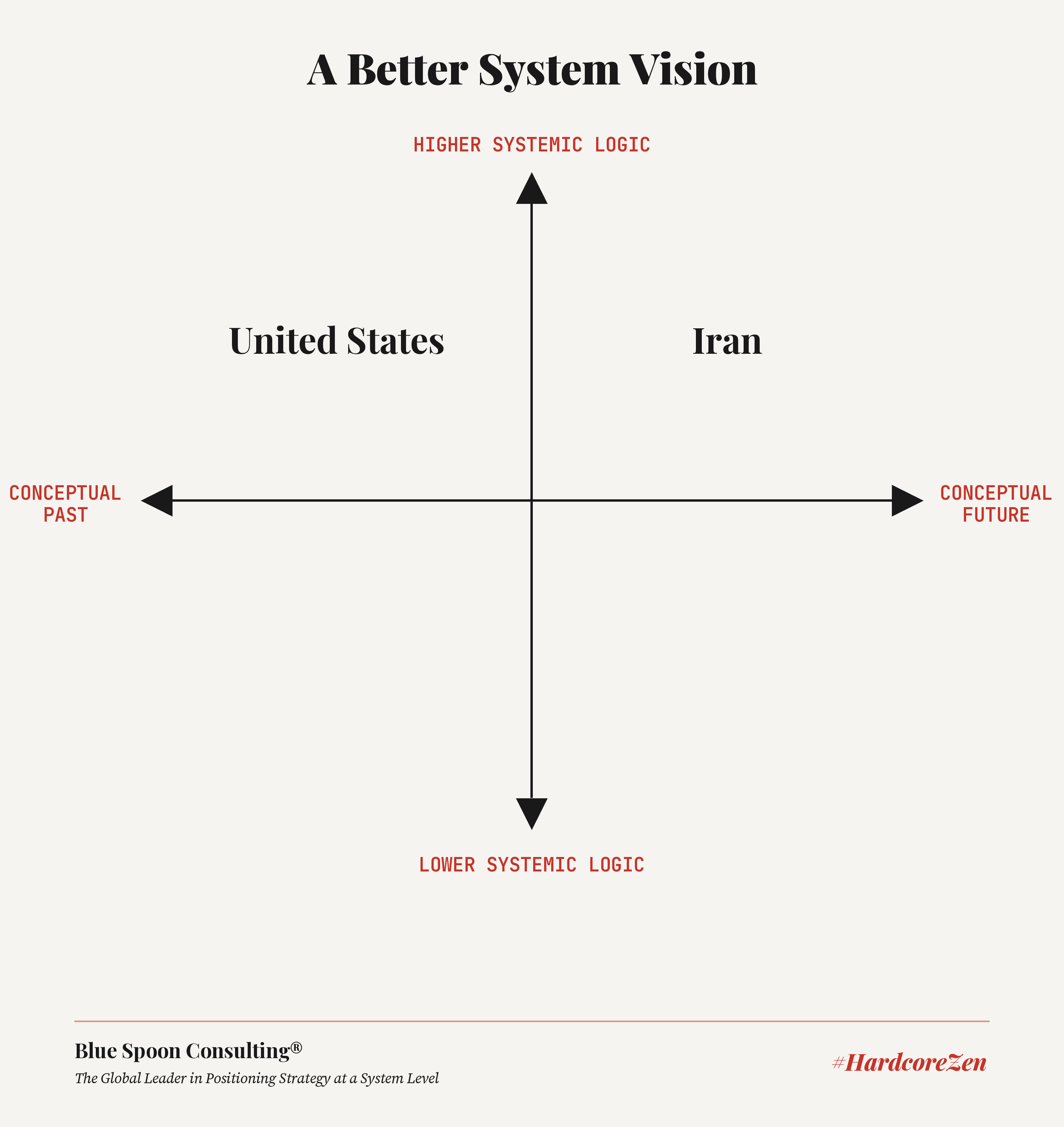
The American Way of War sits stuck in the conceptual past. It decomposes the world into targets, and believes finding a target is the same act as determining an outcome. Iran’s Way of War works in the conceptual future, where the object of contest is not terrain, and not even ships, but a shift of domain entirely, into a different context for economics: whether anyone will insure the voyage.
This is what happens when operations gets confused for strategy. What decides it is not a firepower gap. It is intellectual overmatch, born from fluency in systems thinking.
Mahdi Mohammadi, a senior adviser to Iran’s chief negotiator, posted last week that “the rules of the conflict are changing and being rewritten,” and that Iran was creating new conditions and new platforms in the war.
He is correct.
Strategic Fit vs. Strategic Collapse
Six months in, America’s allies have begun describing the war as a “strategic defeat.”
Trump’s aims are unmet because he never articulated a different system vision, which is the one thing Roosevelt did before he did anything else. Iran is resolute under a harder government. Control of the Strait of Hormuz has been rerouted to Tehran. Patriot missile stocks are drawn down far enough to weaken resupply everywhere else for years. Saudi Arabia no longer trusts Washington to restore regional security after the war, and has been building its own arrangement with Tehran alongside deeper reliance on China.
The new rules of power are not about the means of destruction. They are about finding strategic fit for a total change in context, and the thing that has to fit is never a single enterprise. It is a system of enterprises. Or inventing the next context altogether, which is what Iran is doing.
What separates the two sides is systems thinking as a first language, not a translation we perform under pressure, badly, after the quarter has closed.
Roosevelt did that work deliberately. Change what a country can see and the institutions will follow it there, which is why he asked the country to have a map open in front of it before he said a word. The argument he needed to make was at a level that his listeners were not using.
Qassem Soleimani ran the Quds Force, the expeditionary arm of Iran’s Revolutionary Guard, for twenty-two years. He spent them designing an ecosystem: Hezbollah, the Iraqi militias, the Houthis, each with its own agenda but interoperating as a single organism. So when the United States killed him with a precision strike in 2020, the system he had assembled went on working without him. This is why Israeli and American decapitation strikes on the Iranian leadership look impressive and miss the point entirely.
Roosevelt and Soleimani understood the same thing from opposite ends of a century. Conventional strategy plays the player. Strategy at a system level plays the board.
Trump has said that the one president he never wanted to be is Herbert Hoover. It is a revealing ambition, because it is defensive. Hoover is the cautionary tale, the man the crash of 1929 swallowed. He is also a reference point in system collapse.
Hoover left the White House in March 1933 and Roosevelt walked in. Same desk, same country. He used creativity and big ambition to rethink what his nation could become.
Roosevelt did not spend February 1942 avoiding Hoover’s fate. He spent it as a system builder, asking a frightened country to hold a map open while he explained why.
/ jgs
John G. Singer is the founder and Executive Director of Blue Spoon and the author of When Burning Man Comes to Washington: A Field Manual for Riding Chaos. Hardcore Zen is published weekly on Substack.
Blue Spoon runs the Working Whiteboard: one session, one chart — your market as a system, objectives positioned strategically instead of operationally, original storylines of value. Inquire.