


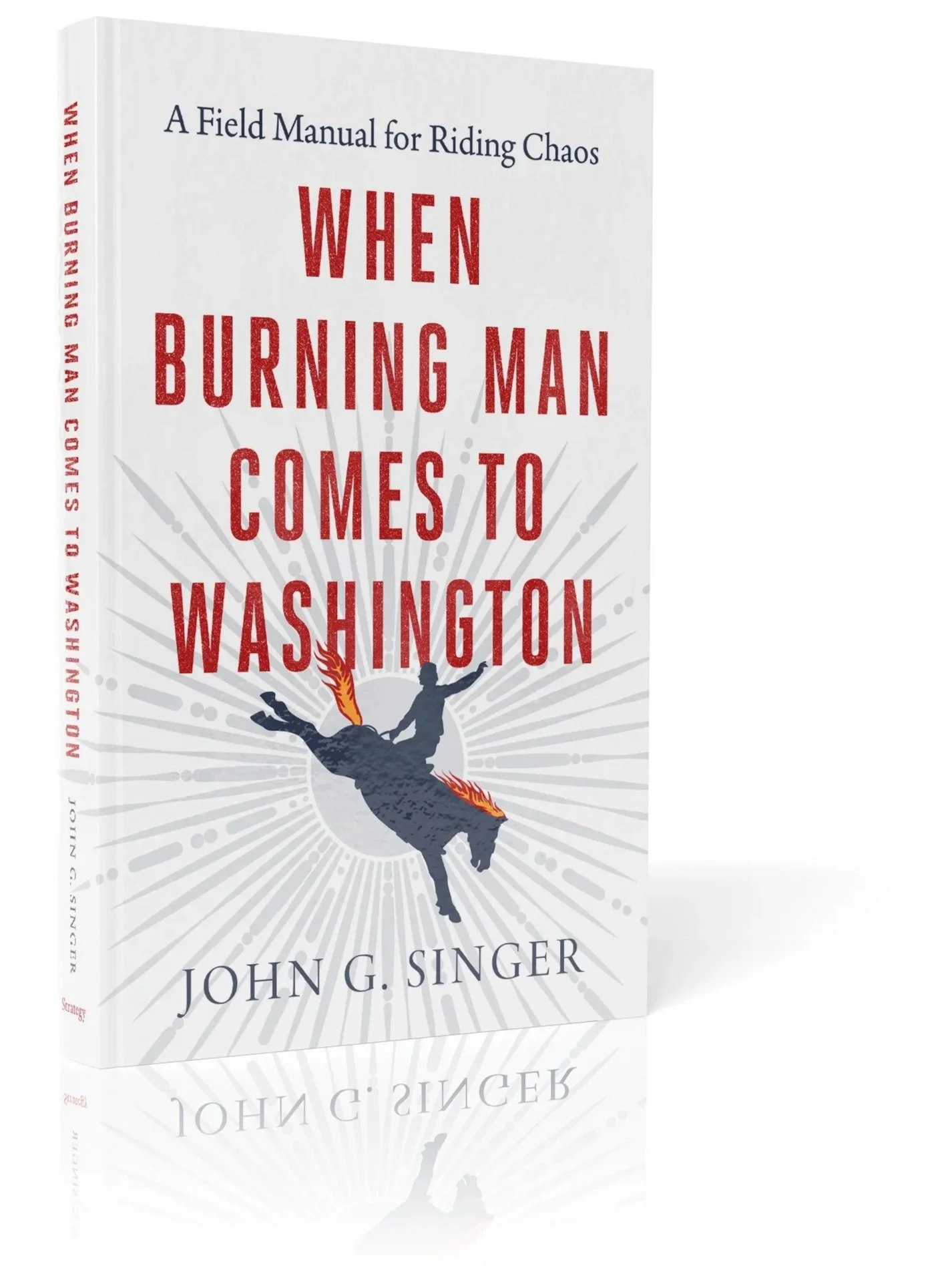
When Burning Man Comes to Washington
A Field Manual for Riding Chaos
Read it before the meeting. You'll hear different things once you're inside the room.

A Field Manual, Not a Book
When Burning Man Comes to Washington isn't a book. It's a field manual you bring with you into meetings. Not to quote. Not to brandish. But to quietly re-orient how you see the room.
Leadership today is haunted by ghost frameworks — dead language, inherited assumptions, and operating myths that keep institutions performing competence long after the world they described has vanished. Strategy meant to stabilize now anesthetizes, muting awareness of where power has moved, how narrative operates, and how ecosystems actively generate advantage.
Donald J. Trump is signal, a high-voltage indication that the old order has exhausted its ability to absorb shock or metabolize change. He didn't invent the collapse so much as understands how to surf the debris field as it is being formed. What Trump exposes is not a politics, but a transition, a world adrift, flowing into an era that is still unnamed, unstable, and ultimately unknowable.
When Burning Man Comes to Washington is a field manual for this moment. It doesn't promise certainty or restoration. It offers orientation, a way to see clearly when the familiar language fails and when strategy dissolves into ritual.
The world does not run on efficiency, technology, or best practices. It runs on power, narrative, and big system design. Those who understand this shape markets. Those who don't are shaped by them.
From the Preface
Industries once thought stable now behave like weather patterns: unpredictable, nonlinear, and driven by forces most leaders never learned to see. The comfortable vocabulary of "innovation," "transformation," and "disruption" has curdled into a mask, ectoplasmic generalities that mean everything and nothing at the same time. The problem is that we're trying to describe system-level change with tools built for a different era, with a fossil vocabulary still pretending it's alive.
And so a dinosaur in a fur coat is not a mammal.
Read it before the meeting. You'll hear different things once you're inside the room.
Six Threads, One Argument
Systems Thinking
Big system design as the real unit of competition, and why incremental optimization cannot reach it.
Narrative Strategy
Story treated as infrastructure rather than decoration. Narrative hardens into power, and power sets the terms.
Geopolitics
Washington read the way a market is read, with Trump as signal rather than subject.
Healthcare Economics
Rebates, PBMs, payers, and the VHA — the live case where incentives and access refuse to resolve.
Complexity Science
Industries behaving like weather: unpredictable, nonlinear, driven by forces most leaders never learned to see.
Punk Rock Ethos
Irreverence as method. What the counterculture understood about institutional decay before the institutions did.
For Operators
Executives running a business inside a category that is coming apart faster than the plan can be revised.
For Strategists
Anyone tired of frameworks that describe yesterday's winner and stop working the moment conditions move.
For Policy
People designing inside institutions where the system, not the org chart, decides what is possible.
Signals From the Edge
"Singer lays bare what most management gurus won't admit: your strategic frameworks died years ago; you just haven't buried them yet. This field manual teaches executives how to see systems, build ecosystems, and lead through chaos without flinching. Sharp, irreverent, and vital for anyone navigating institutional transformation."
"Singer gives us keen insights into the shock and awe of change in healthcare, technology, and geoeconomics, eviscerating common assumptions on strategy, markets, and leadership, while proposing a new playbook for navigating it all. Irreverent to the old-world order and provocative to leaders perplexed from the sand rapidly shifting under their feet, Singer's prose grabs us by the collar in a punk-rock anthem to the present moment. This book is a rallying cry for those who are boldly claiming a place in the new world order."
"At a time where much is spoken about disruption, chaos and crisis, John Singer digs deeper into this new reality. This book conveys the feel and dynamic of our times viscerally with strong examples and analogies. He busts a lot of bubbles. Arguing that the linear world of A to B solutions is no longer viable, John explores what is emerging in its place. Focusing on interdependence and ecosystem thinking, John shows us what strategy is becoming."
"John has a rare talent for unpacking complex trends, connecting dots that seem unconnectable, and sparking those delightful 'Ah! I never thought of it that way' moments for his readers. This latest work is a brilliant compilation of essays, beginning with a provocative analysis of President Trump's system-thinking prowess and culminating in a critical exploration of the intersection of Big Tech, Big Pharma, and Big Healthcare. For current and aspiring leaders seeking to make an impact, this book is not just recommended, it is an essential read."
"In a world where 'strategic plans' have supplanted strategy and even common sense, When Burning Man Comes to Washington looks at strategy as it is. Let's call it 'realpolitik' colliding with 'realstrategik'. This is a book for the strategic thinker who understands the importance of vision and the futility of endless cycles of strategic planning as the source of sustainable competitive advantage. The pages are replete with wisdom from systems theorists who have developed the tools to succeed in the post-modern era. It is well worth a read."
"John G. Singer offers a remarkably lucid exploration of how entrenched systems resist change — and why understanding their hidden metabolic forces is essential for anyone seeking meaningful impact. A bold and thought-provoking reflection for leaders navigating profound disruption and collapse."
ESCP Business School, Paris & London
"John's work shaped some of the most transformative strategy I've ever been part of. His ability to see, and reimagine, entire systems enabled us to build a direct-to-patient ecosystem at Pfizer that most believed was impossible."
Former Senior Director and Team Leader, Global Access Transformation, Pfizer
"John's 'punk rock ethos' has always resonated with me, and the premise of this book could not be more timely. In an era where healthcare is being fundamentally reshaped by AI, digital transformation, and new political realities, conventional thinking is a recipe for irrelevance. Now is not the time for traditional choices; if we want extraordinary outcomes, we must think in extraordinary ways."
"When Burning Man Comes to Washington is an ambitious and unconventional work that challenges many of the assumptions underpinning traditional strategy thinking. John G. Singer reminds us that strategy is all about critical thinking and system level decisions. He pushes readers to consider strategy not as incremental optimization but as system-level design — a perspective that feels both timely and necessary in an era of accelerating complexity.
What makes this book distinctive is its willingness to provoke. Singer's arguments are not always aligned with conventional frameworks, and that is precisely their value: they force us to question the adequacy of inherited models and language.
This is less a manual of answers than an invitation to rethink the questions. It is a bold contribution that will stimulate dialogue about what strategy must become when the old maps no longer fit the territory."
Co-Editor, Strategic Management Review
Available Worldwide
Read it before the meeting.
/jgs