

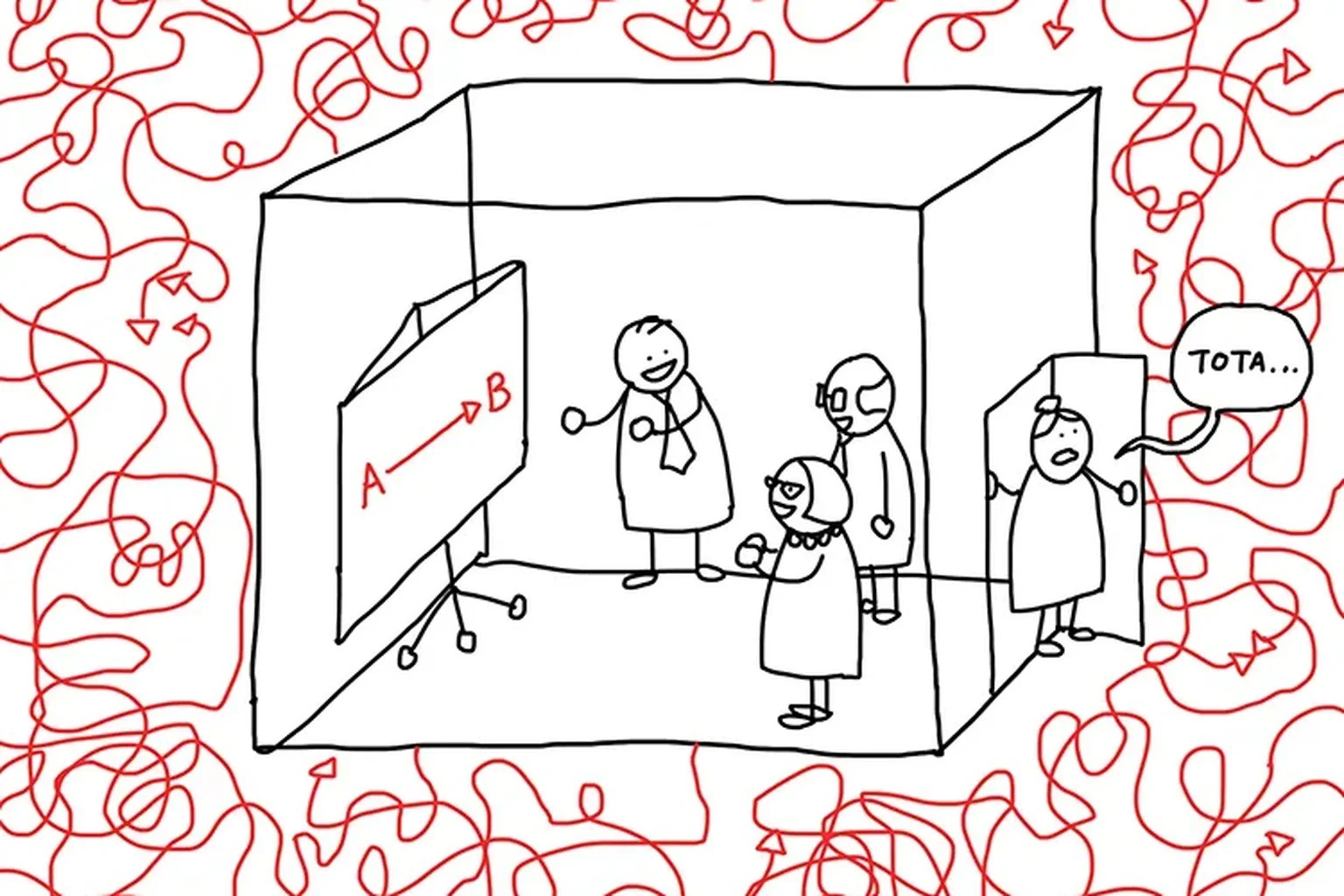
The Working Whiteboard
Ninety minutes with your leadership team. One session, one chart.
Hardcore Zen is the method. The Working Whiteboard is where it gets applied to your market.
Strategy sessions usually start with the company and reason outward — the plan, the portfolio, the roadmap, the competitive set as currently drawn. The output is a longer version of what walked into the room.
The Working Whiteboard starts with the system. Your market gets positioned on two axes — how far forward or backward your strategic frame sits in conceptual time, and whether you are optimizing inside the current system or designing the next one. Once the market is on the board, the arguments change. Objectives that looked strategic turn out to be operational. Advantages that felt durable turn out to be inherited.
One session. One chart. Everyone in the room looking at the same system at the same time.
Three Stages
The session is ninety minutes. The work around it is what makes those ninety minutes worth holding.
Before
Research documented. Your organization positioned at a system level rather than a competitive one. Working themes and avenues identified, so the session opens on substance instead of setup.
The Session
Ninety minutes with your leadership team, building the chart together. Your market as a system, drawn live, with the disagreements surfaced rather than deferred.
After
Objectives positioned strategically instead of operationally. A launch news release written from the future. The narrative architecture that makes the new position legible to the people who have to act on it.
Leadership Teams Facing
What Comes Out of a Session
Hardcore Zen is the method. The Working Whiteboard is where it gets applied to a market. Five working outputs below, each an instance of the method: reframing the terrain, designing a new economic system, or building the narrative architecture that makes it legible. These are other people's markets. Yours would look nothing like them.
The Next Magic Quadrant
Gartner's Magic Quadrant maps vendors inside an existing market. This maps the market itself.
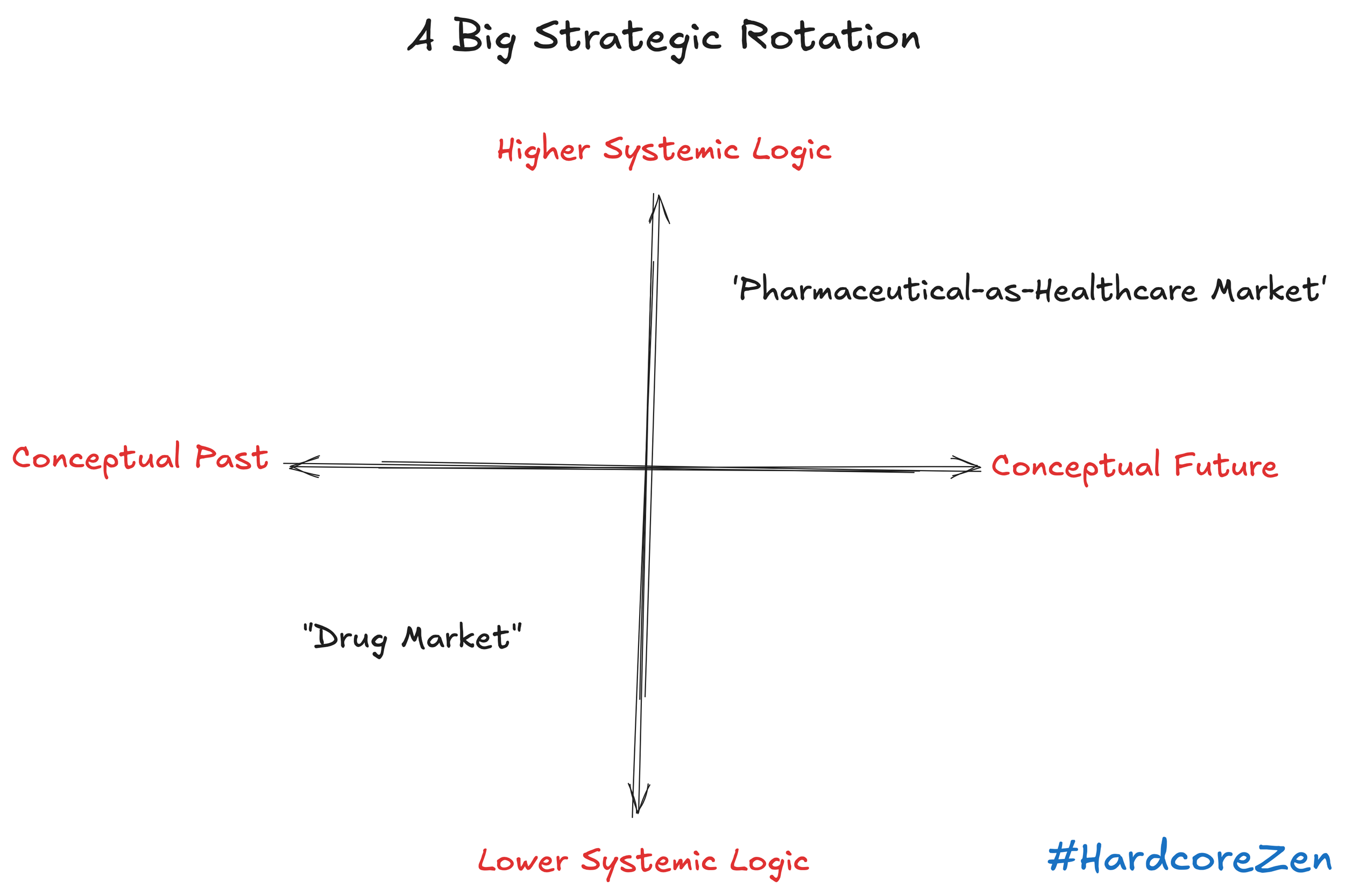
The x-axis is time — not calendar time, but conceptual time. How far forward or backward is your strategic frame? The y-axis is systemic logic — are you optimizing inside the current system, or designing the next one?
Modern strategy lives in the upper right: high systemic logic, conceptual future. That's where Amazon operates.
Remnant Context lives in the lower left: low systemic logic, conceptual past. That's where institutions go to hold meetings about the meetings they had about the problem they identified three years ago.

When You Say "Drug Market"
Many management teams miss or misunderstand the conjuring part of market innovation: markets are less 'out there' in the ether somewhere, but constructed deliberately, sparked by different words to think different thoughts, to lead with unique industry narratives.
The pharmaceutical industry still calls itself a "Drug Market." That's not a description. It's a signal. It tells you where the industry is positioned on the quadrant — lower left. Conceptual past. Lower systemic logic.
The big strategic rotation is from Drug Market to Pharmaceutical-as-Healthcare Market — upper right. This isn't a rebrand. It's a complete inversion of the competitive unit. The drug is no longer the product. The system of care surrounding the drug is the product. The molecule is a component. The ecosystem is the strategy.
Shifting the 'Center-of-Gravity'
The pharmaceutical industry's center-of-gravity problem is simple to draw and almost impossible to solve from within. "Drug Power" dominates the frame — the molecule is the product, the pipeline is the strategy, the patent is the moat. "Everything Else" — the care systems, the data architectures, the economic networks that actually determine health outcomes — is compressed into a sliver.
An ecosystem-centered strategy inverts the ratio. "The Power of Everything Else" becomes the frame. The drug doesn't disappear — it becomes a component inside a larger economic system designed to produce health, not just prescriptions. This is the Big Strategic Rotation — from drug market to pharmaceutical-as-healthcare market.


How to Escape a Doom Loop
Exit from a collapsing system is not about moral clarity or managerial discipline. It's about structural re-imagination: the deliberate design of a new ecosystem that aligns value flows, absorbs feedback, and produces self-generating markets.
You can't imagine your way to new strategy when your compensation, your board, your shareholder expectations, and your entire operational vocabulary are still encoded in the Standard Model.
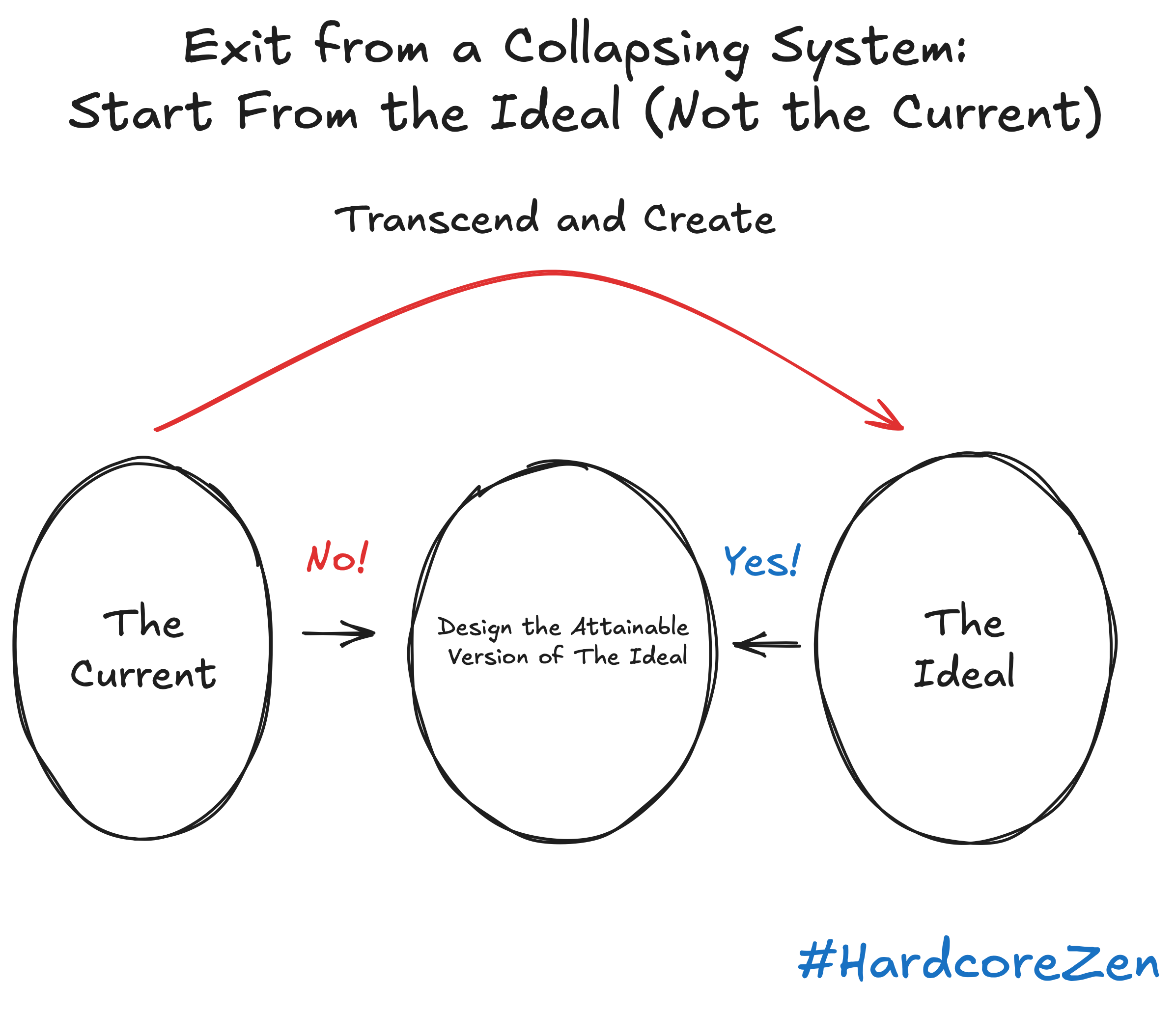
Hardcore Zen inverts the sequence. Start from The Ideal — the system as it should exist if you were designing it from scratch, unconstrained by the architecture you inherited. Then work backward to design the attainable version of that ideal.
The Missing Feedback Loop
Most of the infinitely-expanding galaxy of technology services vendors are struggling with the strategic physics, pitching LLMs that look and think like a rehash — if for no other reason than they're based on internet data that has already been scraped, cleaned, retrained, and resold over and over again to death.
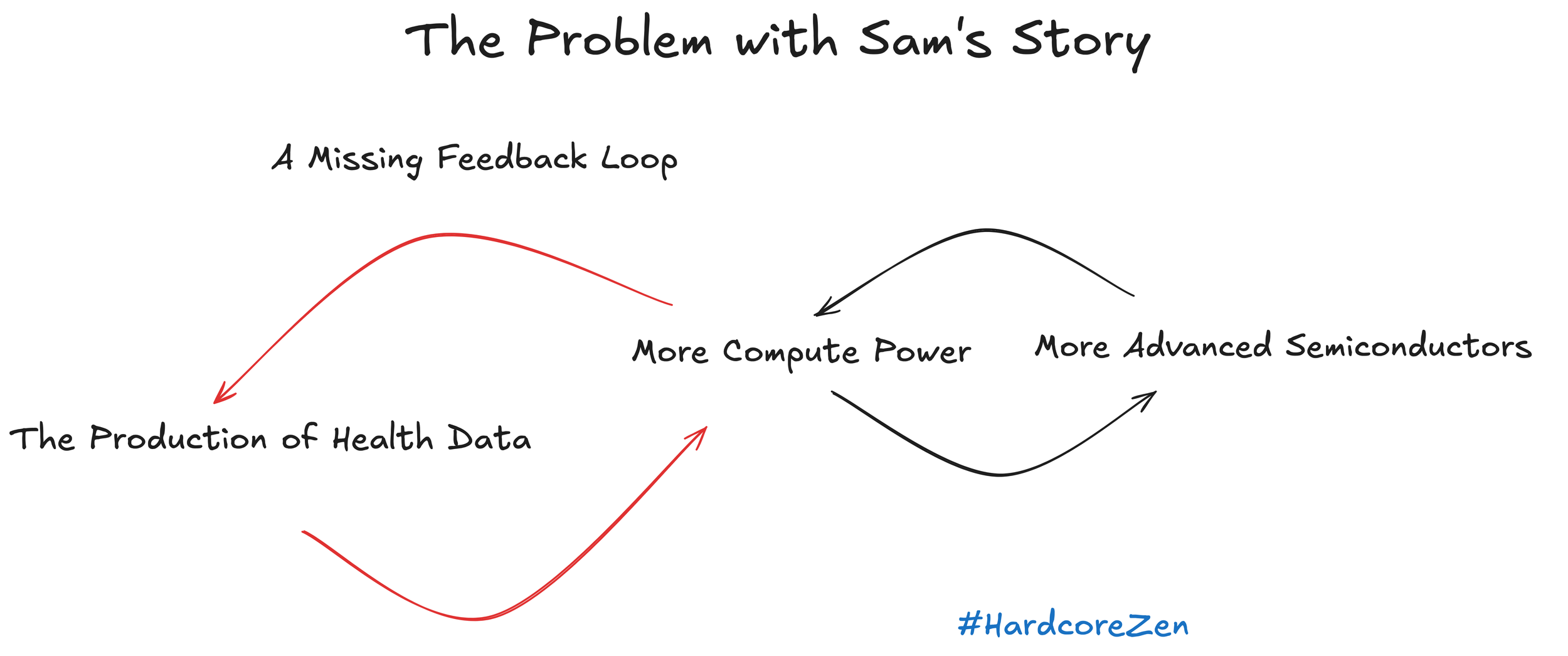
At a system level, Sam Altman has a Missing Loop Problem. His narrative runs a tight circuit: more advanced semiconductors produce more compute power, and more compute power produces better AI. The black loop is self-reinforcing. It doesn't need the outside world. It just needs more of itself.
But the red arc — the missing feedback loop — connects to the production of health data. Messy, fragmented, regulated, embedded in institutions that don't share well. It doesn't scale like silicon. It doesn't obey Moore's Law.
Ready for Modern Strategy?
Blue Spoon runs the Working Whiteboard: ninety minutes with your leadership team. One session, one chart — your market as a system, objectives positioned strategically instead of operationally, original storylines of value.
Inquire