


This Is What Happens When Your Storyline of Value Stops Computing
Reality bites. Sometimes harder than expected.
saw a rising tide of bad juju — the physics of fear and frustration, the energy of the angry and aggrieved — swallow the AI industry whole.
Silicon Valley knew the reckoning would show up in the , the outcome of which was a considered judgment by voters that they were getting a bad deal. Tech leaders had been reading the omens, most visibly in the polls showing public sentiment toward their industry evaporate. They had read a Republican Senate memo warning that campaigns alone “can not fix the toxic brand of an entire segment of the economy.”
They kept spending anyway, big and hard and deliberate, pummeling the public with a storyline of value that didn’t compute.
It wasn’t the results that took them by surprise. It was the speed and scale of the wipeout, the velocity of a context breaking apart. Which is also no surprise — it’s hard to step outside of the complexity of which you are a part and see the “causal density” of your operating environment, the number and tangle of factors that make the future hard to predict, direction harder to find. And it’s all but impossible to fix a feedback loop you’re paid to fuel.
Democrats took the House and the Senate, handing the governing party its worst losses in half a century. Candidates who ran against data centers won the governorships of Texas, Georgia, Ohio and Michigan. Local measures to ban or restrict them passed nearly everywhere they appeared. It was a mind-bending verdict on one industry’s value proposition.
As fate would have it, many of the AI industry’s leaders were gathered in Napa on itself. The WSJ Tech conference, the Journal’s long-running, annual gathering of tech executives, founders and investors, had been on the calendar for months, its panels — “AI Agents Enterprise-Wide” and “Where AI Meets the Economy” — set long before anyone knew how the election would go.
The second day of the conference was , after the returns were in. Dina Powell McCormick, president of Meta Platforms and the executive who oversees its AI infrastructure, was widely quoted on the industry’s narrative failure, the product-market fit that doesn’t fit, the strategy that doesn’t make sense, strategic or common. “The visible sort of manifestation of AI is a data center,” she said. It is the one piece of the technology a voter can point at and refuse, and on Election Day voters did.
The other visible manifestation of AI is the people who lead it, and voters can point at them too.
In a Verasight survey , Mark Zuckerberg was viewed unfavorably by 52 to 24 percent and Elon Musk by 47 to 34. , a UMass Lowell poll of likely voters had Musk down 14 and Zuckerberg “the least favorably viewed American in the survey,” underwater by 38 points — of the 29 public figures the poll rated, only Vladimir Putin fared worse.
Powell McCormick’s remedy was for the industry to get much better at explaining what it makes and what it could do for society, to push more on the allure of technical potential as the path to the betterment of the common man. “I think we need to double and triple down on telling the story,” she said.
OpenAI President Greg Brockman, also in Napa, made the same point. The industry, he said, needs “to do a better job of really communicating to local communities.”
Both are half-thoughts, floating in an orbit for innovation that defines progress in technological terms rather than economic ones.
Neither Brockman nor Powell McCormick is positioning the end state of the big vision, the what’s-in-it-for-me that is the first rule of sales. Communicate what, to local communities? Triple down on which story? Musk had already quadrupled down on a story, the one where “America is toast if the radical left wins,” spending nearly half a billion dollars on the midterms to keep the advocates for AI in office. It didn’t work.
Voters didn’t reject the technology. They rejected the terms they were offered by the technologists.

Houston, We Need a New Narrative
“Radical” and “stunning” are now word viruses, the default vocabulary of a single week of shock by those who continue to read the bones the wrong way: Regime change in Washington. Nvidia investigating its own CEO. CoreWeave’s looming extinction. Hyperscalers weighing an exit from the United States. Voters in at least 38 jurisdictions banning or restricting data centers. The grammar of surprise, now a verbal tic.
The ballot results were close to unanimous.
More than a dozen Ohio towns voted to halt or restrict new development. Alhambra, California, voted 82 percent to prohibit data centers. Sunbury, Ohio, passed its ban in a landslide. Texas, Georgia and Ohio, three of the states that elected governors promising to freeze development, hold more than 40 percent of the data center capacity planned in the U.S. Bernie Sanders was on X calling for a national moratorium.
All of it landed on an industry that was already losing the argument and, as of , had lost trillions in market value across the US, Europe and Asia. On the Nasdaq alone lost about $2.5 trillion. The same day, the Dutch bank ING put about $500 million of data center loans up for auction all at once, an unusually public exit that reportedly includes a $25 million slice of Project Jupiter, OpenAI’s Stargate site in New Mexico.
Oracle, OpenAI’s Stargate partner, has lost more than half a trillion dollars in market value since its peak in .
OpenAI’s answer to narrative collapse was to rename data centers “compute campuses,” part of its post-midterm policy and PR plan. Which is tactics from Fantasy Island, as ridiculous as Oracle’s pitch to the people of southern New Mexico — in return for their support of Project Jupiter, Oracle would sponsor Dino Dig, a park where children dig up fake dinosaur bones.
Trey Parker and Matt Stone, the creators of South Park, have a rule for why stories like that fail.
Every beat of a story has to cause the next one. Beats joined by “and then” are a list, and audiences tune out. Beats joined by “therefore” carry consequence, and the story moves. We are building AI. Therefore what? We are harvesting data. Therefore what? We are at war with Iran. Therefore what?
One word is the difference between operations and strategy. The industry’s story is all “and then.” More chips, and then more data centers, and then more capacity, and then more AI. An ouroboros, the ancient serpent eating its own tail. An infinite loop, consuming itself.
Brockman admitted there is a distance between Silicon Valley’s thinking and reality. “From San Francisco trying to build infrastructure in Texas, Georgia, and other places,” he said, “you can’t just tweet and say: ‘This is going to be good.’”
In the ground truth of towns like Upper Sandusky, Ohio, where 77 percent of voters just wrote a data center ban into the city charter, that cognitive disconnect needs a different roadmap to close, the distance to cross more like a canyon.

A New Context Layer for Capitalism
, three authors, Alex Imas, Mohamed El-Erian and James Manyika, made the most serious attempt yet from inside the industry to name what is going wrong. Two of them hold senior positions at Google.
AI, they argue, is a cooperative game. The big gains arrive only when labs, builders, employers, workers, communities and governments align on value, and they last only if each group does better inside the coalition than outside it. As the Nobel Prize–winning economist Michael Spence put it, “You cannot solve a cooperative game uncooperatively.”
You also can’t solve strategic problems with technical solutions.
The industry thinks it is in the capacity market. The people in Upper Sandusky think the industry is in the extraction market, taking data, land, water and power and paying them off afterward. Neither description gives the community a role it would vote for.
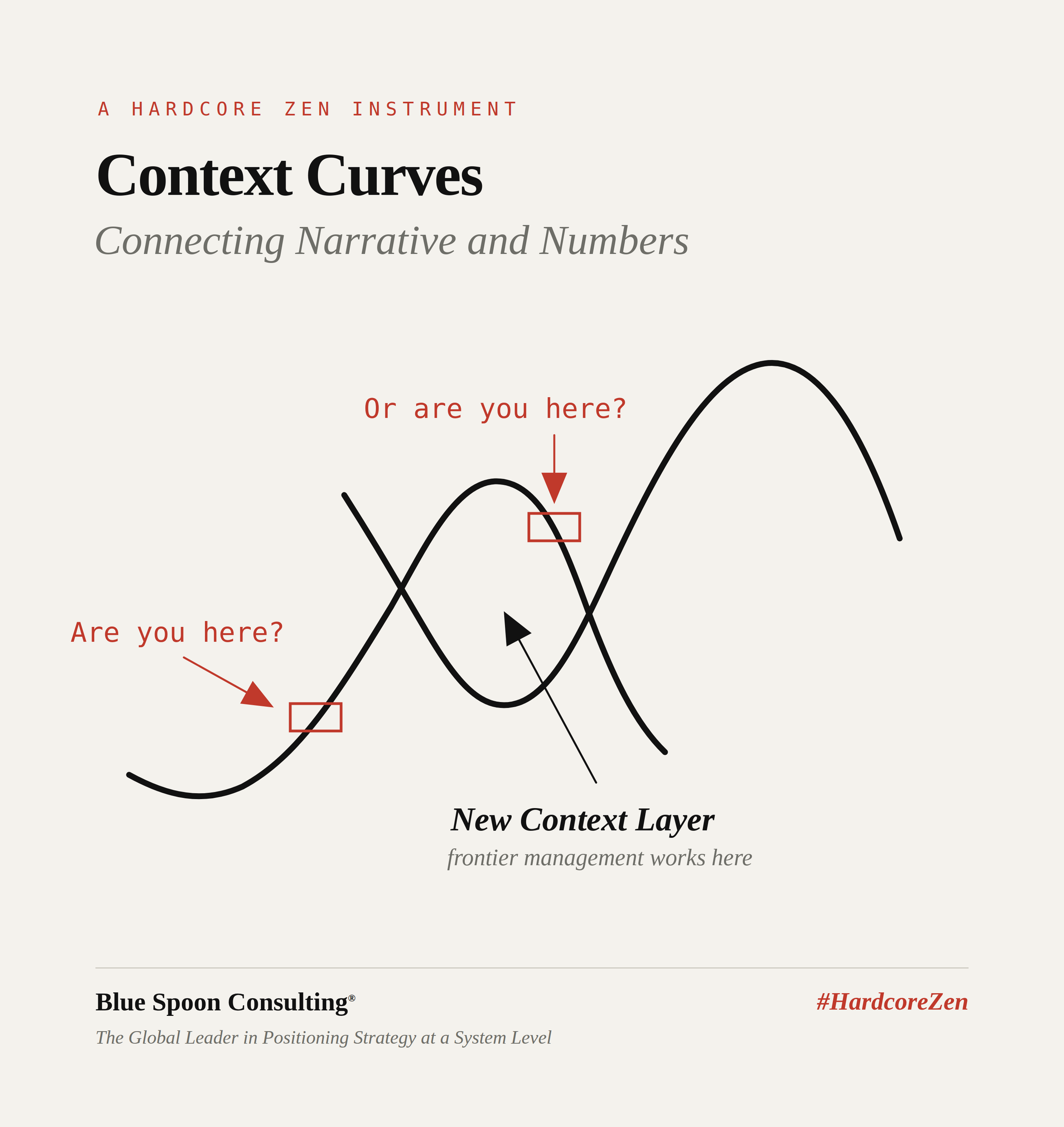
A new industry narrative solves a three-body problem — the markets that finance, the communities that host and the governments that permit. Its organizing pitch is marketcrafting for public value, the answer to Parker and Stone’s “therefore.” It is the origin story for a different mode of economic competition, combining frontier innovation with frontier management.
That means a market written into being with intention, jointly articulated with the host communities as founding members, not benefits recipients. Their water, their land, their grid and their data would count as productive inputs, with ownership attached. That economic system can’t be bought one county at a time. It has to be built, with rules everyone at the table helped write.
There is a difference between “Winning in an AI-Shaped Economy” and winning in a human-shaped economy, of which AI is a part.
The first was the frame for another WSJ panel discussion on afternoon, where the chief communications officer of Philip Morris (yes, the tobacco company) and a Berkeley Haas management professor discussed the skills — critical thinking, creativity, trust — that may decide which companies, and governments, thrive.
And I agree; those are the skills for leading through the transition space the world now confronts, another dimension of mind and body (PwC now demands them — , it will put more than 85,000 employees through a certification to help its people “develop critical thinking and judgment”).
That new critical thinking is systems thinking. The capacity to leap out of the frame and feedback loop you’re in, to see the context you’re defined by, and to position a new one to compete, create and communicate from. It’s the stuff of modern strategy, one that doesn’t follow a tech vision so much as give it better direction.

Slop Happens
The problem with the conference in wine country is the same narrative problem that has the technology industry now on its heels, the one that didn’t help its cause in the midterms: it was of the AI industry, by the AI industry, for the AI industry. The program had AI shaping the economy and humans competing for a role inside it. Voters want the reverse.
In the unwritten screenplay for a different context layer for capitalism, the lead character is people, not technology.
Anthropic is expected to go public. We’ll see whether its vibe of value, already slipping, can hold against a tide that hasn’t crested.
/jgs
John G. Singer is the founder and Executive Director of Blue Spoon, the global leader in positioning strategy at a system level. Hardcore Zen is Blue Spoon’s method for frontier management: the work of holding a position at the edge of a system still forming, rather than optimizing inside one already decided.
The Working Whiteboard is a ninety-minute session for leadership teams practicing frontier management. One session, one chart — your market as a system, objectives positioned strategically instead of operationally, original storylines of growth. Inquire.