


Why the Biggest TAM in IPO History Is Too Small
Anthropic is about to hit the roadshow circuit. It will pitch big investors not on a model but on an ambition. Its narrative rides on the past work and content of everyone on the planet paid to think. It values that work at more than $40 trillion, the biggest total addressable market any company in the history of humanity has put in front of investors. Fitting, for an industry that has laid claim to existential matters.
Anthropic’s prospectus never uses the words “total addressable market” to size its frontier. The label for the surreal, blow-up-your-brain potential came from the Wall Street Journal’s coverage , which read the $40 trillion as a TAM, and then ran some rough math on how Anthropic arrived at the number.
The Journal also set the figure against the history of IPO forecasting. Snowflake sized its market at $80 billion (it is now worth about $130 billion). Airbnb reached for $3.4 trillion (it booked about $12 billion in revenue , under half a percent of its ambition). Snowflake undershot and Airbnb overshot, which is typical. Market sizing tends to be a theory, a wet thumb held up to the wind, then printed to the decimal point.
SpaceX, , claimed $28.5 trillion and called it “the largest actionable total addressable market in human history.” Anthropic cleared that by more than $11 trillion — its near-term opportunity is about a third of the global economy and more than the GDP of the United States.
We are going to infinity and beyond. Buzz Lightyear would be happy.

Stuck in Low Earth Orbit
In the spirit of floating mind-boggling market theories, here’s another. Anthropic’s number for the future is too small because its vision flows from the past. Literally. The $40 trillion is built from payroll data, a record of what enterprises paid people to do. SpaceX, for all its altitude, has the same problem.
Elon Musk sells life on Mars, yet the biggest slice of his market is enterprise-level.
Of SpaceX’s $28.5 trillion, $22.7 trillion is AI for “enterprise applications.” The rockets point to radical progress. The money points back to the Standard Model of work — making an enterprise operate more efficiently, now with AI. Ross Perot built Electronic Data Systems on that model in , processing data for Frito-Lay and, soon after, Medicare claims. Sixty-four years later, Musk is selling the same thing.
So Anthropic and SpaceX are still circling the planet they launched from. So are the labs, by name. Claude Enterprise. ChatGPT Enterprise. Gemini Enterprise. Grok Enterprise. So are Microsoft, Amazon, Meta, Oracle, Accenture and Deloitte, and the new “enterprise consultancies” the labs are launching with private equity.
The center of gravity for these big market visions, the vocabulary positioning previously unheard-of possibility, comes down to one word. That word is “enterprise.” It sets the mind. And the mind sets the limits, for strategic imagination and for judgment. The narrow human frame narrows what the machines are told to do.
In the history of labor and business development, the customer has been assumed to be one enterprise, one market, one institution, one C-suite, one brand team at a time. Anthropic and SpaceX follow this long convention.
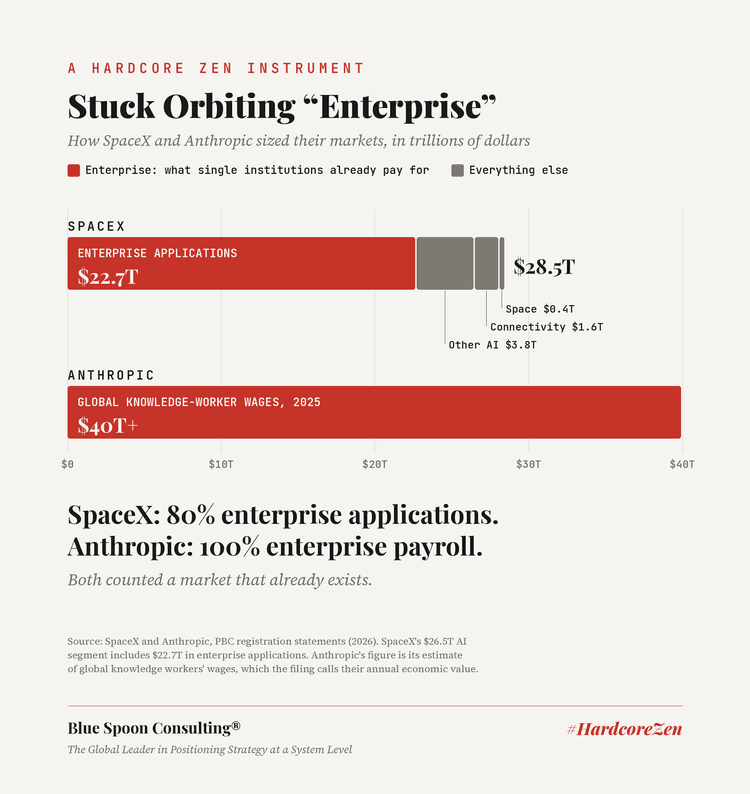
Anthropic counts as customers nine of the ten largest pharmaceutical companies, separately eight of the ten largest healthcare companies, and separately the U.S. and foreign government markets. Each gets its own product, Claude for Life Sciences, Claude for Healthcare, Claude for Government. Nowhere does the filing describe a Claude for the drug market, the provider market and the government market working on the same problem at the same time. For the company that made alignment its calling card, there is no Claude for Value Alignment.
In Wholeness and the Implicate Order, the physicist David Bohm, writing about the world at large, warned that “the notion that all these fragments are separately existent is evidently an illusion, and this illusion cannot do other than lead to endless conflict and confusion.”
In Bohm’s sense, Anthropic’s origin story is born of a fragmentary worldview. The vision in the prospectus is unsystemic. And so it can’t deliver the next-level breakthroughs its own ambition promises. The $40 trillion TAM is an illusion.

Past Is Prologue
If your jumping-off point is illogical, proceeding logically from it still produces an illogical destination. In this case, an elevator pitch that lacks strategic fit with how reality behaves.
The knowledge work behind the $40 trillion, the work Claude is learning to do, the work that produced the enterprise property that companies are now getting paid to feed into the machine built to replace the people who did it, rests on the same fault line Bohm describes. It was produced in the enterprise, by the enterprise, for the enterprise, because that is how the world of work has been organized.
Companies are selling out their workers. They are also selling out themselves. The enterprise is feeding the machine that will replace the enterprise.
The labor statistics used to calculate Anthropic’s headline number are collected employer by employer, in part because that is how the government agencies that gather the data see work. This economy pays people to think a certain way, inside enterprises, each treated as a single unit of measure. With the possible exceptions of China and Estonia, no economy has ever paid its people, at scale, to think and work across enterprises, concurrently, as a network.
And it is likely to stay that way.
Customers realize value from Claude, Anthropic tells investors, through “more productive employees, faster processes, and embedded intelligence in their products.” Two of the three are efficiency. OpenAI’s Deployment Company pulls the same lever. Everyone is running. Nobody has asked where to.
“AI is creating real productivity gains, but productivity alone is not a strategy,” Andrea Guerzoni, global vice chair of EY-Parthenon, said , after a survey of 1,200 CEOs found more than two-thirds of them focused on strengthening the businesses they already have. Strengthening a business is not the same thing as inventing a market.
The labs are getting very good at wiring their models into companies, one account after another. No one is wiring the companies to each other, into new economies.

Money Left on the Table
, Anthropic bought a one-person biotech, an early test of Mark Cuban’s prediction that AI will mint a trillionaire who is “just one dude in the basement.”
By Anthropic’s account, Mithril Medicine’s founder, Cody Tranbarger, used Claude to run contracts, logistics and experiments across 11 outside labs, and took a candidate treatment for a rare muscular dystrophy from idea to promising results in mice in under 18 months. “There is no single problem to solve,” Anthropic wrote. “The bottlenecks are distributed all throughout the drug development process.”
Bohm would recognize the illusion. So would any patient.
The bottlenecks aren’t only in the enterprises that discover drugs, the customers of Claude for Life Sciences. They’re in the enterprises that control access to health, the customers of Claude for Healthcare and, separately, Claude for Government.
Access is already evaporating — Obamacare premiums will rise another 13 percent , after 26 percent , and nearly five million people have left the marketplaces. That is on top of the 26.7 million people in the United States who had no health insurance at all . Employer plans are set to climb about 10 percent. One reason, health benefits consultants say, is AI in doctors’ offices. The tools write up each visit in more billable detail, so the same care can cost more.
The better AI gets at discovering drugs, the worse the problem becomes. Every cure like Mithril’s lands on a financing model that can’t afford it.
Each enterprise gets more efficient. The system gets less affordable, less accessible and closer to collapse.
Anthropic is measuring the production of work instead of the production of health. The TAM for Claude isn’t $40 trillion based on old workflows, the corpus of content poured into the machine from the conceptual past. It’s more than twice that in the workflows born in the conceptual future, the ones that create new context for competition. And they run not on old content data but on living biological data.
The world loses nearly 3 billion years of healthy life a year to disease and injury. Priced at the world’s average income, about $14,300 a person, that is $41 trillion. About the size of Anthropic’s entire market, every year. Priced at three times income, the most health economists have long said is worth paying for a healthy year, it is $124 trillion. With the food system’s environmental and social costs added in, the ones the disease count leaves out, the range runs from $45 trillion to $128 trillion. The middle is about $85 trillion.
Capturing it starts by adding to the narrative the two words — a noun and a preposition — Anthropic’s prospectus leaves out. The same two words missing from the “enterprise-wide” solutions and services sold by everyone since Perot. Two words nowhere to be found in the labor statistics. System of enterprises.
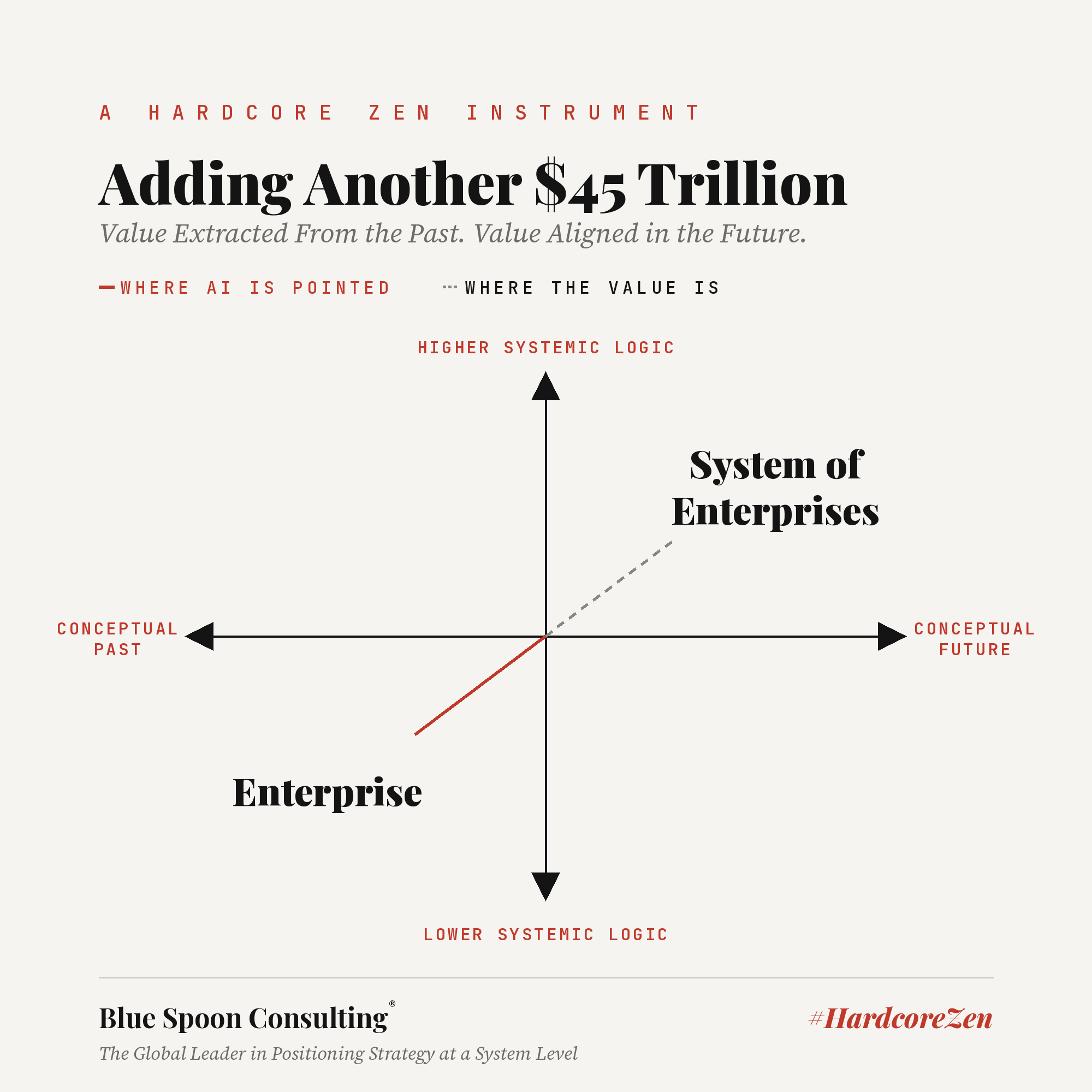
Healthcare is an N-sided market. The drugmaker, the payer, the provider, the employer, the government and the patient each hold a piece of a system that stopped working as one long ago. A cure reaches anyone only when all of them move at once. No single enterprise can make that happen. It takes positioning for value alignment across enterprises, not value extraction between them.
All the labor data Anthropic is trying to capture is a record of work already done. Biological data, from genomes to wearables to clinical records, is a record of the system itself. It is bigger than the world’s entire record of the past.

Falling with Style
We the People are now locked in a maelstrom of conceptual conflict feeding on itself. The way out starts with a mind stretch, a wider frame than the history of labor allows.
In Wholeness and the Implicate Order, Bohm traced the fragmentation to language itself. The subject-verb-object sentence, he wrote, “implies that all action arises in a separate entity, the subject.” The prospectus is written in that grammar. Anthropic is the subject. Each industry is an object. Claude for Life Sciences. Claude for Healthcare. Claude for Government. One subject, three objects, no system.
This is where the value alignment problem starts.
is the midterm election, and people are afraid. They aren’t asking to get ahead. They’re asking to hold on. Six in ten going to the polls are worried about affording health care. Nearly two-thirds say AI is bad for jobs. Nearly three in four don’t want a data center near their home, up from four in ten . Voters are turning against the infrastructure Anthropic’s plans are built on.
Discontent with the status quo is accelerating. That bad juju is becoming a business risk for the technology industry and its leaders. Blackstone now expects Anthropic to land a junk credit rating after its IPO, reversing its earlier call. OpenAI has raised less than half of the $30 billion it sought in its latest funding round. Oracle’s stock dropped nearly 9 percent after it moved to raise $20 billion — the surprise wasn’t the size of the ask but the velocity with which it needed the money.
As Woody told Buzz, this isn’t flying. It’s falling with style.
/ jgs
John G. Singer is the founder and Executive Director of Blue Spoon, the global leader in positioning strategy at a system level. Hardcore Zen is Blue Spoon’s method for frontier management: the work of holding a position at the edge of a system still forming, rather than optimizing inside one already decided.
The Working Whiteboard is a ninety-minute session for leadership teams practicing frontier management. One session, one chart — your market as a system, objectives positioned strategically instead of operationally, original storylines of growth. Inquire.