

Anthropic’s First Public Benefit Report Is an Incomplete Thought
Empires rarely die at the gates. No challenger storms the capital. No barbarian horde. Empires fail from the inside, drained by the cost of holding and defending what they took. The money runs out. The loyal elites drift away. The governed stop consenting. Then the center can no longer hold the periphery. The edge decides.
Anthropic understands this.
It is chartered as a public benefit corporation. Its board answers to shareholders, to everyone its conduct touches, and to a public benefit written into its charter. It has to account for the balance. it published its first Public Benefit Report. In it, the company concedes that a handful of companies, nations and people make the decisions that shape AI, that Anthropic is one of them, and that the result is a “significant power imbalance between the decision-makers and the people whose lives are affected by developments in AI.”
Albert Bourla understands this.
Two years after rolling out generative AI across his business, the chief executive of Pfizer had adoption without acceleration. Commoditization was congealing. He had too little of the “neurodivergent” thinking Palantir’s Alex Karp calls the leadership trait, the weirdness, that will decide who succeeds in the next version of the world. During the Concordia Annual Summit in New York in , Bourla said he wanted more “radical progress,” which means a hard break from the conventional, a conceptual shift into a different dimension of thinking to enable a different dimension of performance.
The central model, run by technology experts, wasn’t delivering for Pfizer. So he handed AI decisions to the leaders closest to the work, the ones who see the signals first, read them right and act before the center hears about them. That is frontier management. The thinking model — the frame — goes ahead of the technology model, the means to carry it out. The question for modern strategy is who sets the frame.
Emmanuel Macron understands this.
France is furious and in the streets. Protests that began in the schools self-organized into cost-of-living riots, then into a bigger feedback loop that now includes Italy, Spain, Portugal and Albania. People are pissed off and afraid, at scale. The money is running out too. France borrows heavily to pay its bills, and every riot raises the price of the next loan. “We have a mess on our hands,” said Macron’s prime minister, Sébastien Lecornu. From the classrooms of France to the walk-ups of Brooklyn, a generation is being priced out of adulthood.
Donald Trump understands this too.
He was the master of balancing on the edge, and now he can feel it slipping.
The loyal elites are drifting first. Tucker Carlson, once one of Trump’s most prominent media allies, broke with him over the Iran war. Republicans in close races are trying to outrun him. Greg Abbott, the three-term governor of Texas, the biggest Republican state, skipped Trump’s San Antonio rally . The Pew Research Center has his approval with the American public at 30 percent, level with where he left office in .
Both American political parties are underwater, though. The Democrats have lost the plot too, collectively drifting for decades, and now their edge, the Democratic Socialists, is rising against the center. The public wants what the non-consenting adults in the streets of France want. What the people of Brazil just voted for. Radical change. A “full overhaul” of the Standard Model, on their terms.
What’s happening? Everything, everywhere, at once.

“Calling on the Ecosystem”
Every empire hoping to endure needs to manage a portfolio of systems — the old and dying, the new and forming, the signal of the next one at the edge — positioned with a narrative that turns power into legitimate, lasting authority.
The AI industry, particularly the American one, the handful of companies carrying (and risking) the country, is scrambling to build that narrative in a world that is turning against it. In the United States, worry about AI now outruns excitement nearly six to one. In Europe, two in three expect the machines to destroy more jobs than they create — Microsoft offering 60,000 employees, a quarter of its global workforce, “voluntary buyouts” would seem to be another data point validating the concern. The technology hasn’t won people’s trust. Neither have the people selling it. A majority of young Americans — the ones who can’t afford a home, can’t afford a baby, can’t afford life — distrusts every AI leader the pollsters asked about, Anthropic’s among them.
Anthropic’s board set five charter pillars for itself as a public benefit corporation, each describing “a condition we want to be true in a world where AI has gone well.” Realizing them, the report says, “encompasses not only Anthropic but also governments, academia, civil society, and the broader AI industry.”
Bounding its vision within the AI industry is the first problem.
The only character with dialogue in Anthropic’s screenplay is the AI industry, which exposes a more general flaw in roadmaps to conquest, not just now but since the bow and arrow. Tech-led visions are the short road to parity. If your $40 trillion ambition is based on writing a new origin story of what comes next, other industries belong not as background characters, the customers and markets to target, but as executive producers, jointly articulating a better, more complete value proposition.
The first problem leads to the second problem, a bridge built halfway across the river, best expressed in Pillar 5.
Pillar 5 aims for AI “to develop new medicines and to fix the market that delivers them.” It caught my attention for what it misses, and misunderstands, about innovation and the pharmaceutical industry, and by extension what the cost of healthcare means for life, liberty and the pursuit of happiness, everywhere.
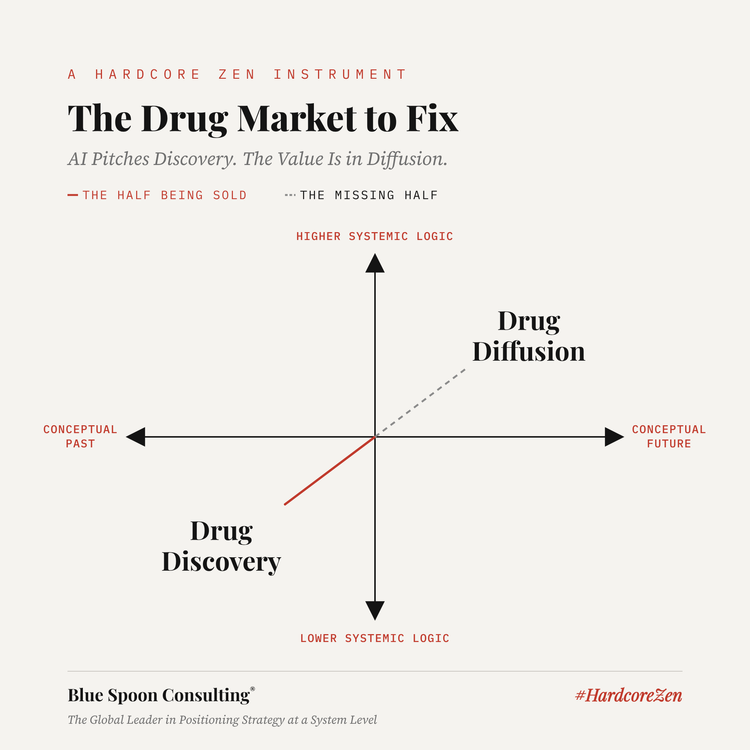
The thing to “fix” is not the market that develops new medicines. It’s the system of markets holding back their diffusion. That’s an access problem. From The Frontier Value of Biological Data, first published on Hardcore Zen:
AI-powered drug discovery pitches speed and, perhaps, an abundance of cures, but never asks the next question about access and diffusion: then what? The cure still has to get through healthcare’s embedded administrative-industrial complex — a payer system, also AI-powered, whose organizing idea is controlling “drug spend and trend.” It is a cost argument built on centuries-old actuarial models pricing the value of a life.
AI pitches discovery. The value is in diffusion. A cure no one can afford isn’t a cure. It’s inventory. At the humanity-saving scale the AI industry loves to claim, healthcare isn’t a sector of the economy. It is the economy.
Anthropic’s president, Daniela Amodei, wrote the report’s foreword. She “called on the ecosystem” to pace the frontier of innovation.
There are two kinds of ecosystems. The first is assumed to be already out there, somewhere, floating in the ether — the word used as shorthand, a stand-in for a vast, complex, self-organizing and self-sustaining organism. The second has to be designed, with intention. That’s the third problem.
Anthropic, like nearly all of the technology industry, treats ecosystems as weather to forecast, not source code to write. In its universe, everything orbits the technology. Anthropic’s Public Benefit Report offers half a narrative, and not yet a better economic system underneath it.
As if on cue, another ecosystem “out there” answered Amodei’s call, on . Not the one she was hoping for, though. Hackers came for a flaw hidden for more than a decade in the code behind 70 percent of the world’s websites. AI found it. AI is helping exploit it. Governments across Europe pulled their own websites offline. The National Security Agency told everyone else to do the same.
Digital transformation is now running in reverse.

Edge Organizations Are Marketplaces
Markets are not discovered. They are written into being after someone reads a signal at the edge, in the seam between systems. And the better ones are those that align the production of technology and the production of revenue with the production of public value.
Near the Finnish town of Muhos, Google cleared an estimated 250,000 trees for a data center before completing its environmental review, and regulators ordered the work stopped. A Finnish conservation leader called it “pure arrogance.” More than 93,000 Finns have signed a petition for tighter rules and a fee to compensate the communities that host the sites.
This is the edge, asking for terms.
Anthropic’s IPO filing warns that local opposition to data centers is growing more organized. It books the edge as a risk to its own commercial benefits, and to those of the entire AI ecosystem orbiting it, out there, somewhere. Market crafting for public value books it as an opportunity, the deliberate design of economic systems where the public earns from every AI-enabled market, product, service or revenue stream its data is mined to create.
Speaking of new opportunities at the edge:
Across the world, falling birth rates keep worsening the fiscal picture. Fewer people make fewer transactions, which means less tax revenue for the very things putting people in the streets. France recorded more deaths than births for the first time since the Second World War. Britain’s fertility rate is at a record low, and the country is broke. Its welfare state runs on borrowed money, with debt at 94 percent of GDP. The United States and China face the same arithmetic.
AI’s answer is the promise of productivity. The machines will make a shrinking workforce do more, a workforce they are helping to shrink. It is half a bridge, the same incomplete thought Anthropic’s report brings to fixing the drug market. Productivity without people is output with no one to buy it and no one to tax it.
AI’s other answer is synthetic intimacy, chatbots built to flirt, sold to a generation already having less sex, and fewer children, than any before it.
AI’s first answer leaves no one to buy. Its second leaves no one to be born.
AI needs humanity, a new licensing deal with it, and more of humanity, not less. For Anthropic’s next Public Benefit Report, a story could start with the most basic humanity-saving element of all, the production of reproductive health. It could help the company find the missing loop to a future born from value alignment, not value extraction.

Fortune Favors the Feedback Loop. So Does Destruction.
, the new AI empires started paying for consent. Anthropic committed 5 percent of its shares to a public benefit fund dedicated to “the long-term benefit of humanity,” which isn’t the same as giving humanity a cut. Elon Musk pledged a SpaceX share to every American child. President Trump told data center builders to pay a “dividend” to the communities that host them.
A gift depends on the giver. A deal depends on the terms. A dividend is a right. And a share for every child assumes there will be children to receive one.
, America’s periphery votes. Not on AI by name. On market access: the housing market, the healthcare market, the drug market, the job market. On who the economy is working for. On the feedback loop of anger and fear that “the mess” won’t be solved for the common good.
Mainstream corporate America is starting to treat AI spending as a cost, not a source of growth, with no signs of payoff outside the tech sector. An entire category of AI companies is facing “guppy-level death.” A lot of AI computing power could end up “collecting dust.” It’s another signal of a feedback loop forming, a context breaking, an operating environment morphing faster than the AI powers themselves can contain.
An empire survives only while it can cover its own costs. This one will survive only while it pays the people it is built from.
The edge always decides.
/ jgs
John G. Singer is the founder and Executive Director of Blue Spoon, the global leader in positioning strategy at a system level. Hardcore Zen is Blue Spoon’s method for frontier management: the work of holding a position at the edge of a system still forming, rather than optimizing inside one already decided.
The Working Whiteboard is a ninety-minute session for leadership teams exploring the frontier of value. One session, one chart — your market as a system, objectives positioned strategically instead of operationally, original storylines of growth. Inquire.