

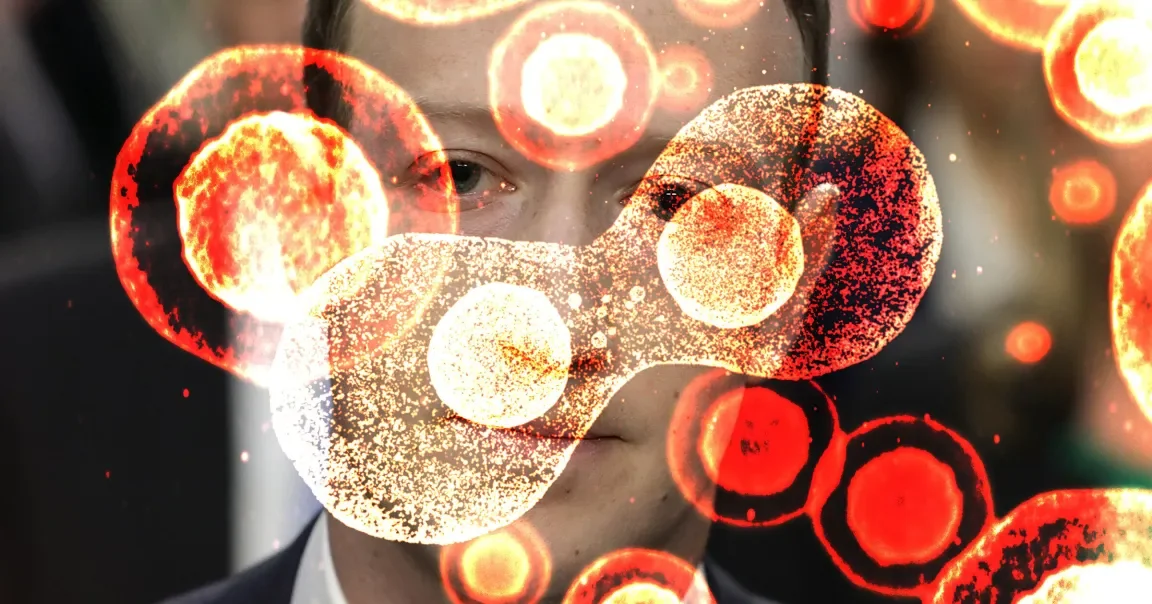
Mark Zuckerberg is building a virtual cell. I want a cut.
Around , Blue Spoon published an essay arguing that the AI industry is spending trillions on infrastructure for models that are running out of data to train on. There was about to be no fuel left for the pilgrims, the devout settlers who leave the comfort of the known to stake everything on a frontier.
That argument didn’t start with a data forecast. It started with a closer look at the half-thoughts and bets of faith that steer whole industries and governments. They’re stories whose lead characters deliver dialogue that sounds operationally exciting but stops one question short of the next level, much less of being complete. (Show me the essay.)
Then, as now, the narratives aren’t systemic because the vision isn’t. They are the sound of one hand clapping.
AI-powered drug discovery pitches speed and, perhaps, an abundance of cures, but never asks the next question about access and diffusion: then what? The cure still has to get through healthcare’s embedded administrative-industrial complex — a payer system, also AI-powered, whose organizing idea is controlling “drug spend and trend.” It is a cost argument built on centuries-old actuarial models pricing the value of a life. A diagnostic that promises to predict disease years in advance runs straight into the same then-what question. A health plan that loses about a fifth of its members every year has little reason to pay today for health whose returns it will never collect. That’s a value alignment problem.
The technology industry is telling and selling the same half-vision, the unfinished thought.
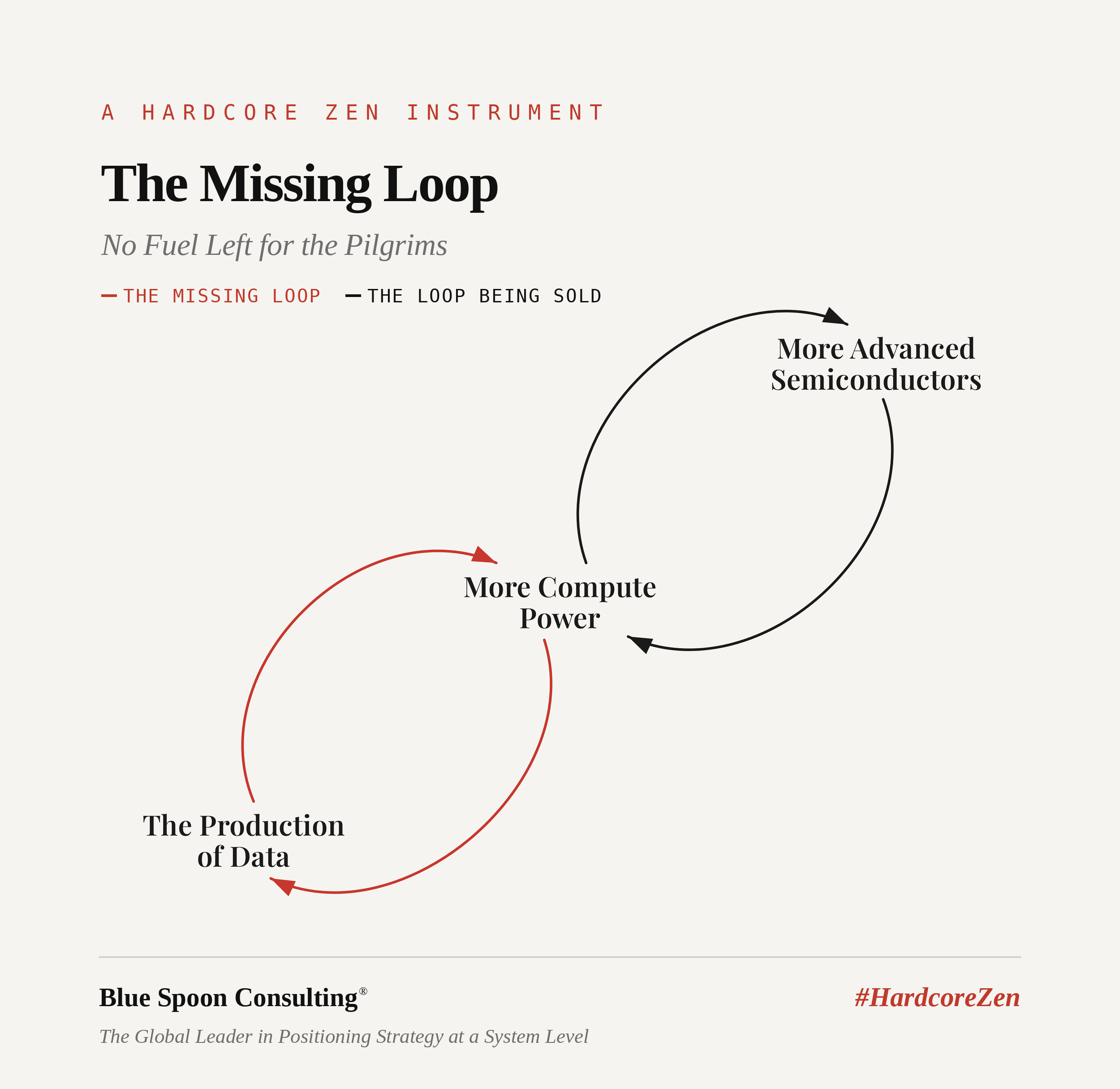
Its driving, dominating, defining — and increasingly tenuous — frame centers on compute power and the infrastructure to power compute. The result is a sprawling network of chipmakers, cloud providers, utilities and lenders, an economic subsystem kinetically trapped by the physics of its own construction. It is locked in the feedback loop of a consumption narrative. More compute demands more advanced semiconductors, and more advanced semiconductors demand more compute.
Everything in the loop, potentially the biggest capital project in American history, is running on the current stock of internet data, what OpenAI’s former chief scientist called “the fossil fuel of AI.” What little new data the loop produces is mostly exhaust: synthetic text from its own models, chat logs from its users, answers written by the data laborers startups like Mercor pay by the hour to feed the flywheel, “to get the data companies won’t share.”
So compute über alles has a “missing loop” problem: the money goes to chips and power, not to new data.
When Blue Spoon published that essay, Epoch AI, an independent research nonprofit that has advised the UK government and the European Commission, had already put the usable stock of human-written public text at roughly 300 trillion tokens. That stock — everything published online, in books and in public records, the stuff that makes AI run — was projected to be fully consumed sometime between 2026 and 2032. The shortage is Mercor’s business model. (Investors led by Felicis Ventures, with Benchmark and General Catalyst, valued it at $10 billion . Nvidia has since been in talks to invest at $20 billion.)
We’re now inside that closing window. Nobody has scraped the last page (yet), but the free part is over.
, CNN signed a multiyear deal letting Google use its journalism in AI products, joining more than 400 publications Google now pays. Anthropic agreed to pay $1.5 billion to settle with authors over roughly half a million books, and more than 100 other copyright suits are still pending. Publishers that didn’t sue signed licenses instead. News Corp’s deal with OpenAI is reportedly worth $250 million over five years, and the disclosed deals alone already run into the high hundreds of millions of dollars.
The data wall isn’t made of brick. It’s made of lawsuits and licensing deals. That money, too, goes to the old stock, not to producing categorically different data to build a qualitatively different world.
Biological Data Dwarfs Internet Data
The next frontier of value — the kind of new money that matters to Meta, UnitedHealth, Eli Lilly, Nasdaq, New York City and the United States — is biological data. The infrastructure to produce, ingest and metabolize it is going up now.
On Biohub, the research nonprofit Mark Zuckerberg founded with Priscilla Chan, announced $1.8 billion in funding, data, computation and measurement technology for a universal virtual cell, a model that lets scientists run biological experiments digitally before paying to run them in a lab. Its partners include the Department of Energy, the National Institutes of Health, Google DeepMind, Isomorphic Labs and Meta.
Biohub’s virtual cell is a move to stake a claim on the missing loop. The loop hasn’t locked itself in yet, but its contours are forming, rough at the edges, around the untapped value of biological data.
Zuckerberg is not alone.
In a startup called Network Bio raised $50 million to give AI developers computational access to tissue and blood from more than 500,000 patients at Duke, Mass General Brigham, Penn and Colorado. Oura, Whoop, Apple and Samsung are spending billions to prove that the devices on your wrist and finger can predict disease. Apple has trained a model on more than 15 billion hourly measurements from 162,000 Apple Watch volunteers. Its Health app pulls medical records from hospitals running Epic and other record systems, and it will let users order a $119 Quest Diagnostics blood panel covering more than 50 biomarkers. Quest’s rival, Labcorp, launched an AI app in , partly powered by OpenAI’s models and built entirely on lab results from the samples Labcorp processes.
All of these bets rest on one premise: a blood draw is worth more than a click. Three gaps explain why.
The first gap is size, and it runs the opposite way from what most people assume.
Epoch looked at whether protein sequences or medical data could carry AI past the data wall and concluded the stock was too small to make a dent. An analysis from Dimension, a venture fund that backs biology and AI, found public biological data “much more sparse” than the text that trains frontier models, limited “to whatever we’ve already observed.”
Counted as what already sits on a server, they’re right.
The internet has been written down. Biology mostly hasn’t. Genome sequencing alone was projected to throw off 2 to 40 exabytes a year by 2025 (an exabyte is a billion gigabytes), and healthcare data stood at 1,218 exabytes almost a decade ago, growing an estimated 36 percent a year, but almost none of it is clean, linked or ready to train on.
The second is depth.
The largest datasets AI biology has to work with top out near a billion cells, and Alex Rives, Biohub’s head of science, says the field needs an order of magnitude more. A single human body holds tens of trillions. Eight billion people walk the earth today. Meta reaches 3.6 billion every day; it knows what they click. Now Meta-via-Biohub wants to know what their cells do.
The third is value.
Internet data’s great commercial engine is advertising, a global market built on the infinite scroll and worth about $1.06 trillion . Meta, which reports third-quarter results , sold $59 billion of it in the second quarter alone. Global health spending reached $10.6 trillion in , roughly a tenth of world GDP. Internet data taught machines to talk and to sell. Biological data teaches them how life works, and that is the fuel for the production of health, the largest market on earth and its own sort of infinite scroll. A body never stops making new data.
The internet’s data is a finished stock, nearly spent. Biology’s has barely been measured.
I Am a Data Factory (and So Are You)
Internet data could be taken without asking, because its authors had already published it and had nothing left to withhold. Private health data is taken too — de-identified medical records are bought and sold every day. (They’re also stolen nearly every day: healthcare organizations reported 697 large breaches , about two a day.)
When Truveta launched its genome project, 17 health systems invested in the company and Regeneron got exclusive rights to sequence the volunteers’ samples, along with access to their de-identified records. Truveta’s chief executive likened patients joining to signing up as organ donors, “a simple act of service with a profound impact.” Whose bottom line would be impacted the most profoundly was left unsaid.
The funder got exclusivity. The institutions got equity. The data source got the language of a gift.
Network Bio sends the data it generates back to its commercial partners and the academic centers. The 500,000 patients whose tissue and blood feed it aren’t on the list. Nobody is mailing them a royalty check.
This section’s title is Nicholas Carr’s. A leading critic of what technology does to the people using it, he saw the outline of all this in an essay by that name, written in and republished .
The internet economy — surveillance capitalism — trained humanity to think of itself as a data mine, an inert deposit waiting for someone to dig, then thanked it for its service. Carr thought the data mine metaphor was wrong. People make data, actively, with their minds and their bodies, every time they drive, buy, text or post. Or get their blood drawn. That makes them less like mines than factories, and it makes the platforms something like plant managers, scripting the shift through the design of their apps.
Biology makes Carr’s metaphor literal.
A body is a living factory. Its cells divide, signal, respond and repair every hour of every day, and everyone is measuring. The continuous glucose monitor, once a prescription device for people with diabetes, is now an interface layer between the body and code, sitting on Walmart shelves for anyone curious about their metabolic health. Abbott and Dexcom alone sold more than $12 billion of CGMs .
Technology keeps assuming the physical world away, relegating it to the background in favor of a vision built on software. But in the same way an army can’t cyber its way across a river, AI can’t compute its way across a bloodstream. Real biological data is the bigger prize, and only real people make it. And it changes every time something real goes in, digested or injected. Food. Or a drug.
Life sciences — pharma and biotech — is the one ecosystem big enough to match tech, or beat it, and craft the next chapter of capitalism and economic development. It sits on exabytes of data. But it has never had the architecture, or the policy vision for total system leadership, to make that data, and the markets that produce it, work like one economy.
Health data is the most intimate data there is, but I wouldn’t call what guards it modern, or even effective, law — the American regulatory framework built to protect it was written in , for the fax machine. Still, the privacy hawks’ fear has hardened into a default assumption: people will never knowingly trade what their bodies make for money, so the only safe price is zero.
Zero is also, conveniently, what they’re paid now.

A City Asks the Wrong Questions
New York spent much of on AI.
On the City Council sat as a committee of the whole, a rarely used format that brings all 51 members into one room for an issue too big for any single committee. Senior staff from OpenAI, Anthropic, Google and Meta testified under oath on whether AI could destroy us.
Julie Menin, who leads the Council, asked them to put a number on the odds. None would. OpenAI’s witness said she didn’t know, and didn’t think it mattered. Menin called that “flippant at best.” None of the companies would commit to halting a release that failed a safety test.
On the Council turned to SpaceXAI, which had skipped the first hearing and showed up only under a rare subpoena. That hearing’s title named its organizing idea: “Continuing Discussion about the Risks Posed by Artificial Intelligence.” The bills on the table would add kill switches, third-party testing and a right to sue.
Fair questions, all of them.
They are also half a thought. Every one plays on The Fear, and asks how to prevent the possible harm wrought by AI. None asks how the city, as a market maker, could give AI better direction: to build a new tax base grown from the biological data its eight and a half million people produce. (Blue Spoon’s series The Cardiac Borough explored the frontier value of cardiometabolic health as New York’s next dominant export, built at the scale the city now brings to capital. Show me more.)
New York keeps asking how not to get hurt. It should be asking how to get paid.

In Apple We Trust
There are two kinds of people in the world: those who know their data has been hacked, and those who don’t know it yet.
That’s why I trust Apple and Chase.
By one JPMorgan executive’s count, hackers try to break into Chase 45 billion times a day. the bank is spending almost $20 billion on technology, in part to keep them out. Apple says there has “never been a successful, widespread malware attack against iPhone.” Both companies have made protection part of what they sell. Chase will make me whole when I get hit. (Disclosure: I bank with Chase and use an iPhone.)
That’s trust with my money and my phone. Trust with my biology is a different deal, and I’m ready to negotiate with the right partner. Not out of fear that my data will be extracted or stolen. For profit.
Would I hand over my biological data to a brand like Quest Diagnostics, Mount Sinai or Regeneron to monetize? I think I already have.
So has Haley Billey.
Billey bought an Oura Ring to track her fertility, and its readings eventually sent her to a doctor, who found an autoimmune disorder. She was part of a Los Angeles Times story on consumers sharing what their bodies produce with the wearable industry. In Billey’s view, the trade is simple: “I’m happy to have them use the data they get from me to build stronger algorithms.”
It sounds like generosity. It’s closer to biological acquiescence.

Taken, Not Stirred
The next version of the world won’t come from perpetuating extraction that widens a two-class economy, the kind of split that put more than half a million people in the streets of France . It will come from positioning a system for value alignment, market crafting for public benefit, stirring the Standard Model in a way that helps UnitedHealth and Meta and Regeneron make another $100 billion.
They are not the enemy. They’re trapped in what they built.
Data for free is so last era. Data equity is where the future will come from. It’s time for the AI industry to strike a new licensing deal with humanity, and I would be happy to grab a Guinness with Mark and chew on a strategy for him to lead the way. But working as free raw material to pay for his next Irish castle isn’t on the table.
Make no mistake, the rush is on, and I want a cut of what I know is already being extracted from me.
/ jgs
John G. Singer is the founder and Executive Director of Blue Spoon, the global leader in positioning strategy at a system level. Hardcore Zen is Blue Spoon’s method for frontier management: the work of holding a position at the edge of a system still forming, rather than optimizing inside one already decided.
The Working Whiteboard is a ninety-minute session for leadership teams exploring the frontier of value. One session, one chart — your market as a system, objectives positioned strategically instead of operationally, original storylines of growth. Inquire.