

Misalignment in Orlando: Oracle, AI and Systemic Value

You can’t write a future in the past tense.
Oracle opens its Health and Life Sciences Summit in Orlando tomorrow, under an invitation that says the pace of change in healthcare and life sciences is “no longer incremental; it’s systemic.”
The next era, it goes on, demands bold leadership and cross-sector collaboration. Like all the pending paradigm shifts and new world orders before it.
The Summit is framed as the moment to hear how leaders are moving their businesses and industries and policies to AI at scale: smarter payer operations, faster drug discovery, and, at long last, a new era of patient engagement. Which will presumably differ from the new era of patient engagement announced in Health Affairs thirteen years ago, under the headline “Rx For The ‘Blockbuster Drug’ Of Patient Engagement.” Or the one 48 years before that, when Lyndon Johnson’s Great Society funded the first community health centers and required the “maximum feasible participation” of the patients they served.
Now, sixty-one years later, the newest new era convenes at Disney’s Coronado Springs Resort, inside Walt Disney World.
For all that unbridled ambition around the potential of technical potential, the agenda never reaches the question of who wins or loses in the world that AI is remaking. Over three days and sixty sessions, not one mention of competition.
What it offers instead is a lesson in theme-park service.
Thursday, the last day of the Summit, begins with “What Healthcare Can Learn from Disney,” twenty-five minutes with Oracle’s CEO, Mike Sicilia, and a senior vice president of operations from Walt Disney World Resort, on operational rigor.
What that session is unlikely to address is who Disney is in the healthcare system: an employer of some 160,000 people in the United States, a buyer of care large enough that a hospital system designed a plan around it, Orlando Health’s Cast Advantage, exclusively for Disney’s “cast members” (its word for its employees). And as of last month, Disney is also a company restricting spousal coverage because its healthcare costs are climbing close to ten percent a year.
If the agenda was about alignment, or economic competition enabled by collective action, the more interesting conversation would be with the Disney executive who works in benefits, not operations. Or between Starbucks and AHIP, the trade association for health plans in the United States, whose chief executive is already speaking on a keynote panel called “The Payer Innovation Imperative.”
Because the grande latte picked up on the way to the summit tells the same story.
Starbucks has spent more on employee health insurance than on coffee beans since at least 2005, when Howard Schultz called the rise in costs “completely non-sustainable” — Starbucks is now raising health insurance premiums for its workers, in some cases close to double. In October it stops covering GLP-1 drugs for weight loss, keeping them for other conditions. PwC, a global sponsor of Oracle’s Summit, made the same cut in July, keeping the drugs for diabetes and dropping them for weight management, while selling consulting to other employers facing the same decision. Bank of America kept its GLP-1 coverage and spends more than $250 million a year on it, about 13 percent of its health budget.
This is the ground truth from the real world. None of it is on the Summit’s agenda.
What fills the space instead: connected and connecting, AI-powered, AI-enabled, AI-native, workflows, efficiency, administrative burden, clinician burden, operations, outcomes, interoperability, adoption, modernization, transformation. An operations agenda, end to end.
A market is where advantage is won or lost. This is a summit about administering one.

Operating in the Past Tense
Nothing disengages me faster than “patient engagement” marketing. But when I see “systemic” (or “systematic,” when the copy means systemic) in the promotion, I tend to stop and take a closer look. Systemic is the biggest claim anyone can make about the depth and direction of transformation. There is no concept larger than system. It is also the cheapest one to print.
Systemic has become a word virus, like “cost” and “crisis” before it, spreading through the antique narratives keeping a $6 trillion healthcare economy operating in the past tense.
It operates in the past tense for two reasons: means are being confused for ends, and the conceptual boundaries in the narratives — healthcare or the economy, government or market, technology or humanity — are still standing. And they are still standing because fragmentation is a habit of thought, not a feature of reality. It is so deeply embedded that it is, well, systemic.
Dissolving those boundaries is the work of modern strategy.
In Foreign Policy this month, Charles A. Kupchan, a senior fellow at the Council on Foreign Relations, makes the case the world’s only real hope of maintaining order is “a new international system,” although he patterns it on the past: the Concert of Europe of 1815. After Napoleon’s defeat, Europe’s great powers agreed to manage the continent together, value alignment before anyone had a name for it, a first attempt at a European order, a century and a half before the European Union.
Hope is not a strategy, though, and the problem now is that the current order has already collapsed. A future constructed from a two-century-old framework is not where I would put my money.
So the systemic work, the heavy lift, waits for someone else to pick it up. It is hard, abstract, and unfamiliar. It sounds strange in a room organized around workflows and efficiency, a room that trusts the Magic Quadrant and the Forrester Wave, so nobody wants to be the one proposing it, especially at the risk of a place in the next round of layoffs. The person with the unfamiliar idea is the easiest one to cut.
And while the work waits, the gap widens. The “completely non-sustainable” sustains itself completely.
That gap, between the ontology of the past and the one the future needs, is not strategic drift. It is strategic atrophy. Cognitive surrender to the old template, powered by AI.
The Antique Enterprise, Automated
On September 10, Oracle reported a quarter that beat Wall Street on revenue and earnings.
Revenue rose 30 percent to $19.3 billion, and cloud infrastructure more than doubled. Under its own headline in the earnings release sat a new product, an AI Data Platform that automatically generates what Oracle calls an Enterprise Ontology, “a model defining the core concepts, relationships and rules of the business.” The premise is that no company can point AI at its private data, or put agents to work inside its processes, until somebody has written down, in precise semantic detail, how the business runs.
Palantir built its reputation doing that by hand, customer by customer. Oracle says it has made the work inexpensive, easy and fast.
The trouble comes when frontier technology is used to embed an obsolete ontology — the semantics of the past — into an economic system that already runs, already pays, and is expected to produce something new, or at least different. It won’t. The industry’s most advanced tools are being used to lock in its oldest assumptions. And Oracle is not the only one selling the attempt.
PwC is running a campaign it calls the intelligent enterprise: strategy, technology, operations and governance that operate as “a single system.” Deloitte, another global sponsor of Oracle’s summit, calls it the agentic enterprise and advises clients to manage their AI agents as a silicon-based workforce. Accenture sells an Intelligent Digital Brain built to structure the proprietary knowledge a company already holds. Salesforce says it builds agentic enterprises too.
Ditto the Indian tech sector, $315 billion in revenue this fiscal year and nearly six million employees. Infosys sells a path to the agentic-first enterprise, TCS sells an agentic platform for drug development, HCLTech sells one it calls AI Force, and Wipro runs an event series branded as the Agentic Enterprise. (Disclaimer: I previously held a senior leadership role at Wipro, where I helped stand up its Silicon Valley innovation center.)
The smartest technology available is being used to sell the same destination, and to make the old mode permanent.
So the new operating model is being positioned ahead of the new thinking model, which leaves open the question of who does the strategic thinking, humans or the machines. Agency, the human judgment and power to decide and enact what gets built and what it is for, is being surrendered to the technology instead of staying with the people who are supposed to give it direction.
Or we are simply turning everything over to the ghost in the machine.
Intelligence, taken seriously, crafted strategically, has to cross the boundary of any one enterprise. That requires a different ontology. Not one company’s concepts, relationships and rules. The concepts, relationships and rules among many. Interspecies communication. Cross-sector collaboration approached as concurrent enterprising. An ecosystem, specified.
“Intelligent enterprise” is the conceptual past with an adjective attached.
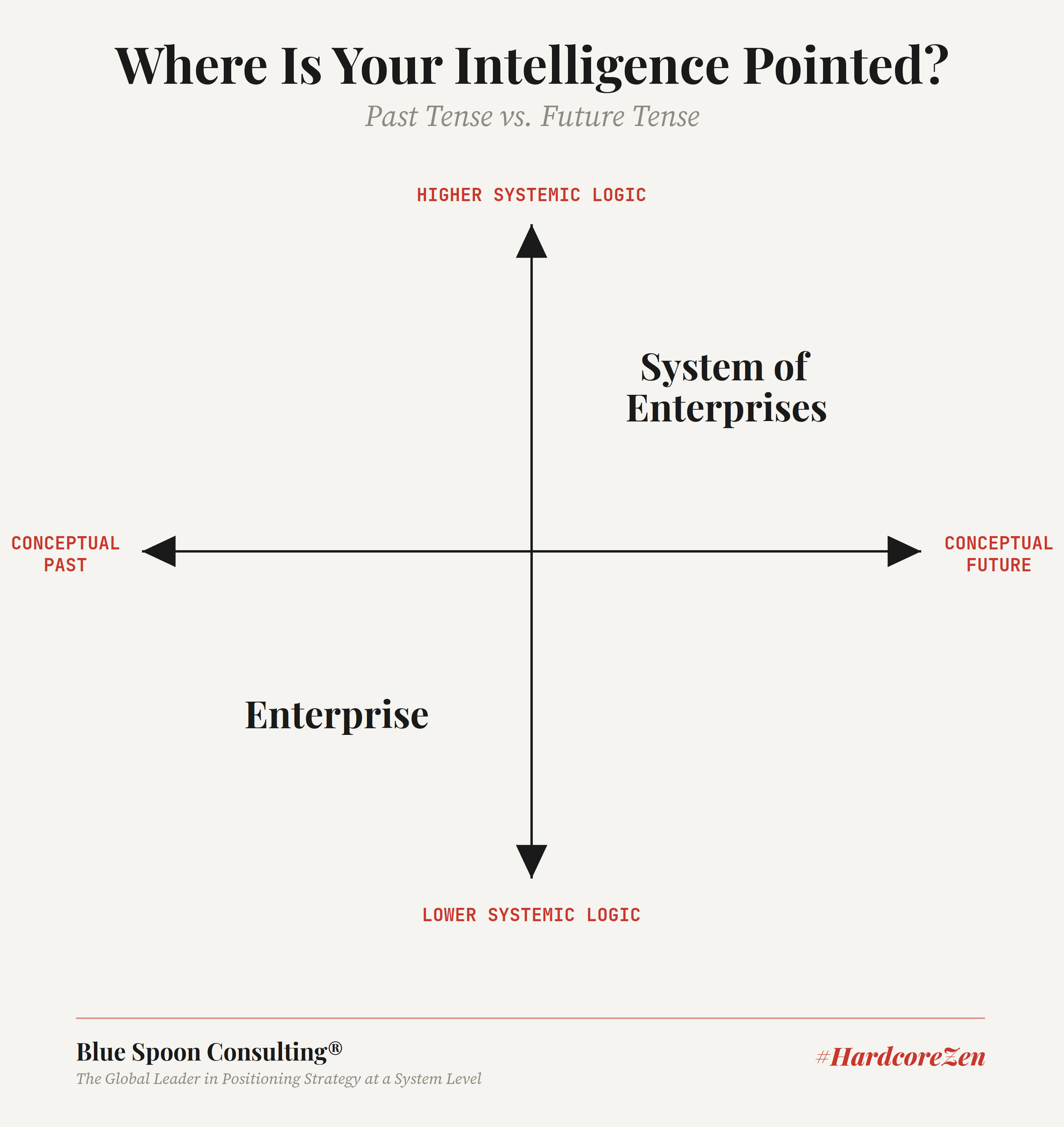
The question is no longer whether a company becomes intelligent. It is where the intelligence gets pointed. If the change desired is systemic, it gets pointed beyond the boundaries of any one enterprise.
On September 15, Quorum Health, which operates eleven acute care hospitals in rural and community markets across nine states, announced it will standardize its clinical, operational and financial technology on Oracle: the electronic health record, a clinical AI agent, patient accounting, a patient portal and a data intelligence layer, all on top of the applications it already runs on Oracle.
Every item on that list makes eleven hospitals better at being what they already are. Faster claims. Cleaner schedules. Tighter billing. Operational efficiency, organized around the old ontology. An Enterprise Ontology of Quorum can describe all of it precisely, and nothing beyond the boundaries of itself as an enterprise. The model stops where the company stops.
Going beyond it, systemically and not incrementally, starts in a different context.
The production of cardiometabolic health, not the treatment of its complications, becomes a new standard of care and a service line of its own. The electronic health record becomes a publication platform, not a billing archive, licensing the new clinical knowledge it produces to AI companies, the way the New England Journal of Medicine licenses its archive to OpenEvidence. Life sciences companies enter the ecology as collaborators with providers, developing personalized drugs and diagnostics with the patients, the families and the employers those hospitals serve.
Data equity gives Quorum’s patients a cut of the future revenue their biology creates, which makes them suppliers rather than sources. (Biological data is the one input in the AI race that cannot be scraped. It has to be given, which makes the terms of the giving a strategic question, and one of the largest open opportunities in life sciences.)
Last month Network Bio launched with $50 million in financing and a network of academic biobanks at Mass General Brigham, Penn and the University of Colorado Anschutz. It also has a $30 million licensing deal with a top-10 healthcare company it won’t name to read the disease signatures in donated tissue. Network Bio’s chief executive, Asad Ali Ahmad, says every patient “leaves a barcode of their disease in their tissue” — the patients whose barcodes these are will not be party to that agreement.
But maybe they should be.
Data equity is a licensing deal with humanity. It is an answer to the strategy question the AI industry as a whole is now confronting. The same deal could also help solve a growing narrative problem for Oracle, and for its shareholders specifically: data equity explains what a data center gives back to the community, now one of the most politically radioactive questions in the country. This includes Florida, where the Summit convenes — the governor signed a law this spring so residents would not have to subsidize the companies building them.
This is what systemic value alignment could look like, by design, not by default.

Future Tense
For the record, Accenture, Salesforce and Oracle are all worth less than they were a year ago, and so is every Indian major named here: Infosys, TCS, HCLTech and Wipro. PwC and Deloitte are partnerships, so nobody outside gets to see.
No brand, business, market, industry or government working in the ontology of the past finds its future there. The future starts with new concepts. New concepts build new context. New context changes how companies (and governments) compete, and what they create.
Oracle’s Health and Life Sciences Summit sustains the past because it thinks in fragments. It watches a hurricane of cascading strategic collapse engulf healthcare, calls it systemic change, asks for cross-sector collaboration, then names itself for two industries held apart by one word, “and.” Healthcare here. Life sciences there. That word holding an obsolete ontology in place.
Fragments have no strategic depth. Strategic depth is the capacity to take a shock and stay standing, and it lives in the connections between the pieces, not in the pieces themselves. Intelligence bolted onto a brittle arrangement of separate parts makes the parts faster, not stronger.
A summit that means to lead systemic change could start by losing the “and.” The two markets were never separate. The boundary was always artificial.
/ jgs
John G. Singer is the founder and Executive Director of Blue Spoon, the global leader in positioning strategy at a system level. Hardcore Zen is Blue Spoon’s method for frontier management: the work of holding a position at the edge of a system still forming, rather than optimizing inside one already decided.
Blue Spoon runs the Working Whiteboard, a ninety-minute session for leadership teams based on Hardcore Zen. One session, one chart — your market as a system, objectives positioned strategically instead of operationally, original storylines of value. Inquire.