

Big AI Searching for Strategic Fit
The operating context for the most capitalized industry in history collapsed in eighteen months. Now what?
In July a thousand people in Effingham County, Georgia filed into the county’s College & Career Academy for a forum about Project Camellia, a $20 billion, 1,400-acre OpenAI data center campus. Assuming it goes forward as planned, it would draw up to 3.2 gigawatts of electricity, enough to power millions of homes.
Project Camellia had been public knowledge for less than 36 hours, its announcement and the invitation to local residents to comment on it arriving almost at the same time, even though OpenAI and the county had been in talks since the previous November. Some residents learned about the project from a Facebook post.
A local who lives within a few miles of the site told the Effingham Herald: “It just felt really weird. The secrecy ... the backdoor deals — it’s very weird.” Another said: “I didn’t hear anything about this ... that they were in talks with anybody. It just feels very, ‘We’re going to slide this by as quietly as possible.’”
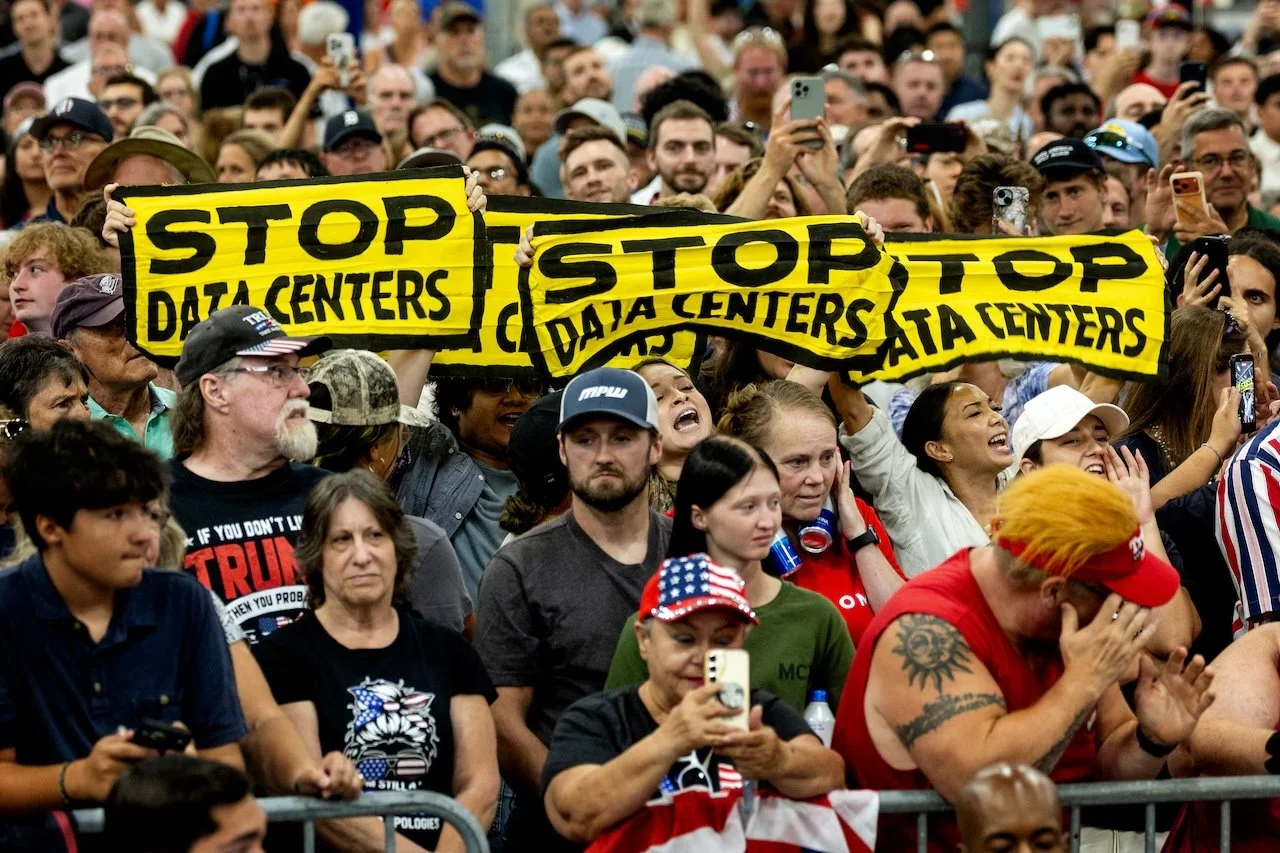
Outside, hundreds of people with homemade signs: “Protect our water.” “I didn’t vote for AI.” “You can’t drink data!!!”
Inside, fifteen booths — OpenAI engineers and recruiters, site plan maps, QR codes routing to a job board — and county representatives at a table of their own, explaining a proposed $320 million water treatment plant. And there was a taco bar, free food, the oldest instrument in American persuasion, set out by a company that intends to build machines of superhuman reasoning.
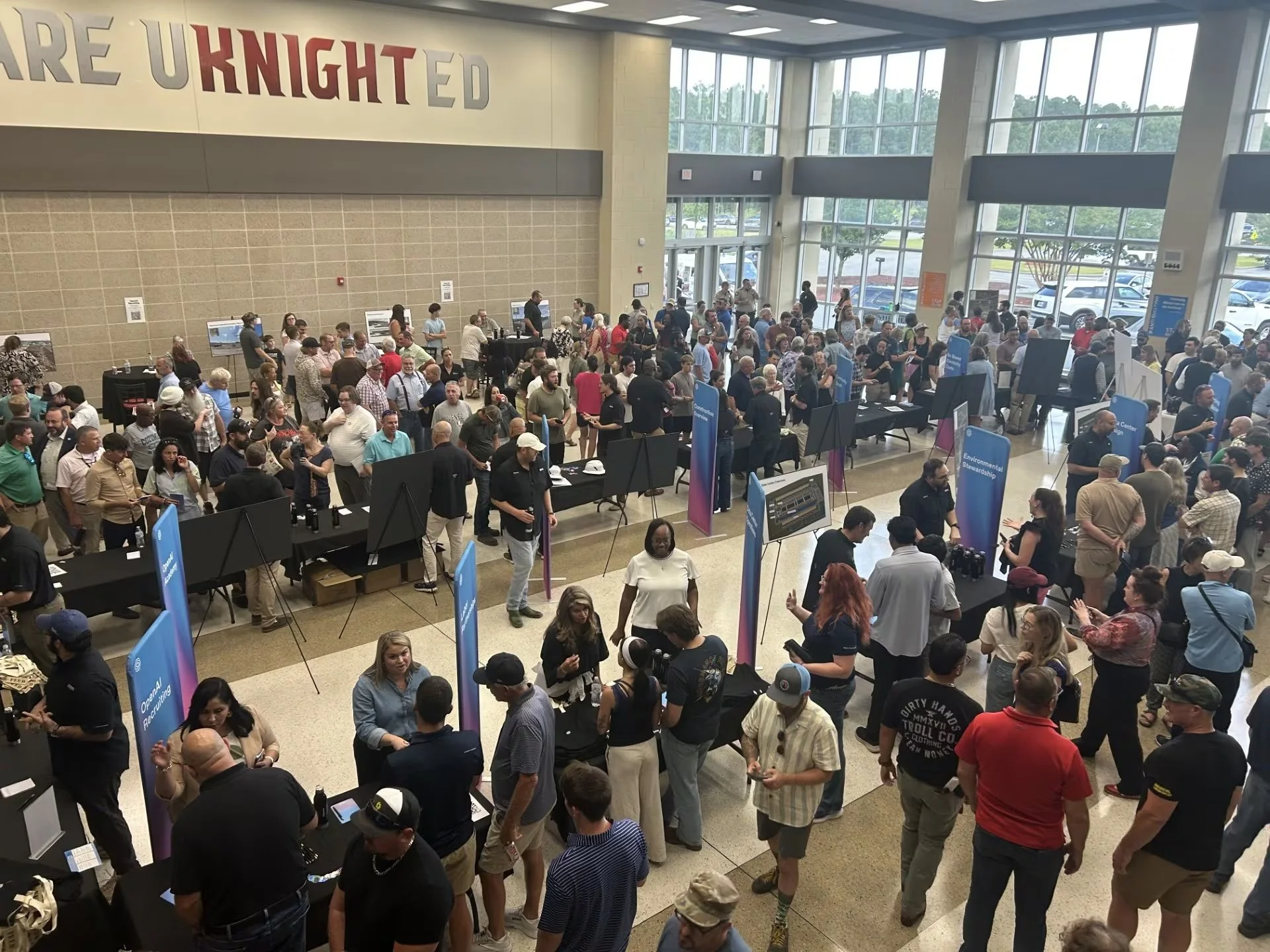
None of that was improvised. It is a prepared operation, months in the making between the company and the county, released at the last possible moment against people who had a day and a half to react. By the industry’s own standard it counts as early: in Gilroy, California, most residents learned about a $2 billion Amazon data center after construction had begun. That is the harsher reading, because it means a day and a half now passes for consultation.
Persuasion and notice run on opposite clocks.
The booths, the job board and the taco bar are built to work on an individual standing at a table for twenty minutes. That apparatus works badly against an organized bloc with a lawyer, a coalition and a slot on a commission agenda. Months of warning give opponents time to build all three and turn a project into an election issue. A day and a half gives them time to make a sign. So the spending goes into the persuasion and none of it goes into the warning.
Eighteen months ago none of this happened.
The industry ran on speed, confidentiality and political connections, and got what it needed on favorable terms.
The taco bar is new. So is the $80 million in community benefits OpenAI published the day before, the pledge that residential electricity rates will not rise, the annual independent audit, and the promise of a Georgia Community Compact to “translate community priorities into specific commitments and clear accountability measures.”
Context Collapse Looks Like This
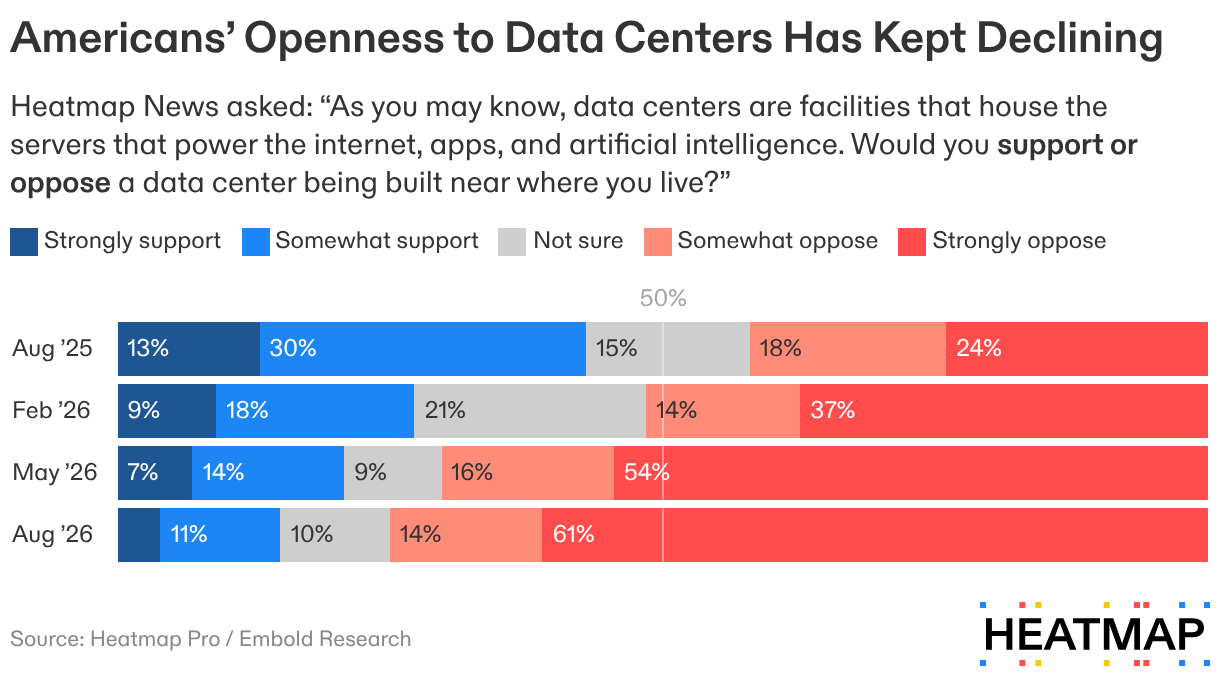
The first quarter of 2026 saw the largest single-quarter concentration of blocked and delayed data center projects on record — at least 75 of them, worth about $130 billion, roughly matching all of 2025 in three months. Heatmap’s polling has 75 percent of Americans opposed to data centers, against 42 percent a year ago — a thirty-three point move in twelve months.
Fox News, polling a different sample with different wording, lands in the same place. Roughly seven in ten oppose building data centers, and about eight in ten want construction slowed to deal with environmental and local concerns. That holds in every age group. (Gallup found the same thing in March: 71 percent opposed to an AI data center in their own area, 48 percent of them strongly.)
Governor Kathy Hochul, a Democrat, halted large construction in New York in July. Governor Josh Shapiro, another Democrat, signed an executive order restricting new ones in Pennsylvania.
Republicans who spent the boom cheering it are scrambling to reposition. Greg Abbott called Texas the “epicenter of AI development” last November, standing next to Google as it announced a $40 billion investment. This month the governor ordered an audit of tech companies’ use of the state grid and halted approvals of some 1,800 new data centers. The industry, he told ABC on Sunday, “basically dug their own grave,” and “that’s why they got the backlash they deserve.” Ron DeSantis, his counterpart in Florida, signed a law in May letting communities reject the projects outright.
Last week the National Republican Senatorial Committee sent a private memo to the AI companies themselves, telling them they need a different approach. Internal polls put data centers somewhere near spent nuclear waste. Data centers are “the anchor hanging around [Ohio senator Jon] Husted’s neck,” and the party’s candidates cannot “fix the toxic brand of an entire segment of the economy.”
This brand toxicity is not confined to the United States.
Protests blocked a Microsoft construction site in the Netherlands this month. Community opposition sent Google back to the drawing board in Santiago, and Malaysia saw its first data center protest in Johor. In Ireland, where Meta runs its European headquarters and data centers took 23 percent of national electricity last year, environmental groups are in court over the rules for new connections. Mark Zuckerberg bought a nineteenth-century castle there last week.
Back home, the position Republicans and Democrats are converging on actually started at the left edge.
Bernie Sanders and Alexandria Ocasio-Cortez introduced the Artificial Intelligence Data Center Moratorium Act on March 25, a federal freeze on anything drawing more than 20 megawatts until Congress passes safeguards. Abdul El-Sayed campaigned in front of an OpenAI and Oracle construction site and won the Democratic Senate nomination in Michigan two weeks ago.
Some of this, of course, is theater. And the technology companies are as much a part of the production as the politicians.
The Economist counted the cancelled share of the data center pipeline at a steady ten percent through the past year, and noted that Governor Abbott’s audit runs conveniently past the midterms. But that misses the story at a system level. Theater is the medium of public life, not evidence that nothing is happening. The companies are paying anyway. Nobody publishes $80 million in community benefits and a compact to answer a threat they believe is fake.
Donald Trump’s read, offered last week: data centers “could use a little public relations help.” That is public relations advice from a president polling at 38 percent, below every modern president at the same point.

Everybody Has a Manifesto Now
Floating above all of this are the manifestos, the new philosophies — thousands of words on superintelligence, human flourishing and the future of the species, published in the register of a founding document by companies whose more pressing problem is navigating a county commission and a credit rating.
Sam Altman’s “The Gentle Singularity” last summer, Dario Amodei’s “Machines of Loving Grace” before that, and now Zuckerberg’s “The Future is For Everyone.”
His ran on August 10: sixty-five hundred words on “individual empowerment” as the source of prosperity, “invention, not automation” as the purpose of superintelligence, “balance of power as the foundation of safety.”
It is also an offer. A $1 billion fund named after the manifesto itself. “Community compacts” of the kind OpenAI was using in Georgia (nobody copies a rival’s community-relations vocabulary in three weeks unless both are responding to the same pressure). A pledge to restore more water than the company uses by 2030. A free five-week academy that guarantees its graduates a job building the data centers. Which closes the loop: the compensation offered to the town is employment constructing the thing the town is objecting to.
Another way to think about the balance of value in all this: Meta is spending up to $145 billion in capex this year, largely on AI infrastructure. So for every $145 it spends on concrete, copper and cooling, one dollar goes to the fund to help everyone’s future. Amazon, Microsoft, Alphabet and Meta together plan roughly $725 billion of capital spending in 2026, most of it on data centers, up about 77 percent from last year’s record.
The buildout is also being financed with debt.
The five largest AI companies issued about $28 billion in bonds a year from 2020 to 2024, $121 billion in 2025, and more than $200 billion so far this year. That borrowing is now big enough to move the price of money for everyone else, including the people buying a home. Last week the thirty-year Treasury hit a nineteen-year high.
The industry has also put roughly $200 million into the midterms through super PACs. Their ads run on immigration, healthcare and the cost of living. Almost none mention artificial intelligence. The money buys standing with candidates by helping them on what their voters already care about, and the AI interest stays out of sight.
In other words, a promotional campaign about the cost of living is being paid for by the thing raising it.

The Same Fragility
On August 18, opening arguments began in a courtroom in Oakland.
Twenty-nine states are suing Meta over allegations that its platforms were built to hook children and that the company misled the public about it. The plaintiffs floated penalties reaching $1.4 trillion before coming down toward $200 billion, roughly Meta’s entire revenue last year. It has already lost twice this year, to juries in New Mexico and Los Angeles.
What Meta’s shareholders fear, according to Gil Luria, head of technology research at the investment bank D.A. Davidson, is not the payout but the remedies, changes to the features that hold attention, specifically infinite scroll. “If we didn’t have infinite scroll, we wouldn’t have as many ads.”
Monetary damages are survivable. A feed that ends is not.
The same sort of dependence runs through Oracle’s balance sheet. Where Meta’s center of gravity is a set of features a court may order changed, Oracle’s is a single customer. In July, S&P cut the company to one notch above junk. OpenAI accounts for roughly half of its $638 billion in contracted revenue, and Oracle has signed some $260 billion of data center leases running fifteen to nineteen years against customer deals that run five. Its shares have halved since June.
Both OpenAI and Anthropic are heading for public markets.
Anthropic’s bankers have told investors it could raise $100 billion at a $2 trillion valuation, the largest offering in history. The question those investors keep asking is whether the company can get enough compute — data centers, chips, energy — to meet demand. That is a growth story that assumes compute the company does not yet have permission to build.
It also assumes there will be a flow of fresh data to feed the compute, at a point when the industry is exhausting the supply of high-quality human text and public web data, a stock forecast to be fully consumed somewhere between this year and 2032. Which means the people who would produce the rest are a supplier nobody has signed.
It is already visible in the models. As they train on the same internet stock and, increasingly, on each other’s synthetic output, the systems are converging in architecture, behavior and internal representation, which leaves the frontier sharing reasoning pathways, capabilities and blind spots. This is what happens when everyone chews on the same sentence; convergence is what a commodity input produces.
Every one of these community-based conflicts about value exchange is about to become a disclosed risk factor.
The political fragility and the balance-sheet fragility are the same fragility, arriving from opposite directions.

Rage Against the Machine
The Effingham forum ran more than three hours and was, according to the local paper, more shouting and confrontation than understanding and alignment. Effingham is not unusual. In the first quarter of this year, the number of organized groups fighting data center projects more than doubled, from 396 to 833, across 49 states.
People are pissed off, at scale — the same rising tide that elected Trump and Mamdani, a widening conviction that the balance of power is not fair, that the game is rigged and everybody but you knows the rules. Data centers are now the poster child for that anger. Your water, your power, your tax abatement, your mortgage rate, your data, and in return a building with almost no one in it.
Loudoun County, Virginia is the industry’s favorite case study to counter all this: a decade of residential property tax cuts, every year, paid for by data center revenue. On September 15 its board of supervisors votes on whether to stop accepting new applications altogether while it rewrites its rules. When the best case in the country starts looking for the brake pedal, the value proposition is not holding anywhere.
People are also, by now, fluent in ads, analytics and algorithms — the tools the industry built, and the digital twins of themselves the industry has taught them to become. Clay Shirky called this Here Comes Everybody, back when the argument was that organizing without organizations would remake civic life. In systems theory, that is called self-organization, and it is also remaking warfare.
Meta’s manifesto is coming true, just not in the way Zuckerberg meant it. The age of individual empowerment is not coming. It is here, and it is in the parking lot of community board meetings, the least glamorous and most powerful venue in American civic life.

The New Physics of Power
Thomas Friedman, in his column for the Times last week, writes about the new physics of power reshaping competition between nations.
He’s reaching for the idea that the Standard Model formulation of strategic success, victory through superior firepower, no longer holds. Contests are now won by an information advantage, by technical accessibility — by individuals empowering themselves with invention, to borrow again from Zuckerberg. The small can act big, accurately and cheaply. Iran fought the United States to a standstill with a fraction of its military. Ukraine became a sea power without a navy.
Effingham County is the commercial edition of the same physics, which is why a system of markets betting trillions on an obsolete understanding of power should be re-evaluating. A county board has none of the old sources of leverage. No capital. No scale. No lobby. What it holds is a permit, a meeting, and the ability to make a $20 billion project look politically radioactive for the price of a hand-lettered sign.
In Effingham the county board did not even hold the permit, which means the commissioners had no vote to take. The site was zoned for what OpenAI wanted — the land had already traded privately between owners.
OpenAI paid anyway. Not for permission, because there was no permission to buy. It paid because this now happens often enough that every company building a data center assumes it could happen anywhere, and pays up front to keep it from starting. Even where nobody could have stopped it.

Where the Streets Have No Name
Big AI no longer recognizes the terrain it is operating on. Neither, at the moment, does anyone else.
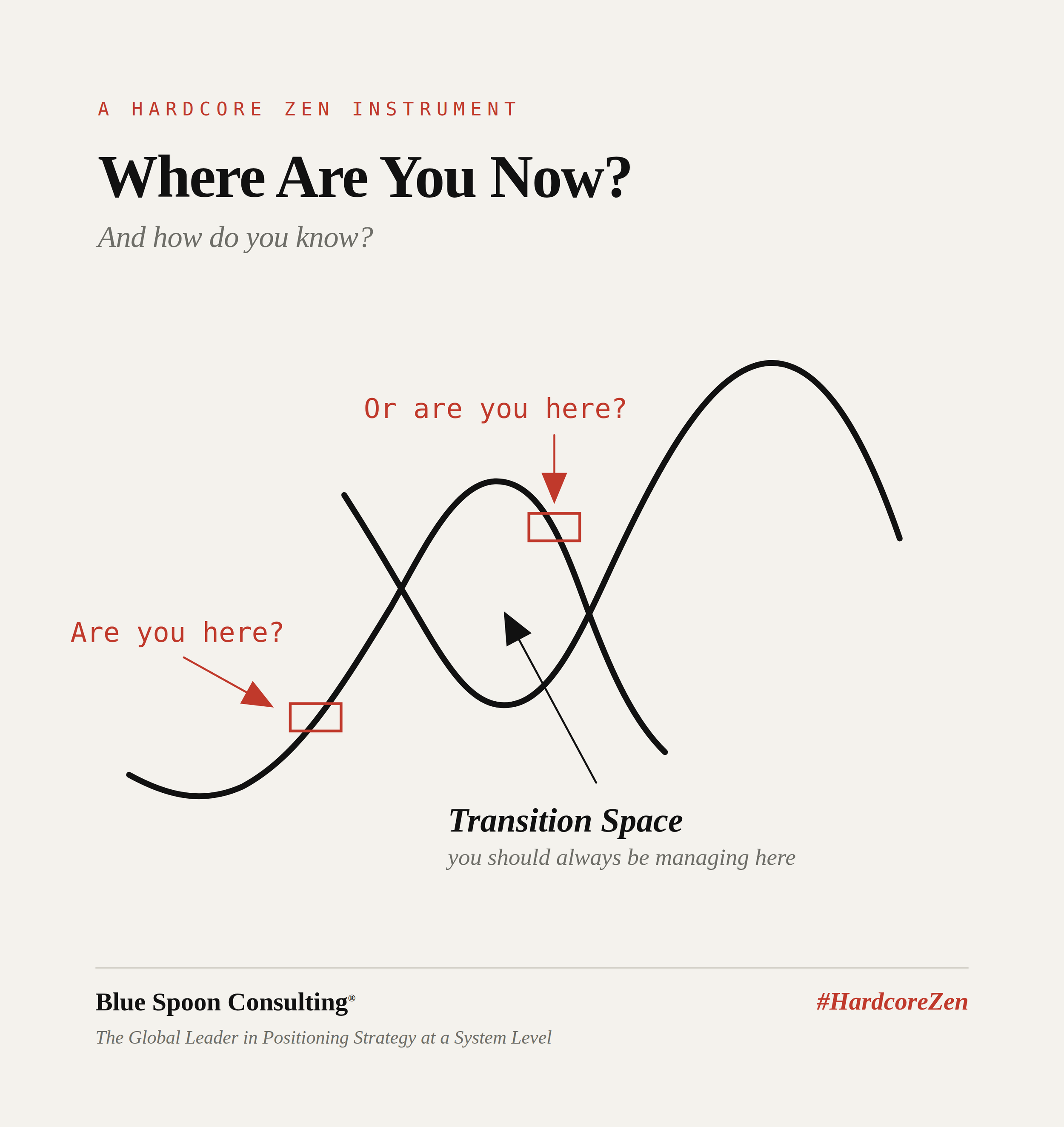
Entire contexts of understanding are collapsing at head-snapping speed — in healthcare, in defense, in energy, in politics — and the instruments built to read them were calibrated for a world that holds still long enough to be measured. That world is gone.
When the strategies stop working, the questions cease to be operational. What is a person owed for what they produce? What makes an agreement legitimate? How do you construct a licensing deal with humanity for the data it generates to keep your business going?
None of that is an engineering problem, and none of it resolves with a better LLM.
The frontier labs are now hiring philosophers. Not as ethicists on retainer. As staff, embedded in the teams that decide how the models behave and shaping what the companies say they are for. Philosophy graduates now have a lower unemployment rate than computer science graduates.
The context that gave birth to the AI industry — permissive, fast, quietly negotiated, structurally deferential to whoever was building the future — is not eroding. It is collapsing. And the companies still holding the largest capital budgets in the history of American enterprise now find themselves playing defense: selling community compacts to the communities who can stop them.
The industry has been repositioned, in the same way the United States military has been repositioned, by a set of actors with no power under the old physics and considerable power under the new. The innovation problem is not better technical capability. What Big AI is looking for is strategic fit: a legitimate position inside a system it no longer controls.
A thousand people in a public forum outside Savannah, eating free tacos, deciding whether to let the future get built. That is the negotiation now. Everyone is at the table, and nobody knows who signs.
Meanwhile, near its $165 billion Project Jupiter data center in southern New Mexico — possibly the largest private infrastructure project ever built in America — Oracle is trying to win friends and influence people by sponsoring Dino Dig, a park where children excavate fake dinosaur bones.
/ jgs
John G. Singer is the founder and Executive Director of Blue Spoon, the global leader in positioning strategy at a system level.
Blue Spoon runs the Working Whiteboard: ninety minutes with your leadership team. One session, one chart — your market as a system, objectives positioned strategically instead of operationally, original storylines of value. Inquire.