

Running in Oatmeal

The Road Ahead for PhRMA’s New CEO?
Doug Beck spent fourteen years at Apple, leading its businesses in Northeast Asia and the Americas, then two running the Defense Innovation Unit, which he helped found in .
The DIU is the Pentagon’s office for mainlining commercial technology into the military. It is a bridge from Silicon Valley to the armed services — Beck would frame the objective as “focus, speed and scale” — with a mission to “convert capitalism into combat power,” to beat China through constant churn and continuous upgrade. Military competition becomes a product cycle, like new iPhone introductions and software updates.
Technical potential is scale-free, though, with no natural ceiling. Which means there is no beating a rival simply by outproducing its technology.
The critic Nicholas Carr called a version of this the endless ladder, the assumption that progress in production technology, from robotics to analytical software to artificial intelligence, means always chasing the next operational improvement.
Faster is still just faster, a yardstick. And speed is not direction. Nor is it an advantage against a rival with deep enough pockets to keep pace. China can match the United States. Samsung can match Apple.
China also competes differently. It constructs context, the system around the technology: industrial policy, supply chains, standards, markets. Together, they add up to infrastructure — not just the rails technology runs on, but the center of gravity that pulls everything else in. Beijing even has a name for it. Its new five-year plan calls for building the “Six Networks” — water, power, computing, communications, urban pipelines and logistics — as one integrated whole.
With an infinite flow of new technologies, defining purpose for the machine only gets harder, more nuanced, more interdependent with things that sit outside “the enterprise.” So the operational answer fills the vacuum where vision should lead. It is easy to explain. It is easy to measure. The DIU even says so. It solves “operational problems” for combat power. The next-step question, combat power to achieve what objective, is not part of the remit: to therefore do what?
The technical frame is standing in for a strategic one.
Every business — indeed every city, every university, every health system, every trade association, every economy — wants its own Silicon Valley-like object, and most have built one. Silicon Wadi in Tel Aviv. Silicon Roundabout in London. Cyberjaya outside Kuala Lumpur. Skolkovo outside Moscow. Walmart’s Store No. 8. Siemens’ next47. Johnson & Johnson’s JLABS. ARPA-H, Washington’s DARPA for healthcare. And everywhere, the chief AI officer.
It is a superbloom.
Donghyun Park, an Asian Development Bank economist, called the genre “Silicon This or Silicon That.” Very few had succeeded, he wrote, and very few were likely to. Most were “often quixotic” efforts that rotated in an orbit of central planning, circling back to reinforce the Standard Model they were hoping to escape. Walmart’s Store No. 8 has since been folded back into the mothership. Johnson & Johnson’s JLABS is closing sites one by one.
One bloom dead. Another wilting.

Complexity Is Its Own Biology
Beck’s essay in Foreign Affairs , “America’s Missing Military Revolution,” is a field report from someone who spent two years trying to push technology through the Pentagon. The economy that grew Silicon Valley, what Beck calls the most sophisticated country in human history, cannot field a military that adapts as fast as its technology.
Officers who understand the need for speed, he writes, feel as though they are “running in oatmeal.”
Procurement is bound to an acquisition system — a military-industrial complex — with an origin story that dates to , when Congress standardized wartime purchasing. Eisenhower gave it that name in his farewell address, cautioning against its “unwarranted influence,” a departing president warning about what would outlast him.
The same speech carried a second warning, quoted far less often. Public policy, he said, could become “the captive of a scientific-technological elite.” An early draft had named a “military-industrial-scientific complex,” until his science adviser talked him out of the third word. Sixty-five years later, that elite builds AI, and its influence over policy is no longer unwarranted. It is invited.
John Maynard Keynes saw a version of this coming.
In he predicted that technology would make his grandchildren’s generation rich enough to work perhaps fifteen hours a week. The wealth arrived. The leisure didn’t. , the Princeton economist Markus Brunnermeier built an AI version of Keynes from his writings and asked it about AI. The avatar warned that the technology could concentrate expertise, and with it power, in the hands of a few. Whether it does, “Keynes” said, is not decided by the technology itself. It is decided by the rules around it — the context that gives it voice and direction.
Complexity becomes its own biology. Nobody plans it. It accretes, one reasonable fix at a time. In a defense market that has grown roughly fivefold in real terms since 1947, to about $1 trillion today, every overrun and scandal of nearly 80 years added a rule. Every rule was sensible. Every rule grew a constituency to defend it and to make money from it.
The American Way of Healthcare took shape in the same years and has its own sort of biology. The system just has more buyers, more markets and more money: $5.3 trillion a year, five times what the nation spends on defense. Whole businesses are built on reducing administrative waste. Revenue cycle management, the business of getting providers paid, is a roughly $65 billion market, headed for nearly $200 billion by 2035. It is growing faster than healthcare itself. Claims management, the business of processing and contesting what gets paid, is a market of about $7.5 billion, and growing, aided by the power of AI.
Two companies, Epic and Oracle Health, run the electronic health records in most American hospitals. Three pharmacy benefit managers, CVS Caremark, Express Scripts and OptumRx, handle roughly 80 percent of the nation’s prescriptions.
Healthcare’s administrative-industrial complex differs from the Pentagon’s in one respect. The Pentagon’s slows new technology to a crawl. Healthcare’s absorbs it on contact and turns it into more complex.

The Abundance Problem
the Pharmaceutical Research and Manufacturers of America named Eric Cantor, the former House Majority Leader, its next president and chief executive, effective . In his first statement, Cantor said he was honored to join the industry’s efforts to expand patient access and to “leverage the promise of AI to speed discovery” of new drugs and, presumably, new cures.
The industry is at a “pivotal moment,” PhRMA said in its announcement. Merck CEO Rob Davis, who chairs PhRMA’s board, said Cantor would lead the organization through its “critical next chapter.”
But technical discovery is not where the industry’s commercial system is stuck. The molecule is the thing pharma already produces well. What it cannot do is get the molecule through a second, competing system of friction and on to the patient.
Today, 46 gene therapies are approved somewhere in the world. Some are cures. Some are cures struggling to find a market. Behind them sits a global pipeline of nearly 23,000 drugs, 4,487 of them gene, cell and RNA therapies. If AI delivers as Cantor hopes, 23,000 becomes 46,000, and the ones that work reach approval faster, with a Food and Drug Administration already using AI to speed its own reviews.
The tech-led stairway to heaven is everywhere.
Mark Zuckerberg tells a16z that to AI researchers, the goal of curing all disease this century now sounds “kind of boring,” as if it will simply happen. Dario Amodei has written that AI could deliver “the next 50-100 years of biological progress in 5-10 years,” from the elimination of most cancer to the prevention of Alzheimer’s. Anthropic now says its AI has discovered a new enzyme system resembling CRISPR, the revolutionary gene-editing tool, which suggests the compression may already have begun.
It is hard to see how the “other system” ingests the promise.
The drugs that could end the obesity epidemic already exist, and they work. Getting the people who pay to treat obesity as a disease is another matter. Only about a third of employers cover them for weight loss. Four states dropped Medicaid coverage on , citing their budgets, and Medicare began paying for them only , through a temporary program.
And the stairway already has a use case, climbed in . , Gilead launched Sovaldi, a pill that cures hepatitis C, at $84,000 a course. At least 27 state Medicaid programs restricted it to the sickest patients. In , Medicaid spent more than $1 billion on the drug and still treated fewer than 3 percent of the roughly 700,000 enrollees who had the disease. State Medicaid budgets were stretched so thin that in the physician Peter Bach and Mark Trusheim of MIT published a proposal. The federal government, they argued, should buy Gilead outright, for about $156 billion, sell off everything but its hepatitis C drugs, and cure most Americans who had the disease.
Nick Bostrom, the Oxford philosopher whose book Superintelligence shaped how much of the technology world thinks about AI, recently said on a podcast that for the transition to superintelligent AI to go well — not doom, not utopia, but somewhere practical and possible in between — two kinds of problems have to be solved. The first is alignment, the work of keeping ever more capable systems doing “the things we intended for them to do.” The second, which he calls governance, is a strategy problem: what ends will we humans put the machine to?
, for the first time, China launched more new drugs than any other country. American labs may still lead in first-in-class medicines, the genuinely new ones. But faster invention is no longer an American advantage, in medicine or in war.
Which leaves a practical question for the Western drug market as a whole, one Hardcore Zen has asked before — if China develops the AI-powered medicine that could cure my father’s cancer, at a fraction of the cost and zero friction, and then positions it at the center of a medical tourism network, why wouldn’t I fly there to get it?
Three months after that essay ran, The Wall Street Journal reported that patients are traveling to China for the latest cancer treatments, with Shanghai a favored destination for its biotech innovation, lower costs and Western-trained, English-speaking physicians. An MD Anderson specialist now advises some of her overseas patients to go.
Call it blue ocean, call it white space, call it competition at a system level — the bigger opportunity for PhRMA’s new chief executive is not advocating for faster, better, more drug discovery via AI. It is innovation diffusion, aligning the value of two systems that work against each other. One economic system makes and practices medicine. The other makes and practices friction. Both are growing. Neither is organized around the production of accessible health as a policy objective.

On Pivoting and Positioning
Eli Lilly became the first drugmaker worth more than $1 trillion, and investors now value it more like a technology giant than a pharmaceutical company.
Its chief executive, Dave Ricks, recently described the business he wants to build, and with it a new market narrative, one focused on keeping people healthy rather than only treating disease. He calls healthcare transactions among the “most miserable, difficult things” people experience.
For the production of health to work as a market at scale, the industry will need to invent a different economy beyond the Standard Model, “now powered by AI.” It means pivoting from a drug market, organized around the molecule, to a pharmaceutical-as-healthcare market, organized around continuous health engagement.
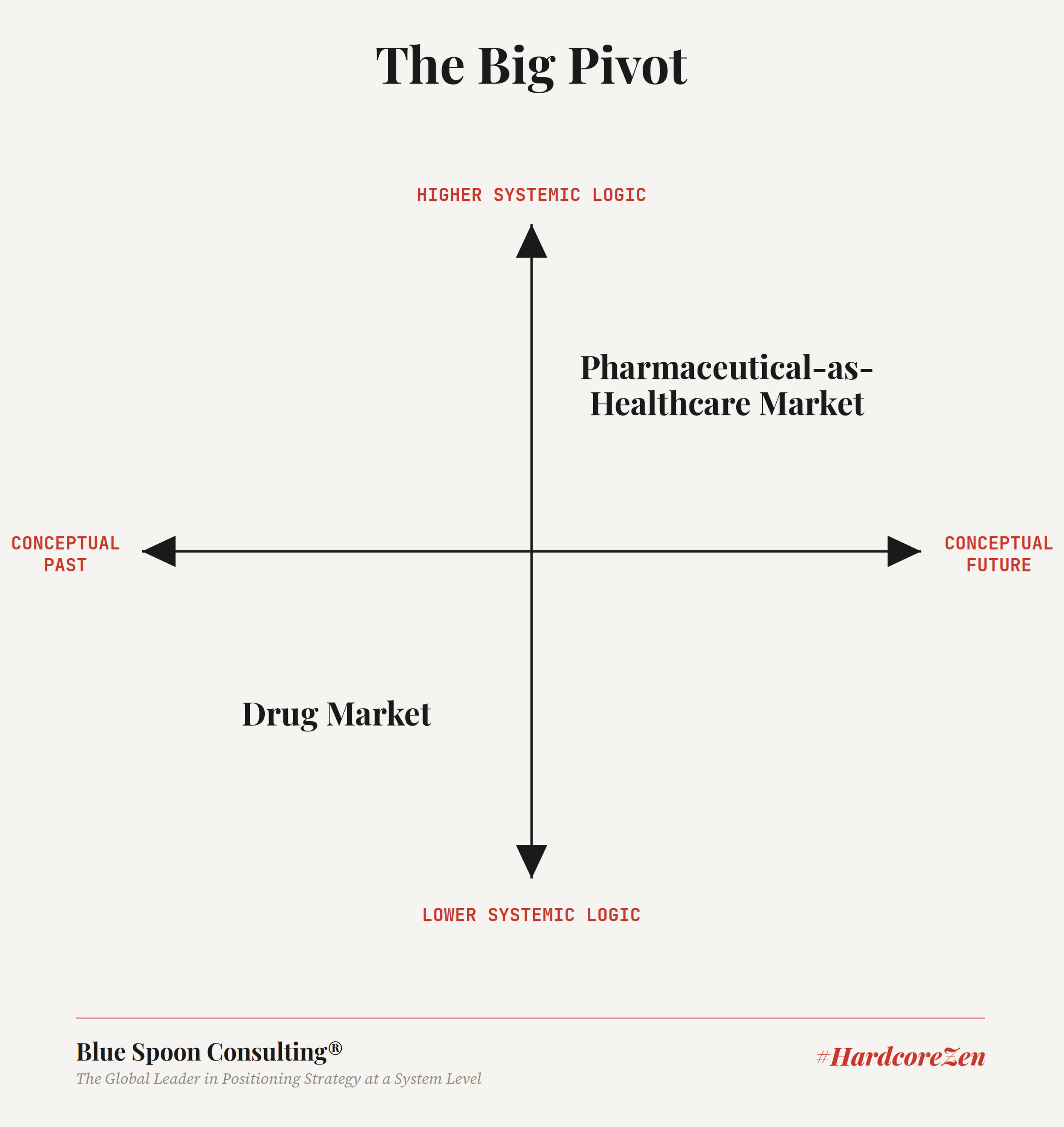
Progressive integration of value, from prevention to treatment to ongoing care, becomes the commercial model. It gives dependable, sustainable revenue to an entire system of markets that could emerge around it.
Ricks also said he wants Lilly to think like a technology company.
Thinking like technology, though, is not just technical invention. It is ecosystem genesis, the management skill of sparking new, self-generating systems that become economies in their own right. Apple, Amazon, Microsoft, Meta, Nvidia, Anthropic, Tencent and ByteDance mastered it, for better and for worse. In healthcare, China’s Ping An has built a network around Ping An Good Doctor, which ties insurance to 50,000 doctors, 235,000 pharmacies and 4,000 hospitals for more than 400 million registered users.
Technology has to be given what it wants, of course, and what it wants is more technology. The risk comes when leaders let that want set the terms, trading the strategic frame for the technical one and handing over their agency with it. Running faster in oatmeal is still running in oatmeal.
Ask not what we can do for AI. Ask what AI can do for us.
/ jgs
John G. Singer is the founder and Executive Director of Blue Spoon, the global leader in positioning strategy at a system level. He was part of the launch team that brought Gilead’s cure for hepatitis C to market, and Blue Spoon’s work applying systems theory to strategy was adopted by the U.S. Army War College for the Department of Defense’s Third Offset Strategy.
Blue Spoon runs the Working Whiteboard, a ninety-minute session for leadership teams based on Hardcore Zen. One session, one chart — your market as a system, objectives positioned strategically instead of operationally, original storylines of value. Inquire.