

Last Week Today at the Oracle Health and Life Sciences Summit

Taking a Page From Darwin’s Notebook
Two days before Oracle opened its Health and Life Sciences Summit in Orlando — a vendor conference that drew the administrator of CMS, the head of AHIP (the health insurance industry’s trade association), a state Medicaid chief, the chief executives of Mount Sinai and Cleveland Clinic, and executives from AstraZeneca and Sanofi — John Oliver returned from a month-long break with an entire episode on one company, UnitedHealth Group.
Oliver is the British-born comedian who hosts HBO’s weekly news satire Last Week Tonight, a show whose segments have been known to move policy. I find him funny and smart. He has a joke for every grim fact, and a receipt for every joke. His latest took apart UnitedHealth at a system level.
In his case against UnitedHealth, Oliver moved through the operations of the fourth-largest company in the world by revenue, $447 billion last year, behind only Amazon, Walmart and State Grid Corporation of China, the Chinese government’s state-owned electric utility, which runs the power grid across most of China. For the record, UnitedHealthcare is not a member of AHIP and was not at the Oracle summit.
Last Week Tonight is known for pairing dense policy reporting with pop-culture references. Oliver used a darkly comic scene from The Resident, a Fox medical drama, in which a consultant cheerfully teaches doctors to upcode, to show how far the American Way of Healthcare — market-based, profit-driven, built to deliver revenue and shareholder value — has seeped into prime time. In Orlando, the same practice went by a friendlier name, “documentation integrity,” sold as an AI feature. Asked on stage by Oracle’s Seema Verma how AI would affect costs, Mehmet Oz, who runs CMS, said, “Short-term AI is going to be inflationary, because it’s going to turbocharge the ability of the current billing systems to work more effectively. You can upcode. You’re not going to miss any diagnosis.”
A data point validating that thesis came within days. An analysis of inpatient billing by the Blue Cross Blue Shield Association, whose 31 independent companies cover more than 100 million people, found that AI coding tools, which comb patient records or listen in on visits through ambient scribes, added $942 million in costs over 2024 and 2025. The diagnoses went up. The treatments didn’t. AI was finding “more billable conditions, not sicker patients.”
That is one network of insurers. Its own inpatient bills. The first two years of AI coding. Scaled to a $5 trillion system — every AI-powered hospital, every AI-powered clinic, every AI-powered payer — the $942 million turns into a new feedback loop that locks the multidimensional dysfunctionality in even further.
Providers’ AI finds more to bill, insurers’ AI finds more to deny, patients’ AI finds more ways to fight back, and everyone spends more on software to outdo everyone else. No one is outside the loop. The technology sold as a fix for administrative cost becomes a new administrative cost, on every side of every transaction.
Meanwhile, the AI-powered pharmaceutical industry anticipates an abundance of AI-powered cures. Every one of them will have to pass through the same loop to reach a patient.
Oliver featured a family’s personal experience, that of a son, 22-year-old Cole Smith, who died of an asthma attack after OptumRx dropped his inhaler from coverage over rebates and its price jumped from under $70 to more than $500. Sadly, the story of a patient failed by an insurer has been told so often that it has become its own tragic form of cliché. There is no narrative surprise left in it.
His strongest testimony came from inside the commercial ecosystem itself: the former case manager who described a 1 percent rule.
A UnitedHealth subsidiary used an algorithm, called nH Predict, to estimate how long Medicare Advantage patients could stay in a skilled nursing facility after an injury. She told reporters she was expected to keep each patient’s discharge date within 3 percent of the algorithm’s estimate. “By the time I stopped working,” she said, “it was down to 1 percent.” Employees said that straying outside it could mean discipline, even termination. The algorithm is now at the center of a class action brought by the families of Medicare Advantage patients who say it cut off their care. Two of them, Gene Lokken and Dale Tetzloff, died after UnitedHealth stopped paying for their stays in skilled nursing facilities. A federal judge has ordered UnitedHealth to open its records on how the algorithm was used.
“If a company essentially forbids its case managers from deviating more than 1 percent from an algorithm, that company is run by an algorithm,” Oliver said.
The same machinery was presented in Orlando as the AI-powered future of healthcare. Oracle announced agents for coverage determination, prior authorization, coding and even appeals, the decisions Oliver had just shown being handed to algorithms. In Oliver’s telling, AI was an arbiter of ruthless operational efficiency. In Oracle’s, it was progress.
Neither is quite true.

The Limits of Our Language
We are arriving at the future drained, the zone already flooded.
In Possible Minds: Twenty-Five Ways of Looking at AI (Penguin Press, 2019), John Brockman, the literary agent and editor, commissioned a collection of essays from leading scientists and thinkers, among them Steven Pinker, Daniel Dennett, Stephen Wolfram, Max Tegmark and Nobel laureate Frank Wilczek, to “challenge the prevailing digital AI narrative.” It was time, Brockman said, to enact a new kind of systems ecology in which organisms and the environment in which they live should be considered a single circuit.
The point was that there is no “out there” that separates the observer from the observed. The world around us is now within us. There is no distinction left to draw. We shape our tools, and thereafter our tools shape us. And so there is no need to call anything “AI-powered” — AI is metabolizing everything and everything is metabolizing AI. The label tells you nothing.
“The limits of my language mean the limits of my world,” wrote the philosopher Ludwig Wittgenstein. We can only act on what we can put into words. What holds for a mind holds for a market: what it cannot name, it cannot see. What it cannot see, it cannot value.
The same logic holds for a government.
As AI accelerates, The New York Times , governments are increasingly being left behind. Europe’s AI Act was proposed eighteen months before ChatGPT arrived, and it now tries to govern something its authors never imagined: less a technology than its own form of life, a new species. Governments don’t understand it and are seen flailing to get in front of it, trying to ride the chaos, to manage a carnival of collapse unfolding worldwide. “There is a disconnect between the law and the reality of what is being regulated,” said Gabriele Mazzini, one of the Act’s lead authors. A law can only govern what its language can name.
Positioning is the battle for mind space. It is how those limits get redrawn with new narratives and a new language for leadership to enact new context. That process starts with better, or at least different, questions.

Looking for the Exit
The most revealing moment in Oliver’s episode belongs to Andrew Witty, then chief executive of UnitedHealth Group. Oliver played a clip of Witty speaking at an investor meeting in .
“There’s no way you would design something as complicated and as contradictory and as difficult to navigate as the system we all find ourselves in today,” Witty said, “because nobody designed it. It simply evolved.”
Oliver played it as an evasion. I see it as the defining statement of our times.
Nobody designs a large system whole. Large systems accrete, one fix at a time, and each fix feeds back into the next. That is ecology at work, Darwin’s descent with modification — each generation inherits the traits of the one before, with small changes. Over many generations those changes add up to something new and self-generating, until you get to the point where the feedback loops are in control. They reward what already exists. Every workaround creates a constituency, every constituency defends its workaround, and the system hardens around its own failures and opportunities.
Witty’s insight is universal.
It describes the European Parliament’s AI Act, written for a technology that has since outrun it. It describes the agentic bank run that Apollo’s chief economist sees coming. It describes why the United States keeps winning battles and losing wars. It describes the economics of data centers, where capital, power and demand chase one another in loops nobody planned. It describes Nvidia’s circular financing, investing in the customers who buy its chips. It describes what’s really happening in a $5 trillion healthcare economy that no one has been able to “fix.”
None of them was designed as it now stands. All of them evolved, and are evolving, branch by branch, like the tree of life Darwin sketched in his 1837 notebook under the words “I think.” By the same token, for any system to escape the Darwinian reaper, it has to evolve into a new species.

Breaking Syntax
A narrative that doesn’t change can’t change the system it describes.
Blue Spoon ran what was said on stage in Orlando through Hardcore Zen, a method for frontier management: the work of holding a position at the edge of a system still forming, rather than optimizing inside one already decided. The result is a narrative analysis, a diagnostic of positioning: Past Tense vs. Future Tense. Six readings set what was said at the summit against what the industry said before: Nixon in 1969, Bush in 2004, Cerner in 2012.
Each reading is positioned as a provocation, a question the keynotes never raised. They are intentional, meant to break from the entire corpus of content currently giving healthcare direction, a monotonous repetition whose very words do little beyond sustaining structural stalemate. Is cost really the problem? To therefore do what? What are you connecting? How do you reroute an industry? What’s in it for me? Where is your intelligence pointed?
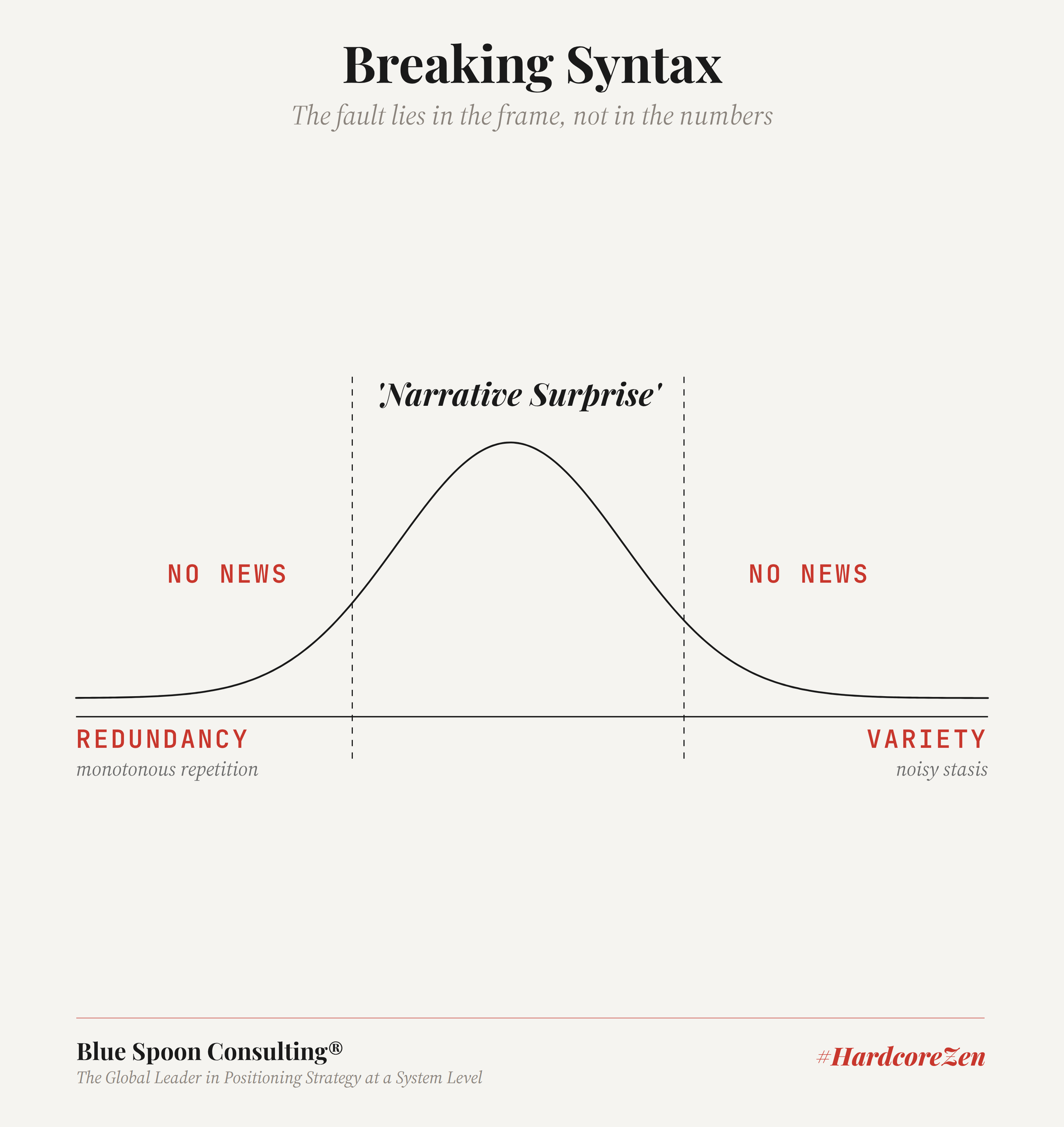
The questions don’t stretch the story. They leave it. That is the point.
Oliver’s verdict is that companies like United are at best pointless middlemen, and at worst “algorithmically driven, ruthless arbiters of who lives and who dies.” Oracle’s answer, two days later, was more algorithms.
In Possible Minds, the Berkeley computer scientist Stuart Russell returned to a warning the mathematician Norbert Wiener gave in 1960: we had better be sure that “the purpose put into the machine is the purpose which we really desire.” Neither Last Week Tonight nor the Oracle Health and Life Sciences Summit asked what that purpose should be. It was assumed. Which is the real risk to humanity.
The full diagnostic is available at bluespoonconsulting.com/hardcore-zen.
/ jgs
John G. Singer is the founder and Executive Director of Blue Spoon, the global leader in positioning strategy at a system level. Hardcore Zen is Blue Spoon’s method for frontier management: the work of holding a position at the edge of a system still forming, rather than optimizing inside one already decided.
Blue Spoon runs the Working Whiteboard, a ninety-minute session for leadership teams based on Hardcore Zen. One session, one chart — your market as a system, objectives positioned strategically instead of operationally, original storylines of value. Inquire.