

Stories Without Proofs

The Gap Between Narratives and Numbers
Last week, OpenAI carpet-bombed mathematics. In a single day the company released more than 700 papers solving 372 open problems. Mathematics, mass-produced.
About a third settle conjectures famous across the field, problems that hundreds of mathematicians had spent decades trying to crack. Martin Bridson, president of the Clay Mathematics Institute, a private foundation best known for math’s Millennium Prize Problems, called the release “breathtaking.” It would be, he added, “exciting for many, frightening for others, and devastating for some.”
Hugo Duminil-Copin — a Fields medalist who studies the mathematics of chance — warned in late August that AI proofs “nuke the mathematical landscape,” bypassing the slow, exploratory, deeply human struggle that produces discovery. His essay’s title: “Care for a little more AI?”
The innovation shock ran from the top of the profession to the bottom, down to the students who were supposed to inherit it.
“Just like a photograph of a mile marker can’t provide much of the value of actually going on a hike,” Kai Shaikh, a doctoral student at Toronto, said, “it would seem to me that proofs without stories, or even stories without struggle or mystery, and first glimpses of strange beasts, are not very meaningful or valuable to us humans.”
Mathematics is still sorting through last week’s wreckage, the latest casualty of context collapse from AI. Others fell first, or will by this time next year. SaaS. Call centers. Financial services. Higher education. Middle management. The entry-level job that used to train everyone else. Same bomb every time. AI makes the work instant and abundant, the expertise common and the struggle optional.
Red Smith, a Pulitzer Prize-winning sports columnist, once said writing was easy: “You simply sit down at the typewriter, open your veins, and bleed.”
AI removes the bleeding, and that is what has the creative world so upset — the writers who write that writing without struggle isn’t writing, the musicians who protest AI-generated music with albums of silence, the filmmakers who would rather die than use AI to prompt a film, the book publishers who pull novels suspected of being written by machine. And now the mathematicians. AI seems to take the imagination out of creativity and the chance out of discovery.
We are in the early stages of a phase transition, a term from physics and complexity science for the moment a system abruptly reorganizes into something new, the way water turns to ice. AI is a change of state, not a trend line.
Every industry, every government, is now grappling with magic and loss. The magic is megaton potential, produced by The Machine without effort. The loss is identity: who we are, why we matter, where we’re headed … the myths we tell ourselves and sell to everyone else.
Mathematics just got proofs without stories. Most of the S&P 500 has the opposite problem: stories without proofs.

Message Sterilization
The old narratives have stopped working because they describe a state that no longer exists.
In February 2024, more than two years before AI began laying waste to industries, careers and forecasts, Fortune published a commentary of mine, “The S&P 500 are running out of ideas — and they can’t keep telling Wall Street that AI will fix all their problems.” I argued then that the index, really the index minus the Magnificent Seven, would run to a standstill if its companies’ case for leadership relied on some form of “now powered by AI.”
Limitless access to new technology is one thing. But harnessing that infinite flow in a way that produces an advantage over a rival is something else entirely. Technology-led visions are the short road to parity. They produce monotonous repetition, lead to overload and boredom, and sustain the status quo.
Repetition — the same story told the same way — is the signal of a loop. The words themselves keep the Standard Model of thought in place.
The diagnosis behind the Fortune headline came from treating narrative as a system: reading across companies and markets instead of down one at a time, and tracking the concepts and strategic themes that travel unchanged from earnings call to keynote to press release. When the same words show up everywhere, the audience stops hearing them — there is no narrative surprise — and the business doesn’t “transform” so much as it runs faster in place.
Martin Hairer, another Fields medalist, warned that AI left unchecked would “sterilise the field” of mathematics. Repetition does the same to a message. It stops producing anything new.
In early 2024 the loop was everywhere: analyst calls, press releases, media coverage, JPMorgan’s healthcare conference and the stage at Davos the month before. There, Politico’s John F. Harris described the scene as “deep, billowy drifts of alpine conventional wisdom.” AI was one of the drifts he observed. Same talking point, top to bottom. Happy-to-glad edits in the keynotes. No more insight on the mountain than at a kid’s birthday party.
Two and a half years later, the loop is still running. In February, more than 20 heads of state gathered in New Delhi for the India AI Impact Summit, which set a Guinness World Record for AI responsibility pledges: 250,946 of them. At Oracle’s Health and Life Sciences Summit last month, the organizing idea was AI, sold as “vision to reality.” (Blue Spoon’s narrative analysis of the Oracle summit: Past Tense vs. Future Tense.)
Earlier this month, Apollo’s chief economist, Torsten Slok, went through the S&P 500’s second-quarter earnings calls and checked them for two letters. Nine in ten financial companies invoked them. Nine in ten communication services companies. Seven in ten energy companies, up from half the year before. Information technology, 97 percent (no surprise). There is no higher to go.
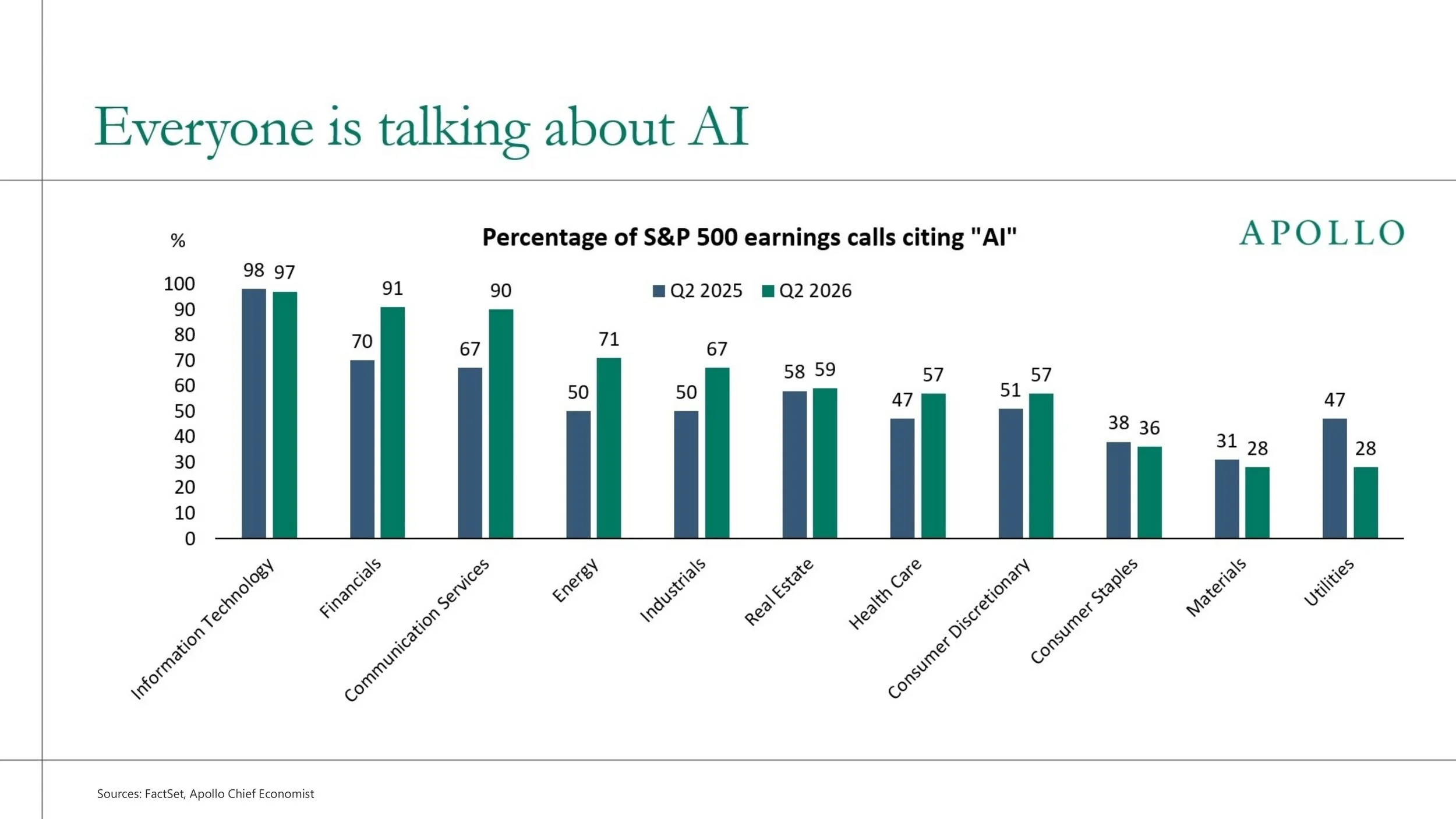
While seven of eleven sectors rode the mystical wave and talked more about AI, one went quiet: utilities fell from 47 percent to 28. The industry selling the power stopped talking about what’s burning it.
Slok offered three readings. Companies are adopting AI. Companies are hyping AI for investors. Companies are planning to use AI to cut costs and jobs. Then the only question that matters: does the talk turn into spending and measurable productivity? His answer, for now, is that the hype has moved faster than the payoff. The San Francisco Fed would agree. By its measure, the economy isn’t getting any more out of what it puts in.
Everyone is winging it.

Checking the Calls
My Fortune commentary made calls on specific companies. Thirty-two months later, the numbers have had their say, so a look back seemed fair.
The index first. The S&P 500 hit a record last week. Without the AI trade, the rest has fallen 7 percent since the end of August. Three-quarters of its stocks fell last month. For thirty-two months, the index minus AI lagged. Now it’s going into reverse.
Then the industries, one by one.
Technology services: called. The industry that was supposed to understand technology best misread it worst.
TCS, Infosys and Wipro — giants of India’s $315 billion technology industry — sold the Street on building AI practices, closing AI deals and launching new AI revenue lines. Their shares are down 38 to 49 percent. In July, Infosys trimmed its growth guidance. Wipro shed 25,000 jobs in two years. Infosys, 12,500. TCS cut 23,000 in one. The pitch said AI was the growth engine. The numbers say AI is eating an economic system orbiting labor arbitrage.
Advertising: called. The industry that sells positioning couldn’t reposition itself.
WPP lost about 40 percent of its value, its seat in the FTSE 100, nearly $7 billion in client accounts in a single year, roughly 11,000 jobs and its chief executive. (It is now led by a former Microsoft executive, who promised to make the company fit strategically “in the era of AI.”) Omnicom absorbed the brand formerly known as Interpublic. It retired DDB, FCB and MullenLowe, names that built modern advertising. Then it set out to cut nearly a fifth of the combined workforce. The deal lost a third of its value before it closed, from about $13 billion to $9 billion.
Media: split. I predicted “a total system collapse in media and publishing companies such as Gannett and News Corp.”
I was half right. Business Insider lost more than 85 percent of its search traffic in a year. The Washington Post cut a third of its newsroom. Local papers closed at a rate of two a week.
Some companies repositioned before the system fell. Gannett renamed itself USA TODAY Co., signed AI licensing deals with Meta and Microsoft and nearly tripled, from $2.38 a share to about $6.80. Then it billed OpenAI for the articles it says the company trained on without paying, suing last week for more than $250 million. News Corp, on the other hand, took more than $250 million from OpenAI in a licensing deal and posted record revenue and profit.
The publishers found a new buyer: the machines that read them. They turned the loss of identity into a bid for a new peer group. Not newspapers selling attention. Data providers selling the raw material of intelligence.

Winning Without Saying AI
Every rivalry in the Fortune piece has been repriced.
Walmart rebuilt itself as an advertising, marketplace and membership business, moved to Nasdaq and passed a trillion dollars in market value for the first time in February. Its earnings multiple rose from about 28 to 39 while Amazon’s fell from about 50 to 21. Lilly built a direct channel to patients and went from 1.2 times Novo Nordisk’s value to about six. Novo has lost about two-thirds of its value since then, replaced its chief executive, cut 9,000 jobs and last month shortened its name to plain “Novo.”
Novo’s response to losing the GLP-1 race was a shorter name and a new tagline. That’s a narrative change without a market change, the opposite of Lilly’s direct channel.
Tesla trades near 390 times earnings on robotaxis and robots. Ford is in the middle of a full reset, navigating its own version of total system collapse. It took a $19.5 billion charge to retreat from electric cars and now plans to sell batteries to data centers through a new unit, Ford Energy, becoming a supplier to The Machine, like the publishers.
A word everyone says can’t move anyone’s peer group. When a company leads the way into a new position, as Walmart and Lilly did, as Tesla keeps doing and Ford is just starting to do, the struggle is specific to that company. Nobody else lived it, so nobody else can tell it. That’s what markets pay a premium for: a unique strategy story.
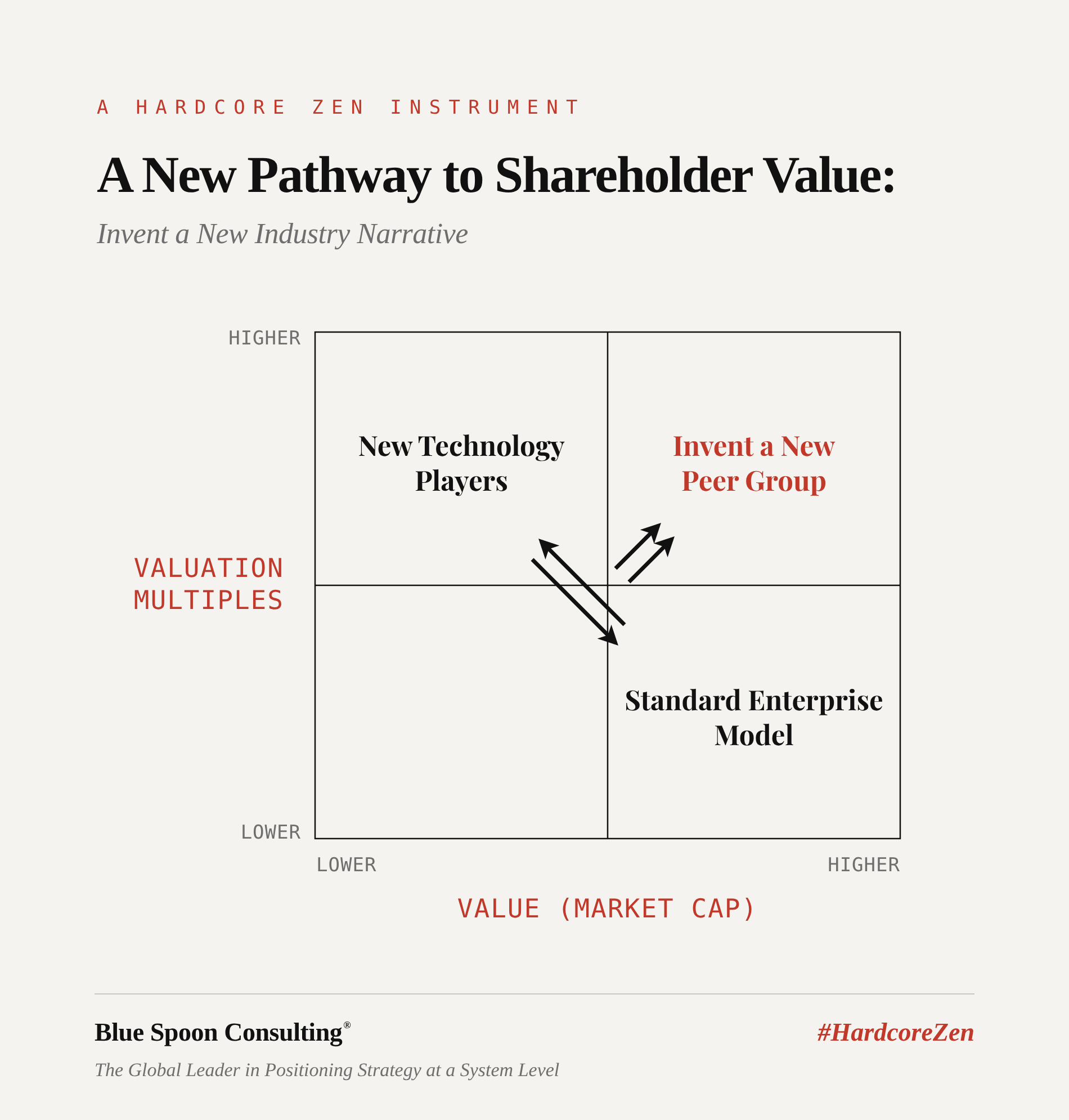
Every company in the Fortune commentary that stalled cast “now powered by AI” as the main character of its story. It was a technology-led vision, the short road to parity. The winners cast AI as an extra, part of the scenery in a new screenplay.
New rule to produce the next economy: context first, technology second.

A New Narrative Art
In 1975, to tell his tale of a galaxy far, far away, George Lucas needed technology that didn’t exist, so he started Industrial Light & Magic, built to serve the story. The effects changed filmmaking, but they weren’t the pitch to Hollywood. Star Wars was never “now powered by special effects.”
Last month, he opened the Lucas Museum of Narrative Art in Los Angeles, at least a billion dollars of his own money spent on a single idea: that telling stories through images runs in one unbroken line, from cave paintings to comic books to the digital screen. “We wanted a museum unlike any other,” said Mellody Hobson, his wife and the museum’s co-founder. There was no peer group for it. So they invented one.
Radical acceptance means seeing reality as it is. Everyone is already “powered by AI,” which means AI alone can’t set a company apart. Narrative can, if it has a persuasive edge and the novelty to punch through.
The Machine produces power, but people produce the story to give it meaning.
/ jgs
John G. Singer is the founder and Executive Director of Blue Spoon, the global leader in positioning strategy at a system level. Hardcore Zen is Blue Spoon’s method for frontier management: the work of holding a position at the edge of a system still forming, rather than optimizing inside one already decided.
Blue Spoon runs the Working Whiteboard, a ninety-minute session for leadership teams based on Hardcore Zen. One session, one chart — your market as a system, objectives positioned strategically instead of operationally, original storylines of value. Inquire.