

Google Cloud built healthcare a flawless copy of a broken context.
“Two clichés make us laugh. A hundred clichés move us.”
In Umberto Eco, the Italian philosopher who would later write The Name of the Rose, crossed America looking for fakes. He was on assignment as a journalist for L’Espresso, an Italian weekly magazine, a European intellectual reporting back on the strange empire across the Atlantic.
What he found became Travels in Hyperreality, a collection of essays published in from which this piece gets its name and narrative thread.
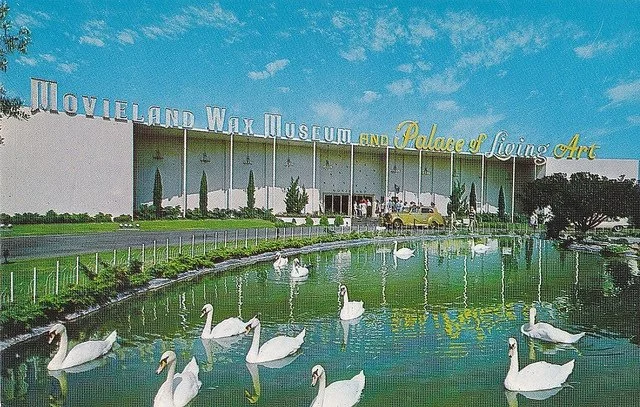
Some of the best fakes Eco found were in Buena Park, California, a few miles from Disneyland, at a wax museum called the Palace of Living Art. It had the Mona Lisa in wax. It had the Venus de Milo with her arms restored. Nobody asked for the arms; the museum supplied them anyway, with the gift-shop logic of American selling. A statue missing pieces looks broken, and in California broken doesn’t sell.
To an Italian, that was close to sacrilege.
Eco called the condition hyperreality. The American imagination, he wrote, “demands the real thing and, to attain it, must fabricate the absolute fake.” A normal reproduction tells you what it is: “replica,” “after Leonardo,” “artist’s impression.” In hyperreality the copy drops that label and presents itself as the real thing, or something better. “Absolute unreality is offered as real presence,” Eco wrote.
The IT services industry sells this experience as a “digital twin,” a virtual replica of a factory, a supply chain or a hospital, wired to the original operating model. New technology gets tested on the copy, then installed in the original, which runs as the upgraded version of itself.
Digital twinning is a market valued somewhere between $20 and $35 billion; all the big system integrators (Capgemini, IBM, Wipro) offer the capability, generally to the CIO, who pays for it out of the IT budget. It’s a technology purchase, not a strategy decision. And every one starts from the same set of inherited assumptions, the same context layer.
The twin copies the enterprise and its operating environment as given. The market as it already is. The definitions as conventionally applied. The rules of the game followed.
The copy improves on the Standard Model, and the improvement is the product. Nobody asks whether the context itself is the thing that’s broken.
, Google Cloud launched its version of a Palace of Living Art for healthcare.
On it unveiled Gemini for healthcare, an agentic AI platform. The promise is to unify “the disparate clinical, operational, and administrative systems” of care. To deliver the “context needed to make a decision.” Whose context and whose decision-making are left to the imagination.
Anyone who has ever experienced healthcare, or cared for someone who has, which is all 342 million of us, knows that the context for treatment, and for access to innovation, never lives in one place. It never will. Healthcare sits across contexts. It is trans-contextual. It flows inside and outside separate enterprises, separate markets, separate economic subsystems that may or may not “care” about one another.
The new and improved Gemini, now powered by AI, plugs connectors into the new or improved third-party vendors, also powered by AI, pulling four markets into one view. The health records (the EHR market). The billing platforms (revenue cycle management). The clinical guidelines (clinical decision support). The CMS datasets (the public payer). Then it “reasons across this context.”
Gemini doesn’t change the market, though. It moves in. The embedded administrative-industrial complex stays embedded. It just runs faster. Hopefully.
Under the new vocabulary of all things agentic, this is still the pursuit of data interoperability, the oldest unfinished project in healthcare technology. HL7, the messaging standard built to make hospital systems talk to each other, dates to . FHIR, its modern successor, arrived in the . Congress wrote interoperability into law with the 21st Century Cures Act in .
Every generation of technology has promised to unify the fragments, and every generation of technology makes the fragmentation worse, not better. Each new wave only adds more healthtech vendors. “We are inundated,” Meredith Touchstone, then director of benefits at CarMax, told the Wall Street Journal , as digital-health startups multiplied and well before AI took hold and took off. Hers is the voice of the employer context, the one Gemini leaves out.
Google’s engineering is serious. So are the people behind it. But what it produces is a unified healthcare system that exists only in the agent’s imagination.
The agent becomes the enterprise, the enterprise becomes the context, and the context becomes the arms on the statue, sold in the gift shop.
A Hundred Clichés Hold a Reunion
Eco’s quote about clichés at the top of this argument comes from another essay in his book. He also took apart Casablanca, which he considered “a hodgepodge of sensational scenes strung together implausibly.” He couldn’t explain its hold on audiences by its quality, so he explained it by its excess. “It is not one movie,” he wrote. “It is movies.”
Every archetype Hollywood owned walks through Rick’s café. The cynic with a secret heart. The lost love who comes back. The noble resistance leader. The corrupt, charming police captain. The letters of transit. The song that brings back the past. Two stock devices in a film look like hackwork. A hundred stop looking borrowed and start to feel like ritual.
The clichés seem to be talking among themselves, holding a reunion, every story the audience ever absorbed, gathered in one room.
Gemini for healthcare — Google’s “purpose-built AI solution” that “brings healthcare-specific data connectivity and robust governance to complex clinical and administrative workflows” — is that room. Google is providing what Eco said every cult object needs, “a completely furnished world so that its fans can quote characters and episodes,” as if they were part of their own private sect.
Data fragmentation is here. Administrative burden is there. So is clinician burnout. So is patient centricity. Ditto for the connected journey. Ditto for whole person care.
Then the cast of lead and supporting characters walks in. Epic. Epic’s competitor Oracle Health. Waystar. Waystar’s competitor TriZetto. Optum, three times over, as launch customer, eligibility connector and evidence repository. GoodRx. Salesforce, Workday, ServiceNow, Microsoft 365. Sixteen systems integrators, from Accenture and Deloitte to Tata Consultancy Services.
The release names fifty-one outside organizations, almost like signatories. Between them they touch nearly every person in the country.
Epic holds records for more than 325 million people. Waystar’s claims rails reach about 60 percent of U.S. patients. TriZetto’s payer systems administer more than half of all covered lives. CMS covers some 70 million people on Medicare and 73 million on Medicaid and CHIP. And every one of them operates in the same context layer, where providers bill and payers pay. No drugmaker. No lab. No device maker. No employer. No family.
Fifty-one organizations, and zero “narrative surprise” in the screenplay they share, the same dialogue about the same operational ambition, pursued since . The interoperability dream has become another mythical area for healthcare, like patient centricity.
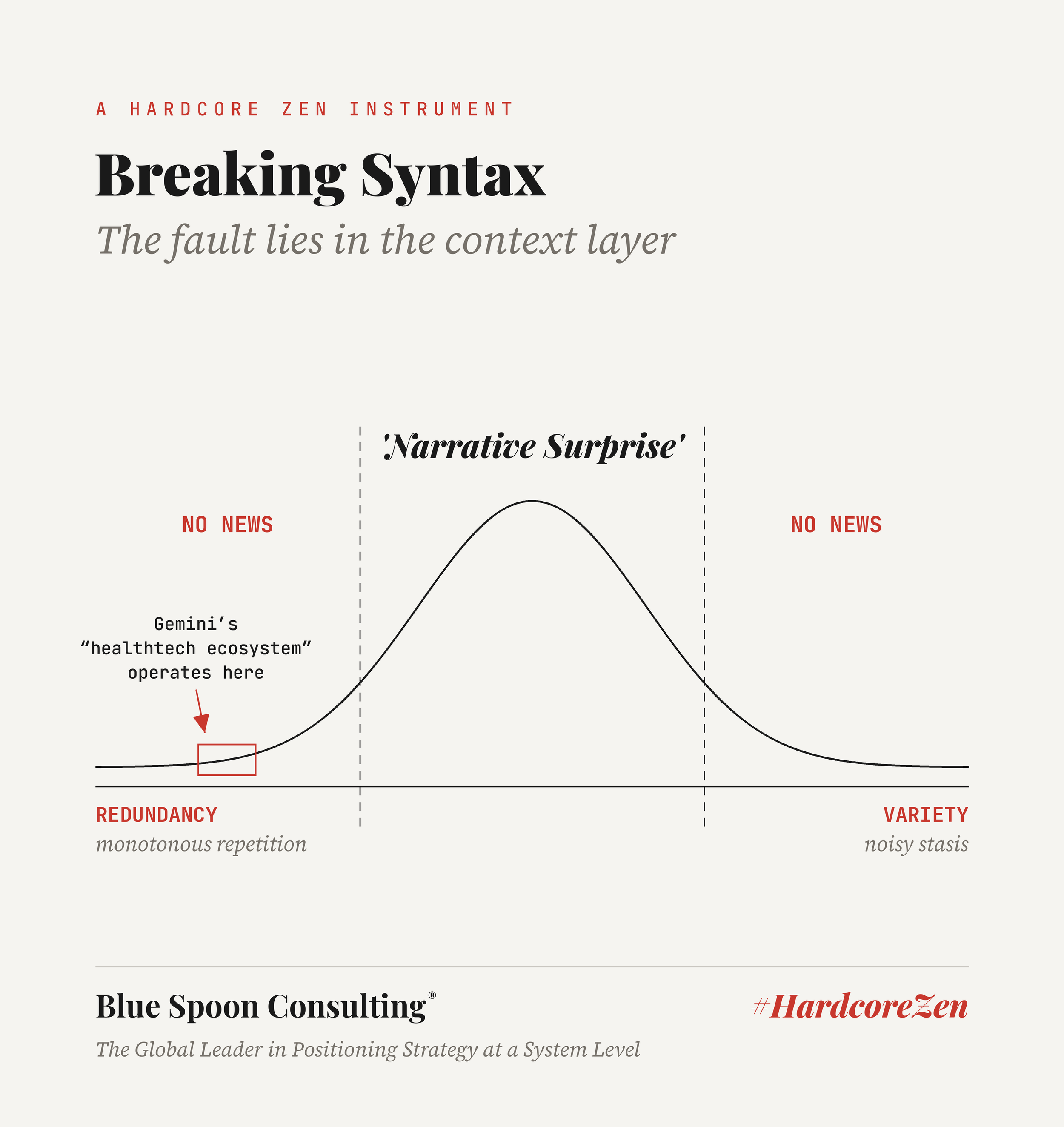
“Technology is at its best when it supports our caregivers and strengthens the human connection that is at the heart of healthcare,” said Dr. John D’Angelo, president and CEO, Northwell Health, quoted in the Google press release.
You certainly can’t argue with the intent, the spirit of the message. That’s part of the problem.
Every enterprise writes its own part coherently, almost warmly, all with an eye on the human context, but the syntax hasn’t changed in decades. The American Way of Healthcare still produces what Eco called a “glorious ricketiness,” pushing more than a quarter of Americans into medical debt and employers to consider dropping health insurance altogether. Among small and mid-sized employers facing rate hikes, 73 percent are actively considering dropping traditional coverage for .
None of this is a knock on Google’s press release. It’s the most complete portrait of the Standard Healthcare Model I’ve seen in one place. That’s why it moves people to buy the familiar operational solution.
It’s also why it can’t change anything.
How One Word Reroutes an Industry
The Venus de Milo, the ancient Greek statue that stands in the Louvre, lost her arms sometime before a farmer dug her out of the ground on the island of Milos in . American healthcare never had any. It was never one economic system.
It’s a provider market, a payer market, a technology market, a pharmacy market and a drug, device and diagnostics market operating side by side, each optimizing against the others, only now powered by AI. Unifying their data doesn’t unify their interests. It produces a perfect copy of a whole that was never there.
“When payers and providers can connect data, insights and workflows more seamlessly, we can remove unnecessary complexity, improve performance and help the entire system work better,” said Sandeep Dadlani, chief executive officer, Optum Insight, also quoted in the Google press release.
The perspective is consistent with AI World, the world of limitless technical potential, with how technology thinks and sells, with what technology wants.
Nobody is against operational improvement. Every large system operates in failure mode most of the time, so in a $5 trillion industry, there’s no shortage of nooks and crannies to “fix” with better technology.
Theoretically.
But Dadlani’s vision of the “entire system” is limited to payers and providers. It’s exclusionary by default, almost by design.
The drug, device and diagnostics markets don’t appear in his sentence at all. Neither do UnitedHealthcare’s self-funded employer customers, many of whom are cutting benefits as costs climb. , Deloitte told most of its roughly 181,000 U.S. employees it is ending GLP-1 coverage for weight loss and raising deductibles and out-of-pocket maximums, calling it “untenable” to carry rising costs alone. Disney is dropping coverage for working spouses who can get it elsewhere.
Forty years of interoperability engineering haven’t delivered a unified system, because the work is being pursued operationally, not strategically, and because it’s organized around the wrong word. Building one is simple. Swap “data” for “market.”
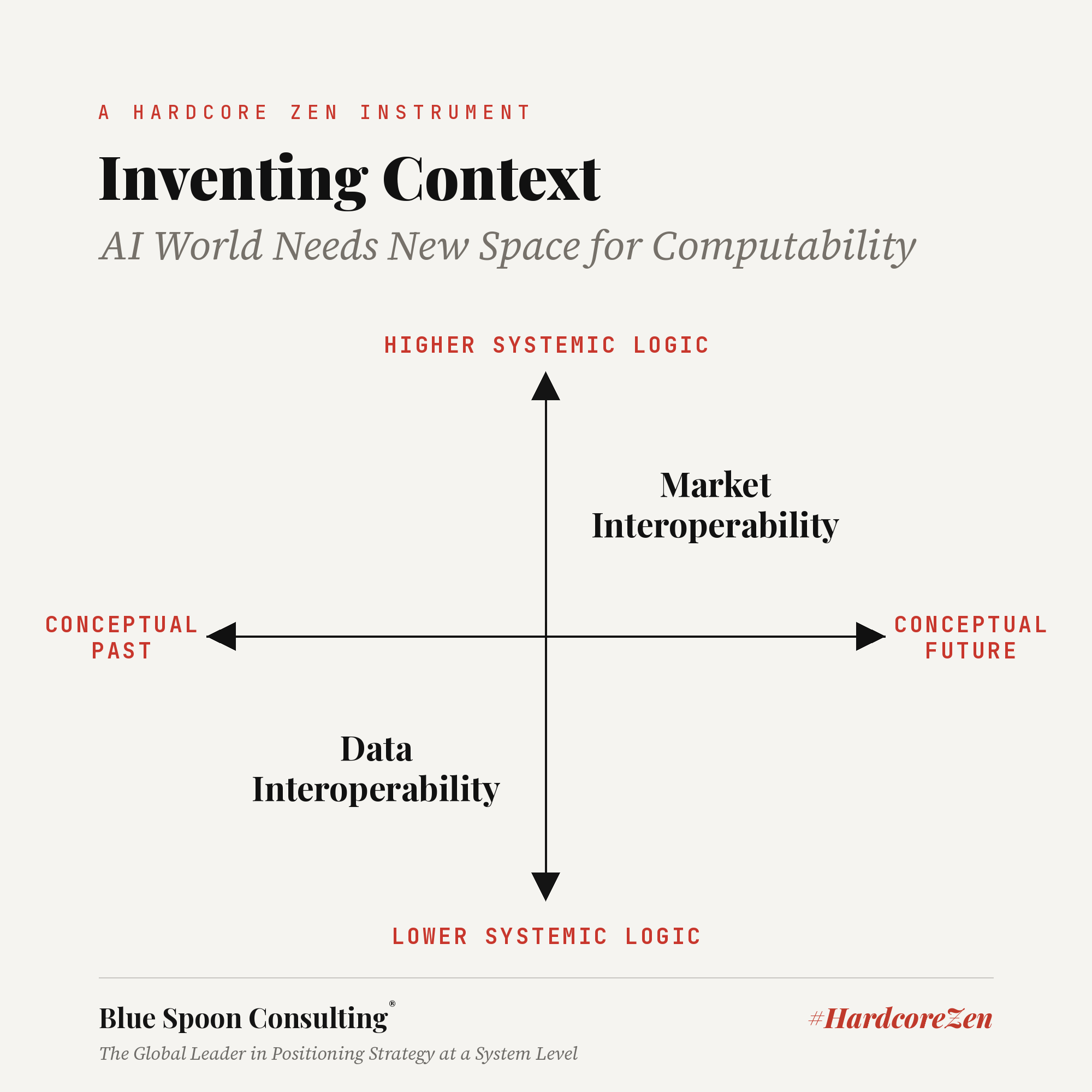
If the ambition is a new industry narrative, data interoperability is too small an objective. It won’t invent the kind of growth that matters to a Google, an IBM, an Optum or a Novo Nordisk. Data interoperability is past tense. Market interoperability is future tense. (Blue Spoon’s narrative analysis of the Oracle Health and Life Sciences Summit, Past Tense vs. Future Tense, applies the same distinction.)
The way out of an embedded complexity is a strategy story positioned to break structural stalemate. It starts by positioning a payer, a provider network, a technology platform and a drugmaker as one system of markets. Value aligned across them. Not extracted between them.
Market interoperability comes first. Data falls out of it. That reverses Google’s premise.
Healthcare Retreats to Its Fortress of Solitude
Google uses the word “context” the way the rest of the industry uses “patient.” Both are stock characters at the reunion, archetypes assumed to be known, hollow and unquestioned, waiting for the right technology to reach.
The new workflows Gemini promises never extend beyond one enterprise, to enable the “and” that combines markets in unique ways. That recombination is the thing that constructs a new context layer for communication and content, and by extension different loops of data production, which the AI economy needs to sustain itself.
Google’s own business needs the very thing its healthcare product leaves out.
Gemini, and the fifty-one organizations gathered around it, is still bounded by the incumbent administrative-industrial complex, not the family. Controlling cost, not producing health, as the context for competition.
Eco’s essay also has a section called “The Fortresses of Solitude.” In it, Superman stands as a symbol of the United States.
Every now and then, he wrote, Superman needs to be alone with his memories, so he flies to an inaccessible mountain range where, behind a huge steel door in the heart of the rock, he keeps his robots, “completely faithful copies of himself.” The fortress is “a museum of memories.” Even Kandor, a Kryptonian city Superman rescued after his planet’s destruction, survives there under a glass bell, its buildings, highways, men and women preserved on a reduced scale.
Gemini for healthcare travels in hyperreality. It is the industry’s Fortress of Solitude. Its robots are faithful copies of the enterprises that bought them. Its “ecosystem” is Kandor, enclosed in a kind of cylinder of transparent plastic, every record and workflow intact. It’s a fine place to be alone with your memories.
Nothing new gets made there.
/jgs
Disclosure: John G. Singer was previously chief strategy officer for Cognizant’s healthcare business, which includes TriZetto, and global head of strategy, innovation and technology for Wipro’s healthcare business. Both companies are named in this essay. He holds no current role with either.
John G. Singer is the founder and Executive Director of Blue Spoon, the global leader in positioning strategy at a system level. Hardcore Zen is Blue Spoon’s method for frontier management: the work of holding a position at the edge of a system still forming, rather than optimizing inside one already decided.
The Working Whiteboard is a ninety-minute session for leadership teams practicing frontier management. One session, one chart — your market as a system, objectives positioned strategically instead of operationally, original storylines of growth. Inquire.