


Industries Searching for Strategic Balance
On , at the Jefferies Global Healthcare Conference in London, Pfizer CEO Albert Bourla did more than describe his market and his ambition for Pfizer. He revealed a mindset about the context Pfizer operates in, the peer group it measures itself against, and the very nature of competition. A strategic worldview, expressed through China’s arrival as the disrupter of the Western pharmaceutical mode of being.
“They introduce a different league,” he said of China. “Us, Lilly, AstraZeneca. One is better in sales, one in marketing, one in R&D, but we are pretty much one category.”
It is a remarkably candid line about positioning, and it touches a hard truth about differentiation, especially now, when frontier intelligence is available off the shelf to anyone with a computer and an internet connection. Twenty dollars a month buys a ChatGPT Plus or Claude Pro subscription. The best intelligence on the market costs about as much as lunch.
Whatever the industry or the mission, commoditization and competitive convergence now happen in an afternoon.
“They are coming, half the cost, 3x, 4x the speed,” Bourla said of the China enterprise. If companies like Pfizer want to compete, he added, they need to match those efficiencies through cost cutting. “That sounds very difficult to achieve unless AI delivers on the promise. And AI for me is the biggest lever to be able to build the Pfizer of the future which, I repeat, needs to be productive at 3x, 4x the speed and half the cost.”
It is the right answer for the leader of a market centered on the production of drugs, and any CEO in his seat would give it. It also points to a second hard truth: cutting costs can fund growth, but it can’t create it. Efficiency is operations. Growth is strategy.
AI can make any enterprise faster and cheaper at what it already does. Deciding what game is being played is a different job.
, China changed the rules on how it pays for one of medicine’s most expensive innovations, and how much.
The National Healthcare Security Administration, which runs the basic insurance plan covering 1.33 billion people, added a CAR-T therapy, JW Therapeutics’ Carteyva for lymphoma, to its reimbursement list for the first time, at about $43,000 a dose, 78% below its launch price. Its sibling, Bristol Myers Squibb’s Breyanzi, built on the same Juno Therapeutics platform, lists near half a million dollars in the United States.
Same science. Two systems. More than a tenfold gap.
Also speaking at Jefferies was GSK chair Sir Jonathan Symonds, who gave the keynote . He looked back on AstraZeneca’s purchase of MedImmune, made while he was the company’s CFO. Industrial logic and the business case, he said, are “what I always look for first.”
He also said the big bet of that era, that “eventually, innovation would be industrialized,” has since been proven wrong.
Unless you’re China.

Playing in a Different League
Beijing defines innovation, its production and its diffusion, at another level. Not the molecule, but the system the molecule moves through. It’s a different center of gravity. The bet Symonds watched fail wasn’t wrong about industrializing innovation. It was aimed at the wrong target, and built on the wrong definitions.
China isn’t racing to discover drugs faster. It isn’t chasing hyper-efficiency with AI. Those are operational things. China is building market access at scale. That’s a context thing. Context is what strategy shapes.
That’s the distinction Washington misses.
, as investors gathered at Jefferies and Anthropic made its Nasdaq debut, the National Security Commission on Emerging Biotechnology, created by Congress to track the biotech race between the United States and China, reported that licensing deals now carry “not just capital but commercialization know-how” back into China’s biotech ecosystem, “creating a flywheel effect.” Its executive director, Caitlin Frazer, said the trend “should be alarming for policymakers.”
It should.
But the commission reads the flywheel as a threat to contain. Washington’s answers so far, from the BIOSECURE Act to proposed limits on investment in Chinese biotech, are restrictions. Restriction is a defensive policy, not an enabling one. It isn’t policy innovation. It isn’t policy interoperability. It isn’t likely to succeed.
Washington is trying to stop a feedback loop already in motion, already self-generating, instead of learning how to spark and sustain one. Or a portfolio of them.
That skill is frontier management: holding a position at the edge of a system still forming, rather than optimizing inside one already decided. The same skill just made billionaires of Anthropic’s cofounders, employees and early investors. OpenAI was built on it too. So was Meta. So is China.
China’s national enterprise strategy runs on systems thinking, and on the Confucian ideal of harmony that Beijing regularly invokes.
In Chinese thought, harmony has a precise meaning. In the Analects, the core text of Confucianism, Confucius set he, harmony, against tong, sameness — the exemplary person seeks harmony, not uniformity. Harmony is different parts held in productive balance, not everyone agreeing. Translated into strategy, it is a coordination idea, not a peace idea. It is “whole person care” elevated to geopolitics.
China’s 15th Five-Year Plan builds its infrastructure around what Beijing calls the “six networks” of water, power, computing, communications, urban pipelines and logistics. Beijing doesn’t plan pipes, grids and data centers one at a time. It plans the system they make together. The network-centric strategy runs offshore too, from the data centers Chinese firms are building across Latin America to Chinese classrooms racing to teach Spanish.
China is applying a military-grade systems doctrine to markets.
This extends the “six networks” concept beyond China’s borders, with physical infrastructure at one end and language at the other, which is systems thinking at the scale of a hemisphere. The CAR-T price is the same move at the scale of a single therapy.
China is challenging what Pfizer and its peers take themselves to be, not just how efficiently they run.
So the question isn’t how to run your Standard Pharma Model faster with AI. It’s what innovation means when a different species, an apex predator, enters your ecosystem. How do you collaborate with a Cambrian explosion of possible minds and options? How do you position yourself in a new peer group?
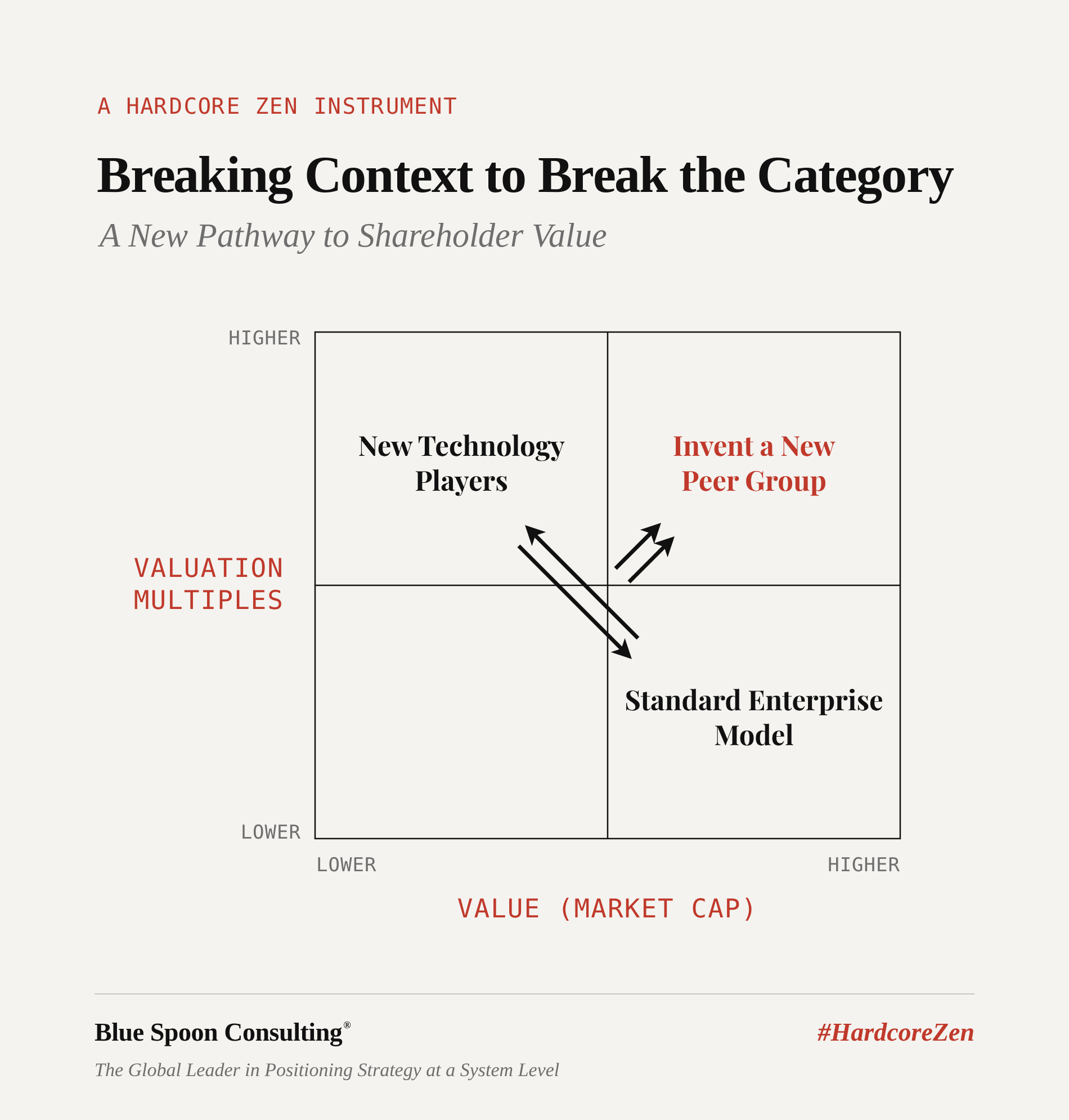
The first question is about how to work with AI. The second is about where you end up.
The explosion isn’t only of intelligences but of moves you could make. You can transact with technology, the diagonal arrows, buying and selling operational efficiency through IT vendors, like Anthropic or OpenAI. Or you can collaborate with AI to jointly articulate a unique context layer, a new space for computability. Those are the arrows that point toward a new peer group.
And you invent that space by combining markets in unexpected ways.
Pfizer, Verizon and Mount Sinai Health System, collaborating as a system of enterprises to set a new standard of care in lung cancer, would outperform AstraZeneca alone selling a lung cancer drug to oncologists at Mount Sinai, even with hyper-efficient detailing powered by Anthropic’s AI.
The Standard Pharma Model buys technology to run faster, to speed up drug discovery, to break bottlenecks and improve R&D success rates. These are the goals every peer Bourla named is chasing, and has been chasing with the same industrial logic, applied to the same contextual frame, since the modern drug industry took shape in the late 1800s.
It’s hard breaking a 150-year-old habit of thought.
The Vaccine Market Comes Undone
On Bourla spoke at Jefferies, and two days before Anthropic’s IPO, the Pan American Health Organization ruled that the United States had lost its measles elimination status, 26 years after the country earned it. It has recorded more than 5,800 cases , even though two doses of the vaccine are 97% effective.
Measles had been beaten. The vaccine arrived in the . In the , Congress started paying for children’s shots, and by the virus had stopped circulating.
the virus reached 45 states.
The Centers for Disease Control and Prevention, built to coordinate the response to viral outbreaks, has lost about 30% of its staff since . States are writing their own treatment guidance, because most American doctors have never seen a case of measles.
They have never seen Ebola either. The latest outbreak has spread beyond Congo into Kenya and Nigeria, with more than 11,000 confirmed cases and 5,500 deaths. Roughly half of those infected have died.
The measles vaccine never changed. The system around it did. Even the word “vaccine” has been emptied out. Its meaning. Its value. Its market.
On the IPO roadshow, Anthropic CEO Dario Amodei said cancer, Alzheimer’s, heart disease and mental illness “will be relics of the past in, I think, less than a decade.” Sam Altman has written that “maybe with 10 gigawatts of compute, AI can figure out how to cure cancer.” So has Mark Zuckerberg, who pledged to help “cure, prevent, or manage all diseases within our children’s lifetime.”
Measles was a relic of the past once too.
This is what happens when your perspective is out of balance: context breaks.
/jgs
John G. Singer is the founder and Executive Director of Blue Spoon, the global leader in positioning strategy at a system level. Hardcore Zen is Blue Spoon’s method for frontier management.
The Working Whiteboard is a ninety-minute session for leadership teams practicing frontier management. One session, one chart — your market as a system, objectives positioned strategically instead of operationally, original storylines of growth. Inquire.