
The Auburn Tigers Bought Frontier Management

“Mad Genius” and the power of system advantage.
I came to Alex Golesh through the Wall Street Journal, which is not where I go looking for football news.
Golesh is the first-year head coach of the Auburn Tigers at Auburn University in Alabama — for readers outside the United States, the Tigers are a business that clears $100 million a year, attached to a public university, where eighty-eight thousand people fill a stadium on a Saturday afternoon and millions more watch on television, all of them analyzing one man’s strategy in real time.
Shortly before Labor Day the paper ran The Mad Genius Taking College Football to Warp Speed, Robert O’Connell’s profile of the coach Auburn had just hired to reverse five straight losing seasons.
When Alex Golesh fled the Soviet Union with his family at the age of 7, he didn’t speak a word of English. So when he turned on a TV in Brooklyn and saw grown men bashing into each other over an oblong ball, he had no idea what to make of it.
All this Russian grade schooler knew was that he liked it.
“I grew up watching hockey, where you can hit people,” Golesh said. “But here, you can just hit people by running into them as fast as you can.”
Thirty-five years later, teaching the art and science of running into people as fast as possible is how Golesh makes his living as the new head football coach at Auburn. And if the sport views him as one of the most innovative coaches in the country, it’s because three decades since arriving in this country, he’s remained a fearless outsider willing to try anything to conquer America’s game.
The Wall Street Journal, August 27, 2026
Golesh entered the profession sideways.
He was a student assistant at Ohio State, cutting game film for the staff and volunteering his own reads on the patterns he found in it. Jim Tressel, then the head coach there, watched an undergraduate in his twenties hand unsolicited opinions to a championship staff and put the nerve down to temperament, the advantage, as he saw it, of someone who had been taking risks since childhood.
Golesh, in other words, reached one of the biggest jobs in American sport by way of the film room, not the field. Because his playing stopped after high school, he had to learn the game from above — entire plays, all twenty-two men at once, patterns across seasons and campaigns — rather than from inside a single position, where a player is taught only his own job. (The quarterback is the one position that sees the whole field, and even then only from inside it, at ground level, with three seconds to decide.)
Golesh was never good enough to play his way in at the collegiate level, so developing system vision became the open door. Most coaches never need that door. Almost every current college football head coach played some level of college football, and the exceptions are rare enough that people publish rankings of them. Nobody with a route in goes looking for another one.
System vision is a mode of seeing, something built over time from a particular vantage, not a trait someone possesses and not the accumulated position knowledge everyone else in the profession came up on. It is instead a working sense that winning at football comes from approaching the game as a complex adaptive system, one whose parts keep changing in response to each other, where a receiver’s route alters a safety’s depth, which opens the gap the running back was never told to aim for; where a tight end lined up a yard wider forces a linebacker to walk out with him, and the run the defense had been stopping all afternoon is suddenly available.
That’s the adaptive half of “complex adaptive” — the system’s response to itself over the course of a game, not just within a play.
I would also argue that Golesh works with a punk rock ethos of disruption; he is willing to go full bore against a sport built on orthodoxy so deeply embedded nobody in it can see the alternatives. Which is where my interest lies: in leaders who win by refusing the givens and the grammar of their industry.

Dictating the Terms
Golesh’s own account of his strategic success is more precise than the Wall Street Journal headline celebrating it. The Standard Model of offense in football, the “elementary” approach he described to O’Connell, game-plans for what the defense presents. It reacts to the system a competitor already has in play. Golesh runs the game at a speed that removes the other side’s ability to react at all. “When you go ‘pace,’ you’re dictating what the defense does.”
Not faster. Dictating. Defining the context in which strategy gets made.
Golesh’s record supports the distinction. Tennessee scored 21.5 points a game the season before he took over as offensive coordinator. By his second year the Volunteers led the country in scoring at 46.1. South Florida had gone 1-11 the year before he arrived as head coach. By the time he left for Auburn three years later, the Bulls were 9-3 and inside the national top 25 for the first time in seven years, snapping the ball every 21.4 seconds, the quickest rate in the country. In between came a 45-0 bowl win over Syracuse, the largest shutout in NCAA bowl history.
American college teams are built from students who graduate and leave. When Golesh moved from Tennessee to South Florida he took nobody with him. The churn was total and involuntary, which is exactly why the same result appearing at both schools rules out the roster as the explanation.
At Tennessee his offense ran more plays per minute than anyone in the country, up from 1.61 a minute the year before he got there to 2.99 in his first season. At South Florida it snapped the ball faster than any team in Division I.
But tempo is the instrument, not the strategy. The means, not the ends.
Football, like any other sport, has actual rules, written down and enforced by officials, and Golesh does not touch them, unlike Lane Kiffin, hired as head coach of Louisiana State the same offseason, who spent the week before Saturday’s opener in a courtroom trying to move players back from NFL training camps onto his roster. The Southeastern Conference, which both programs play in, wrote a rule against him within days, then sued him and his university in federal court.
Kiffin, too, is working with a punk rock ethos.
Both men refuse the givens; they differ on what they refuse. Kiffin went at the rulebook itself, trying to bring players back from NFL training camps, and got a conference rule written against him before the season started, with penalties running to half an athletic department’s operating budget. Golesh goes at the context in which those rules get applied: how many seconds the opposing coordinator gets to call anything, whether his substitutions are possible, which personnel packages are available to him, how much of his week of preparation survives contact with a team Golesh has organized to take those choices away.
A modern strategy moves an opponent onto terms he did not choose and cannot refuse.
Here is what it feels like from the receiving end of that, of being forced to compete in someone else’s context. Bob Shoop, who ran defenses at Penn State and Tennessee, once spent a week preparing his team to play against an up-tempo offense, expecting more than ninety defensive snaps. “We don’t really have a choice,” he told the Chattanooga Times Free Press, and challenged his players to spend the week becoming a tempo defense themselves, to reframe their sense of self.
Shoop was positioning his players for strategic fit to a context somebody else had set.

Abandoning the Old Order
Auburn lost its best player last winter to a market that had only just been invented.
A federal court settlement now lets American universities pay their athletes directly, up to $20.5 million a year per school, with booster money sitting outside that cap entirely. Cam Coleman, Auburn’s star receiver and the most sought-after player available, went to the University of Texas for a reported two million dollars.
So the Longhorns opened this season with a roster valued near forty-five million dollars, assembled from the best parts money could reach. Auburn’s answer was to buy management innovation. It hired Golesh at $6.75 million a year and let him import the configuration that produced the record — the coordinator, the quarterback, the linemen who already knew how it ran.
Two postures, funded at scale, tested inside the SEC across the same twelve Saturdays.
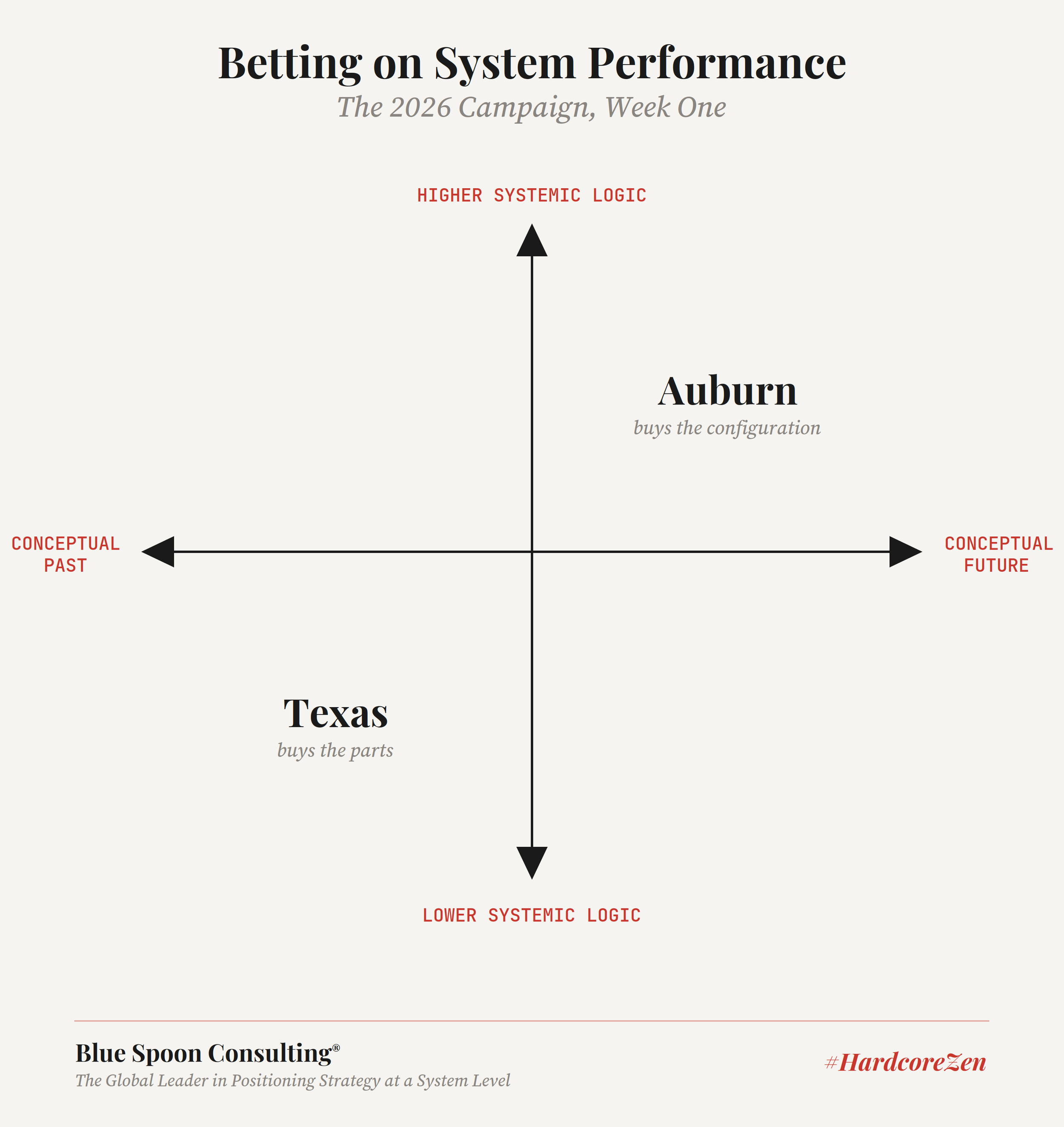
When the old rules stop holding, there are broadly two ways to respond.
Architects draw a blueprint and try to move the world onto it. Artisans assume no such power, improvising and adapting to conditions that will not sit still for a sweeping plan. Texas is the architect, buying the best components to a design borrowed from the order that just ended. Auburn is the artisan, carrying a working configuration across an institutional boundary in the person of its new head coach. (Louisiana State is a third thing: neither drawing a blueprint nor working inside the wreckage, but testing in court how much of the old order still binds.)
This is what frontier management is all about. Not irresponsible risk, and not novelty for its own sake, but working at the edge where the existing accounting was built for a different game than the one now being played. The sudden absence of the old rules and orientations sends everyone sprinting toward the newest or the next better part, which leaves the gap produced by the interactions between the pieces unclaimed.
Everyone bids on the receiver. Nobody bids on the route that moves the safety.

Of Coaches and Kings
Strategy picks the ground and sets the weather. Everything downstream of that is operations: the call, the personnel, the execution, all of it performed on dirt somebody else surveyed, under a sky somebody else ordered up. You can run operations brilliantly for thirty years without ever having chosen the terms you are running them under.
Being good at the job and choosing the conditions of the job are separate things, and most careers only ever involve the first.
Jared Diamond, the Pulitzer-winning author of Guns, Germs, and Steel, published Profits, Prophets, Coaches, and Kings last week, arguing that leaders matter less than their biographers think and, in sports, that firing a head coach to improve a win-loss record is close to throwing dice, because the records that follow look like what you would expect from chance. He is right about the dice and wrong about the conclusion. If the individual explains so little, the thing that explains the rest has to be the configuration of which the individual is a part — which is an argument for studying competition through the lens of systems more closely, not less.
The trouble is the binary.
Diamond sets the Great Man theory against the view that leaders are carried along by forces they cannot control, and then splits the difference. Both positions treat the individual as a quantity to be weighed against circumstance. Neither asks what the individual built. Bronwen Maddox, reviewing the book in the Financial Times, writes that in searching so hard for the right circumstances, Diamond “gives too little weight to ideas, innovations or techniques.”
The missing chapter is the one about strategy at a system level.
Golesh is not a great man bending events to his will, nor is he a passenger on a wave that was coming anyway. He tries to shape the conditions his competitors have to operate inside. System invention does not appear on Diamond’s list, because his question was only ever how much of the outcome to assign to the man.
It does not appear on the executive education syllabus either, where business schools have spent years repackaging the Great Man theory for executives with an all-access pass to the athletic department attached.
Michigan’s Ross School built a six-day executive program back in 2012, taught by its athletic director and its football, basketball and softball coaches. Texas A&M’s Mays Business School launched Leading Champions with its own athletics department in 2019, selling executives a three-day program that combined perspectives from Aggie coaches with Mays faculty expertise. The organizing ideas for both were what you would predict from a genre this worn: leadership, culture, accountability, resilience. The locker-room homilies, the motivational poster messaging.
The part worth teaching, particularly now, is not how a coach inspires. It is systems thinking, applied, by people whose work is graded in public every Saturday.

Auburn 17 – Baylor 16
The most insightful coverage out of Auburn last week was not asking whether the players were good enough. It was asking whether the system would work — whether the tempo could run at all against this level of competition. After five losing seasons and a head coach firing, the unit of evaluation for the Auburn Tigers quietly stopped being the roster and became the configuration.
Fly War Eagle, an Auburn fan site, spent the week before the opener asking whether the players Golesh brought with him from South Florida could hold up in the SEC and whether the offensive line would come together well enough for the tempo to run at all. Those are questions about fit, not about talent.
None of which decided the game. Baylor scored a touchdown with thirteen seconds left, went for two to win the game, and the catch was stopped inches short, upheld on review. A season’s worth of argument turned on one tackle. For the record, Texas blew out Texas State 59-7.
Saturday settles nothing, though. Auburn looked ragged, and Texas beat a team it was supposed to bury. One game is not evidence. A configuration can hold and still look unconvincing in September, and a roster of parts can look untouchable against an opponent it should beat by fifty.
Systems move more slowly than seasons. The art is in managing how they adapt.
/ jgs
John G. Singer is the founder and Executive Director of Blue Spoon, the global leader in positioning strategy at a system level. Hardcore Zen is Blue Spoon’s method for frontier management: the work of holding a position at the edge of a system still forming, rather than optimizing inside one already decided.
Blue Spoon runs the Working Whiteboard, a ninety-minute session for leadership teams based on Hardcore Zen. One session, one chart — your market as a system, objectives positioned strategically instead of operationally, original storylines of value. Inquire.